




Virendra Pandit
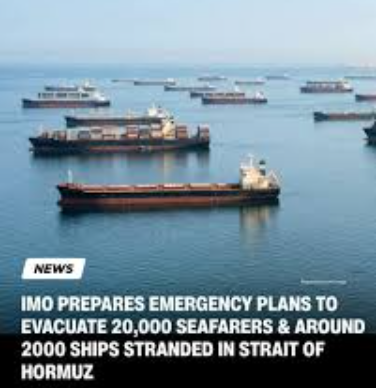
New Delhi: With no signs of an enduring ceasefire between the USA and Iran, the International Maritime Organization (IMO), a United Nations agency, is preparing a plan to evacuate hundreds of ships from the chokepoint, Strait of Hormuz, the media reported on Tuesday.
However, the plan can only be put into action when there are clear signs of de-escalation, IMO’s Secretary-General Arsenio Dominguez said on the sidelines of Singapore Maritime Week.
According to some reports, over 2,000 vessels, carrying 20,000 seafarers, have been stuck in the Persian Gulf, which the Strait of Hormuz connects with the Gulf of Oman and the Arabian Sea.
It is not immediately clear whether Iran, which has weaponized and leveraged the vessels’ passage from the Strait will accept the IMO’s evacuation plan, as it could strip Tehran of its bargaining chip in talks with the US.
The IMO has been working on an evacuation plan for hundreds of ships that have been stuck in the Persian Gulf since the US and Israeli strikes on Iran began more than seven weeks ago, on February 28, Dominguez said.
Details of the evacuation plan being discussed include an order of departure for vessels, depending on the length of time the crew has been stranded, among other factors, he added.
Any transits would follow a long-established route — the Traffic Separation Scheme that was proposed by Iran and Oman and adopted by the IMO in 1968, Dominguez said.
Iran has developed a system over the past weeks that includes a specific route close to its coast and, in some cases, payment.
The IMO is in touch with littoral states, including Iran and Oman, and flag states to finalize the blueprint.
IMO
The IMO is the United Nations’ specialized agency tasked with regulating international shipping, ensuring safety, security, and preventing marine/atmospheric pollution.
Headquartered in London with 176 member states, it sets global standards for ship design, construction, and operation, and focuses on reducing greenhouse gas emissions.
Established in 1948 and first assembled in 1959, it was formerly known as the Inter-governmental Maritime Consultative Organization (IMCO) until 1982.
The IMO maintains a level playing field for the shipping industry, which transports over 80 per cent of global trade.