




Virendra Pandit
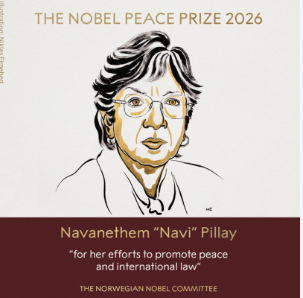
New Delhi: Ignoring US President Donald Trump’s persistent claims of being the most eligible candidate for the Nobel Peace Prize for his self-proclaimed ‘peace-making’ efforts, the Nobel Committee on Friday selected Indian-origin South African jurist “Navy” Pillay, 85, for the prestigious award for 2026, the media reported.
The 2026 Nobel Peace Prize carries a gold medal, a diploma, and a cash award of 12 million Swedish kronor (about USD 1.2 million).
Navanethem “Navi” Pillay, a South African of Indian-Tamil origin, was the first non-White woman judge of the High Court of South Africa. A jurist, she served as the United Nations (UN) human rights chief and headed the Rwanda genocide tribunal. She is currently a judge on the International Court of Justice.
Pillay was recognised for her efforts to promote peace and international law, said Jorgen Watne Frydnes, Chair of the Norwegian Nobel Committee.
He said that Pillay has “significantly enlarged the scope and impact of international law” and led the way to “a more comprehensive global legal order.”
He praised her long career, saying she started off as a lawyer in South Africa confronting deep discrimination.
Pillay’s work “is a source of hope and inspiration to all those who seek to bring about a more peaceful world,” he said.
In a release announcing Pillay’s victory, the Nobel Committee said, “At a time when the number of wars and conflicts is rising, and when judges and institutions of international law are under political attack, the Nobel Committee wishes to issue a reminder that the ability to resolve conflicts without force or violence is dependent on the international rule of law.”
“An international legal system in which war criminals are held to account and the victims of abuse see justice served is a precondition for a peaceful world.”
Pillay was born to Narrainsamy Naidoo and Santhama Naidoo in 1941 in a poor neighbourhood of Durban in the Natal Province of South Africa. Her grandparents came from India as indentured labourers to work on South African sugar plantations in the 1890s.
Daughter of a bus driver, Pillay grew up and began her human rights work during the apartheid era and became the first non-White woman to establish her own law practice and to be appointed as a High Court Judge in South Africa. She became the first woman to start a law practice in South Africa’s Natal Province back in 1967.
After defending many opponents of apartheid, she was elected as judge at the International Criminal Tribunal for Rwanda by the UN General Assembly.
She served on the tribunal for eight years, including four years as president.
Until recently, Pillay chaired the UN Independent International Commission of Inquiry on the Occupied Palestinian Territory and is currently a judge at the International Court of Justice in the case where Myanmar stands accused of genocide.
The Nobel Peace Prize
It is often considered the most prestigious honour on the planet. This year marks the 125th anniversary of the Peace Prize.
The Norwegian Nobel Committee in Oslo received nominations for 287 candidates for this year’s prize, with just over a quarter of them being organisations. Experts say the committee typically focuses on the durability of peace, the promotion of international fraternity and the quiet work of institutions that strengthen those goals.
Last year, Venezuelan opposition leader Maria Corina Machado won the Nobel Peace Prize for her struggle to achieve a democratic transition in the South American nation, winning recognition as a woman “who keeps the flame of democracy burning amid a growing darkness.”
She, however, ‘gifted’ her Nobel medal to Trump shortly after the United States ousted then-President Nicolas Maduro early this year. But it was largely a symbolic gesture: the Nobel Committee has said the honour itself cannot be transferred.