




Manas Dasgupta
NEW DELHI, Oct 9: A government that claims the entire nation is behind it, is bracing up for a series of restrictions in the national capital ahead of the Cockroach Janta Party’s (CJP) proposed protest at Jantar Mantar on Saturday demanding the resignation of Chief Election Commissioner Gyanesh Kumar, forcing the Supreme Court to comment “You can’t use a sledgehammer to kill a fly” questioning the government over unprecedented curbs on Delhi Metro and trains in the Capital to prevent protesters from arriving in Delhi.
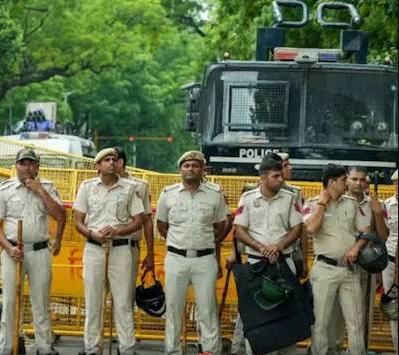
Police have denied permission for the demonstration, while restrictions on metro services and the cancellation of several trains are expected to affect commuters across the Capital. Delhi will also see unprecedented security blanket with over 23,000 personnel on duty.
A multi-layered barricading will also be in place, they said, adding that monitoring will be from the control room through CCTV cameras. Officials said that Face Recognition System cameras will be installed across the national capital. All the neighbouring states, including Uttar Pradesh and Haryana, have been asked to remain alert during the protests.
Expressing concerns for commuters, the court told the Centre that everything cannot be shut as people travel from all parts of the city and asked it to reconsider the restrictions on metro and trains. “Young people, elderly all travel. Commuters have a right to basic facilities,” the court told the Centre’s lawyer, asking for the number of closed Metro station to be brought down. “There is a distinction between restriction and complete closure,” the court noted.
The court heard a petition against closures of metro stations and cancellation of trains by CPM general secretary MA Baby. “All trains are cancelled, Metro stations are closed. You cannot move anywhere. What is happening to my country? This is a peaceful protest,” senior advocate and MP Kapil Sibal, appearing for the petitioner, told the court.
The unprecedented shut down of the public transport system drew sharp comments from the CJP founder Abhijeet Dipke on Friday. He slammed the Centre, saying it should shut down the entire country if it was scared of the youth, a statement coming in the wake of cancellation of trains to and from the national capital on Saturday.
Talking to reporters over the development, Mr Dipke said there was no need for the government’s permission to protest at Jantar Mantar, which is a designated spot. “Shut down the entire country if you are scared of the youth,” Mr Dipke said.
The Delhi Police said permission for the protest had been rejected because the mandatory 10-day advance intimation had not been received. Officials also cited alleged violations of guidelines during the previous protest and said the decision was taken in the interest of public safety.
Section 163 of the Bharatiya Nagarik Suraksha Sanhita (BNSS) is in force in parts of central Delhi. The police have warned that any violation of the restrictions will invite legal action. The measures come amid concerns over the possible movement of protesters towards sensitive locations in central Delhi, including areas around Jantar Mantar and the New Delhi district.
A Supreme Court bench headed by Chief Justice of India Surya Kant expressed serious concern over the closure of 57 Metro stations and restrictions on train services, saying such measures could cause hardship to millions of commuters travelling from Gurugram, east Delhi, south Delhi and other areas for work. The court said public transport services should not be shut down entirely and directed the authorities to consider regulated arrangements that would allow services to continue without compromising security.
The Solicitor General Tushar Mehta assured the bench that he would discuss the matter with the government and concerned authorities to ensure that commuters were not inconvenienced. The court said restrictions should be proportionate to the prevailing situation and that traffic movement must also be ensured.
During the hearing, the court was told that 57 Metro stations had been closed. The bench said it was seriously concerned about the impact on ordinary commuters, noting that while some lawyers might travel in private vehicles, many court staff members relied on the Metro.
“Closing facilities such as Metro stations will cause inconvenience to millions of people. We have to look into this,” the court observed. The CJI said commuters should be informed about the locations of barricades and the alternative routes available to them. The bench stressed that people needed clarity about which transport services would be operational and when.
Justice Joymalya Bagchi said the court had taken note of the restrictions on Metro and railway services, adding that road transport must also remain available. “These things cannot be completely shut down,” Justice Bagchi observed, while noting that restrictions could be imposed depending on the situation.
Justice Bagchi: We have noted the points regarding the metro and trains. Road transport arrangements must also be in place; these services cannot be completely shut down.
Solicitor: Sometimes, a complete ban is necessary.
Justice Bagchi: Measures should be taken according to the situation, but a total ban would not be appropriate.
Mr Tushar Mehta told the court that permission had been granted for a protest on June 20 for one day, but the demonstrators continued their sit-in for 17 days. He also alleged that protesters had attempted to march towards Parliament.
“I wish to state something with full responsibility. Permission for the protest was granted by the police for June 20th. They obtained permission for one day but continued to sit there for 17 days. An attempt was also made to march towards Parliament,” he said. The Solicitor General said more than 200 police personnel were injured while preventing protesters from entering Parliament.
He further alleged that women police personnel had been molested and maintained that the restrictions were necessary to ensure public safety.
He also disputed the suggestion that the entire national capital had been brought to a standstill, saying internet restrictions were limited to specific areas.
The CJI observed that Jantar Mantar’s geographical location and limited space posed challenges for organising large protests, suggesting that an alternative venue should be considered. “In our view, there is an issue regarding the geographical location of the protest site (Jantar Mantar). The space is also small; an alternative location should be considered,” the court said.
He said inadequate space could affect protesters’ fundamental rights by creating difficulties related to food, sanitation and access for ambulances.
The court also emphasised that authorities should issue public advisories explaining traffic restrictions, barricading and alternative routes to help commuters plan their journeys.
The bench clarified that it was not considering the merits of the protest itself because no organiser had appeared before it. The court had earlier indicated that organisers could present their submissions, but senior advocates present said they were not representing them.
Advocate Vrinda Grover said she was appearing in her capacity as a citizen and raised concerns about people being warned against attending the protest. The court said its immediate concern was the inconvenience caused to the public by restrictions on public transport.
It noted that orders concerning Metro and railway services, including an order issued in August under Section 163 of the Bharatiya Nagarik Suraksha Sanhita (BNSS), had been placed before it. The bench was also informed that train services from New Delhi and Hazrat Nizamuddin railway stations had been affected.
According to the advisory, entry and exit gates at the affected stations will be closed from 9 pm on Friday, October 9. Metro trains passing through the affected stations may also run at reduced frequencies. Among the major stations affected are Rajiv Chowk, Central Secretariat, New Delhi, Patel Chowk, Janpath, Mandi House, Barakhamba Road, ITO, Delhi Gate, Khan Market, Lok Kalyan Marg, Udyog Bhawan, Kashmere Gate, Hauz Khas, INA and Lajpat Nagar.
The restrictions could disrupt travel across several parts of the city, including key interchange stations and routes used by daily commuters. Passengers have been advised to check the latest service updates before starting their journeys.
Rail services have also been affected ahead of the protest. Several trains scheduled to arrive at New Delhi and Hazrat Nizamuddin railway stations have been cancelled. A total of 61 Delhi bound trains have been cancelled between Friday and Saturday. 40 trains were cancelled by Railways on Friday and 20 stand cancelled for Saturday.
The cancellations apply to trains scheduled to arrive between 4 am and 2 pm on Saturday. The trains concerned have been cancelled at their originating stations. Passengers have been advised to verify their train status and obtain updated information before leaving for railway stations.
According to sources, a total of 23,000 Central Armed Police Forces (CAPF) personnel are being deployed in the national capital. The Union Home Ministry approved the deployment of 221 CAPF companies between October 8 and 12, apart from the additional 110 CAPF companies provided to the Delhi Police. These include 85 Central Reserve Police Force (CRPF) companies, 10 Sashastra Seema Bal (SSB), seven Indo-Tibetan Border Police (ITBP), seven Rapid Action Force (RAF), and one Central Industrial Security Force (CISF) company.
“We are primarily concerned about the complete closure of these metro station entrances. Our concern is not about any specific protester or individual; rather, it is about the hundreds and thousands of commuters who travel to Delhi from Gurugram, Greater Noida, East Delhi, and South Delhi for their livelihoods,” CJI Surya Kant told the Solicitor General.
While it backed the authorities’ right to implement security measures, the court drew a line at public convenience. “Law enforcement authorities are certainly entitled to implement regulatory measures; there is no doubt about that. If you wish to curb uncontrolled movement, you are free to do so. However, this does not mean you can bring everything to a halt and leave people without any means of transport,” the top court said.
“Not everyone owns a car or has access to private transport. People rely on public transport. Such a course of action is not feasible.” The Supreme Court further noted that the closure of roads also needs to be reconsidered. It directed that an assessment be made regarding which areas require restrictions and which do not.
Ahead of the Saturday protest in Delhi, several groups, including the CJP on Thursday had alleged that protesters were being picked up from across the country. CJP co-convener Ashutosh Ranka said Deepak Baliyan, the organisation’s co-in-charge, had been detained in Rajasthan. He claimed that thousands of volunteers had been detained in Maharashtra, Uttar Pradesh and West Bengal.
On the cancellation of trains, Union Minister Chirag Paswan said, “These are the youth of India—nothing can stop them. To those attempting to spread such misconceptions, I ask: how many trains can anyone really stop? How much connectivity can be blocked? How many roads can be jammed?”
A before the Saturday protest in Delhi called by the CJP and Left groups, students and Maharashtra-based residents associated with CJP and student groups have been receiving notices and calls from State police instructing them not to participate in the protest or seeking details of their travel to the capital.
Advocate Vrinda Grover said police cannot go to hostels. Sankaranarayanan said police have no business asking people not to participate in protests. Senior Advocate C.U. Singh said there was no anticipatory stoppage of the right to protest. He says the government order says trains have been stopped due to the “likelihood of an unruly mob.”
The Delhi Police have registered 25 FIRs related to the SIR protests in the national capital since October 2, with Congress leaders Rahul Gandhi and Priyanka Gandhi Vadra among those named, sources said. The cases relate to alleged vandalism of public property, assaults and scuffles involving police personnel, obstruction of government work and violation of prohibitory orders imposed under Section 163 of the Bharatiya Nagarik Suraksha Sanhita (BNSS) in the New Delhi district. Police have taken action against protesters following repeated incidents of alleged lawlessness during the demonstrations, a police source said.
Meanwhile, the BJP on Friday hit back at the Congress following its attack on the Modi government over U.S. actions affecting Indian IT professionals and accused Rahul Gandhi and his “foreign collaborators” of wanting to create anarchy in the country. In a series of posts on X, BJP spokesperson Pradeep Bhandari said Prime Minister Narendra Modi is the guardian of Indian interests. “Do not forget! Rahul Gandhi openly declared in the past – ‘We are fighting the Indian state’,” Mr Bhandari said.