




Virendra Pandit
New Delhi: Amid media reports that the UAE and Saudi Arabia also ‘secretly’ attacked Iran during its now stalled war with the USA and Israel, Abu Dhabi has denied that Israeli Prime Minister Benjamin Netanyahu visited the UAE and met its President Shiekh Mohammed bin Zayed Al Nahyan.
On Wednesday, in a statement posted on X, Netanyahu’s office said the Israeli leader met Sheikh Mohammed bin Zayed (MBZ), in the Emirati city of Al Ain on March 26 at the height of the war in West Asia, the media reported on Thursday.
According to the Israeli statement, the talks lasted several hours and represented a “historic breakthrough” in ties between Israel and the UAE amid escalating tensions across the Gulf region. It said the discussions focused on regional security cooperation and strategic coordination during the war.
“In the midst of Operation Roaring Lion, Prime Minister Benjamin Netanyahu secretly visited the United Arab Emirates, where he met with UAE President Sheikh Mohamed bin Zayed. This visit has led to a historic breakthrough in relations between Israel and the UAE,” Netanyahu’s office said.
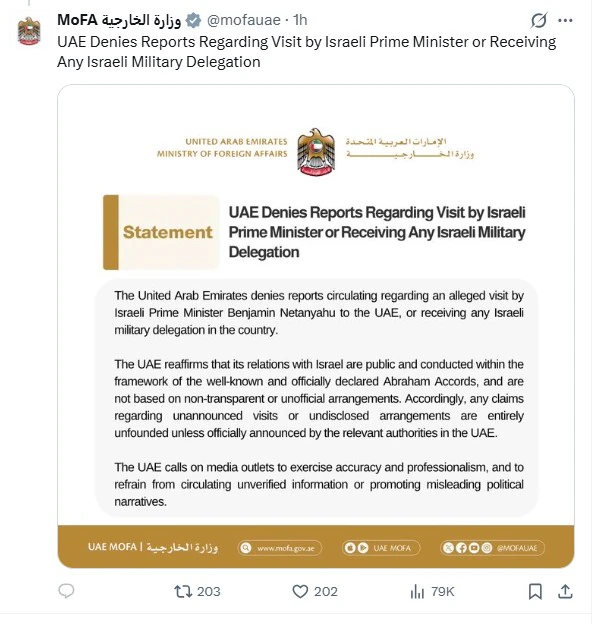
The claim immediately drew a rebuttal from the UAE foreign ministry.
“The United Arab Emirates denies reports circulating regarding an alleged visit by Israeli Prime Minister Benjamin Netanyahu to the UAE, or receiving any Israeli military delegation in the country.”
The UAE also stressed that its relationship with Israel is conducted openly within the framework of the Abraham Accords signed in 2020, which normalised the ties, and not through covert arrangements.
“Any claims regarding unannounced visits or undisclosed arrangements are entirely unfounded unless officially announced by the relevant authorities in the UAE,” the statement said.
The sharply conflicting accounts emerged amid reports of growing security coordination between Israel and the UAE during the confrontation with Iran, which saw missile and drone attacks across the region.
According to reports, Israeli spy agency Mossad’s chief Dedi Barnea travelled to the UAE at least twice during the conflict to coordinate military-related matters between the two countries. The Wall Street Journal had earlier reported on Barnea’s visits.
Meanwhile, US Ambassador to Israel Mike Huckabee said this week that Israel deployed an Iron Dome battery along with military personnel to the UAE during the war with Iran following a request from the Emirates. It marked the first overseas deployment of Israel’s flagship air defence system, which took place in the early phase of the conflict after a call between UAE President and Netanyahu.
Iran had launched retaliatory strikes against several Gulf states, including the UAE, following US-Israeli military attacks beginning February 28. Reports indicated that some attacks targeted civilian infrastructure and energy facilities in the region.
While the UAE and Israel have expanded economic and security cooperation over recent years since 2020, Abu Dhabi has also sought to publicly distance itself from aspects of Israel’s military operations in the region, particularly amid heightened regional tensions and domestic sensitivities over the Gaza war and the broader Iran confrontation.
Saudin Arabia, too!
Saudi Arabia also ‘secretly’ launched military strikes on Iran in late March in retaliation for attacks carried out on the Kingdom during the war, the media reported.
The unpublicized operation reportedly marked the first known time Saudi Arabia directly carried out military action on Iranian soil, signalling a major shift in Riyadh’s response to regional threats.
According to the report, the strikes were conducted by the Saudi Air Force as “tit-for-tat” retaliation after Saudi territory was targeted during the conflict
The report stated that the broader regional war began after US and Israeli airstrikes on Iran on February 28, after which Iran launched missiles and drones at all six Gulf Cooperation Council (GCC) states, targeting US military bases, airports, oil facilities, and civilian infrastructure. Iran also closed the Strait of Hormuz, disrupting global trade routes.
While the UAE adopted a more aggressive posture, Saudi Arabia simultaneously maintained diplomatic channels with Tehran. The Saudi officials warned Iran of further retaliation following the strikes, while intensive diplomatic engagement continued between the two countries.
A senior Saudi foreign ministry official did not directly confirm the attacks but reiterated Riyadh’s support for “de-escalation, self-restraint and the reduction of tensions” to preserve regional stability.
The Saudi retaliation and subsequent diplomatic efforts ultimately led to an understanding between Riyadh and Tehran aimed at lowering tensions.