




By Japan Vijay
Recently, Swami Avimukteshwaranand, occupying the revered seat of Shankaracharya, made a controversial statement asserting that scriptures contain no mention of a deity or entity like “Bharat Mata,” and that the contemporary worship of Mother India is an invention of the Rashtriya Swayamsevak Sangh (RSS).
Swami Avimukteshwaranand has repeatedly made contentious remarks, and videos frequently circulate on social media showing him displaying intense anger toward common citizens and journalists alike. While India’s Constitution guarantees freedom of speech. allowing anyone to express their views, individuals who attain elevated positions through their karma, knowledge, cultural grounding, and hard work—or occasionally by circumstance—carry immense influence over society.
It is not that someone holding the seat of a Shankaracharya should entirely avoid discussing politics. However, such discussions become far more constructive when conducted with politicians above the narrow divides of political parties, religion, caste, or ideology. Furthermore, dialogues with political figures ought to be handled with the discretion of a father imparting practical wisdom to his son, rather than being broadcast to the mass media. When such decorum is maintained, it positively impacts the politics. It is ultimately benefiting the common citizen.
Also read: Sutlej, Social Media, and the Sense of Social Responsibility
Unfortunately, Swami Avimukteshwaranand appears to fall short of this ideal. While this subject merits discussion, the more pressing question at hand is whether Bharat Mata is merely an RSS construct or deeply rooted in our ancient scriptures.
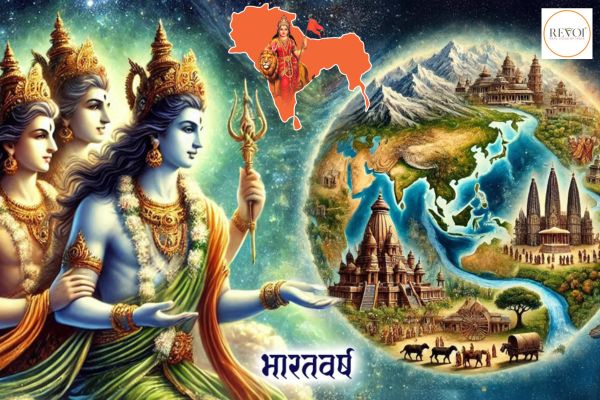
It is a well-known historical fact that the country derived the name “Bharat” from King Bharat; prior to that, the Vedic and Puranic eras recognized names like “Aryavarta” and “Jambudweep.” According to Jain texts, the region was also known as “Ajnabh Varsh” after Nabhiraj, the father of Lord Rishabhdev. Therefore, it is natural that the literal phrase “Bharat Mata” may not appear verbatim in ancient texts. However, this does not mean that the concept of Mother India is an invention of the RSS.
Indian culture, Indian tradition, and the Sanatan way of life are essentially synonymous; treating the earth as a mother is an integral part of this civilization. Reverence for the land is the fundamental duty of every Indian. In the Hindu way of life, the earth is perceived in maternal form, and bhoomi pujan (earth worship) remains mandatory in every major religious ritual for Sanatani families. Surely, Swami Avimukteshwaranand himself has performed earth worship countless times as part of religious rites.
Historically, amidst the Bengal Partition movement in 1905, Rabanindranath Tagore painted “Banga Mata,” which shortly thereafter began to be worshipped nationwide as “Bharat Mata.” This depiction featured a saffron-clad figure holding a book in one hand, paddy in another, a white garment in a third, and a rosary in the fourth. Back in 1876, Bankim Chandra Chatterjee composed the first two stanzas of “Vande Mataram” in praise of Mother India, later expanding them with Bengali stanzas upon publishing his novel Anandmath in 1882.
Ironically, while Swami Avimukteshwaranand attributes the conception of Bharat Mata to the RSS, RSS founder Keshav Baliram Hedgewar was born seven years after Anandmath was published. The concept of Mother India was thus prevalent long before the birth of the founder of the Sangh. Delving further into history, Kiran Chandra Bandyopadhyay staged a play titled Bharat Mata in 1873. By 1857, the slogan “Bharat Mata ki Jai” was already in use, and by 1905, both “Bharat Mata ki Jai” and “Vande Mataram” had become the lifeblood of the freedom struggle.
Between 1893 and 1902, Swami Vivekananda repeatedly invoked India as a living deity in his speeches, even stating that for fifty years, all other deities should be set aside to worship Bharat Mata—decades before the RSS was founded. Maharishi Aurobindo likewise frequently described India not merely as a piece of land, but as a living divine power. In his Chanakya Niti and other texts, Chanakya emphasized that defense of the motherland, love, and loyalty toward it are paramount. The land where we are born and which sustains us is our mother; it was precisely to protect this Mother India that Chanakya devised the strategy to crown Chandragupta as emperor.
In the Bhagavad Gita, Bhagwan Shri Krishna declares that He enters the earth with His divine energies to sustain and nourish all living beings, adding that the earth’s forbearance and endurance are direct manifestations of His own form. Sustaining, nurturing, forgiveness, and endurance are qualities that reside collectively only in a mother. Following the victory over Lanka, Lord Rama famously told Lakshmana:
“अपि स्वर्णमयी लंका न मे लक्ष्मण रोचते। जननी जन्मभूमिश्च स्वर्गादपि गरीयसी॥“
(Even Lanka of gold does not attract me, Lakshmana. The mother and the motherland are greater than heaven itself.) Lord Rama explicitly equated the motherland with the mother.
The tradition of worshipping the earth as a mother has existed since the Vedic era. The Atharvaveda contains the entire Bhoomi Sukta, featuring the celebrated verse:
“माता भूमिः पुत्रो अहं पृथिव्याः“
(The earth is my mother, and I am her son.)
The roots of Bharat Mata reach as far back as the Rigveda (1.164.33):
“द्यौर्मे पिता जनिता नाभिरे बन्धुर्मे माता पृथिवीयं महीयम्। उत्तानयोश्चम्वोर्योनिरन्तरत्रा पिता दुहितुर्गर्भमाधात्॥“
(The heavens are my father and creator, space is my navel and kin, and this vast earth is my mother.)
What remains to be said? From the Vedas to Vivekananda, the earth has consistently been revered as a mother. The land where we reside has been identified as Bharat; invoking and worshipping it as Bharat Mata is entirely natural. When a child begins to understand nature, a mother introduces it through familiar terms like “Dharti mata(Mother Earth), Chanda Mama (Uncle Moon), and “Suraj Dada” (Grandfather Sun).” While the RSS was established in 1925, the people of India have revered this land as a mother for centuries and epochs. Swami Avimukteshwaranand is surely aware that Adi Shankaracharya established four mathas in four cardinal directions precisely to safeguard this very cultural unity of Bharat Mata.