




By Japan Vijay
When we stand in waist-deep water in a river or lake, the ripples caused by a stone thrown from a distance can be soothing. We might even enjoy the sensation of those ripples. However, if that same water is struck not by a pebble, but by a boulder that tears through the earth beneath us, leaving us trapped in a treacherous whirlpool, that is a state of emergency we cannot afford to ignore. Lately, in India, there has been a growing trend of “throwing boulders”—actions designed to create violent waves in the otherwise peaceful flow of society. What is more alarming is that the mainstream society often fails to respond to these provocations effectively, or the reaction itself is misdirected.
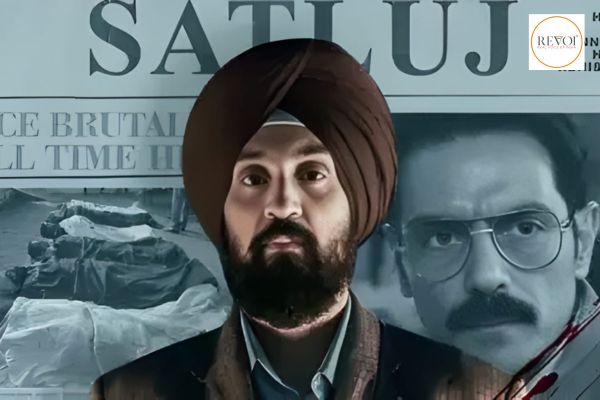
A similar “boulder” was dropped in the form of the film Sutlej. The movie is based on the life of Jaswant Singh Khalra, a Khalistan sympathizer. Starring Diljit Dosanjh as Khalra, the film was produced by Ronnie Screwvala and directed by Honey Trehan. Originally slated for release in 2023, the Censor Board halted it. At that time, the film was titled Ghallughara (meaning massacre or genocide). It was later renamed Punjab ’95, yet remained blocked. Ultimately, when the OTT platform ZEE5 released the film, it was titled Sutlej. Released on July 3rd, the film was pulled by ZEE5 within 48 hours. Fortunately, I managed to watch it before it was removed.
From a filmmaking perspective, it is slightly above average. However, watching it, one cannot help but feel that the narrative is a blatant propaganda piece. It paints every police officer as cruel and even portrays K.P.S. Gill—the “super cop” who helped pull Punjab out of the depths of hell—as a villain. While the film has been pulled and one might assume the matter ended there, the film achieved its intended goal.
Social media saw a flurry of discussions surrounding this film, eventually fracturing the conversation into two polarized camps: one citing the massacre of 25,000 Sikhs, and the other highlighting the slaughter of 35,000 Hindus. This was perhaps exactly what the creators of such propaganda desired. Social media has provided the common man with a precise weapon—the power to present one’s viewpoint directly to the masses. Yet, this comes with a limitation. No one stops us from expressing our opinions, but who decides if the discourse is timely? Who possesses the wisdom to judge whether a narrative is constructive for the nation or lethal to it? An individual’s social responsibility cannot be ignored. The misuse of this immense digital power by an uninformed public can easily spark anarchy.
The discussion surrounding the release of Sutlej should have focused on the historical realities of that era: Indira Gandhi’s “Bhindranwale experiment” to curb the political rise of the Akali Dal; the politics of Sanjay Gandhi and the then-Chief Minister Giani Zail Singh; and how Pakistan and the ISI exploited the situation to fuel the Khalistan movement while the government of the time not only failed to stop it but made a series of catastrophic errors. There should have been debates on the necessity of Operation Blue Star, the Congress-led 1984 anti-Sikh riots following Indira Gandhi’s assassination, and Rajiv Gandhi’s juvenile reaction to the carnage: “When a big tree falls, the earth shakes.”
Instead, the conversation devolved into “Hindu versus Sikh.” For years, Pakistan and the ISI have plotted to establish a narrative that Sikhs are distinct from Hindus. While that subject had largely been put to rest and peace has been restored in Punjab, this film—which lived for only 48 hours—attempted to resurrect those divisions through social media.
Does it not occur to us that as citizens, we should fully comprehend sensitive subjects before touching them? True patriotism involves cultivating such understanding. We possess the tools of mass communication, but is it not high time we cultivated the discernment required to use them?
The Sikh community is inherently patriotic and deeply concerned for the welfare of society. Even at the peak of the militancy in the 80s, the entire Sikh community did not stand with the Khalistanis. Many Sikh youths served in the police and the Army, fighting against the very terrorism that threatened the nation.
I cannot resist sharing a personal experience. In 1985, I was on a school trip to Maharashtra. It was nearly 10:00 PM, and we hadn’t found a place to eat. As the bus moved through a desolate area, we spotted a Gurudwara. Given the tensions of that time, no one was willing to stop. A teacher and I gathered the courage to approach the Granthi Sahib. Not only did he happily grant us permission to use the kitchen, but he also provided rations from the Gurudwara itself. While the meal was being prepared, he took us to pay our respects to the holy Guru Granth Sahib. The Granthi told everyone there, “Hindus and Sikhs are brothers.” Suddenly, the words escaped my lips: “Hindus and Sikhs are brothers? Aren’t we just the same?”
Hearing this, he was overjoyed; his eyes welled up with tears. Even today, the image of that Granthi Sahib and his tear-filled eyes remains etched in my memory.
Dear readers please share your thoughts about the article with us: [email protected]