




Manas Dasgupta
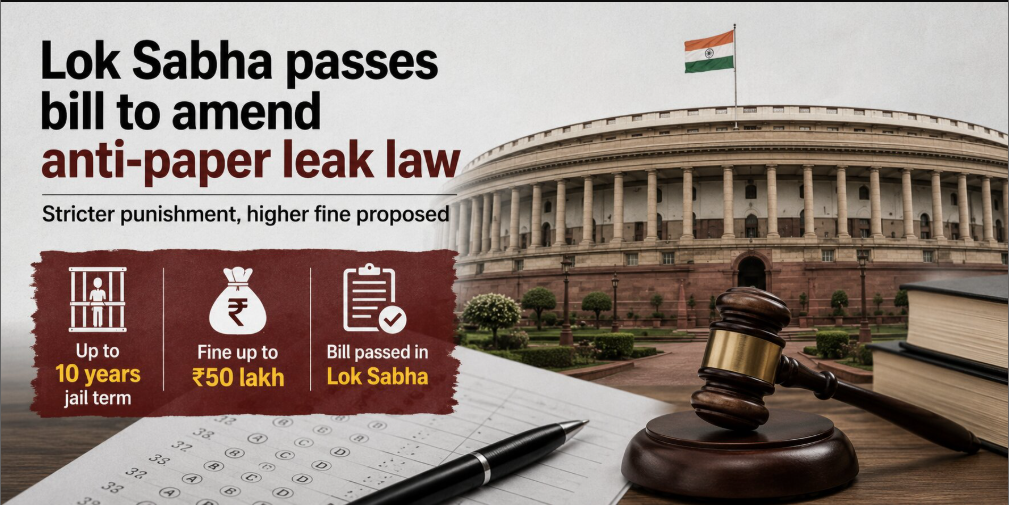
NEW DELHI, July 29: After nearly 10 hours of debate, the “Public Examination (Prevention of Unfair Means) Amendment Bill, 2026,” popularly known as anti-paper leak bill, was passed by the Lok Sabha on Wednesday amidst repeated disruptions triggered by certain remarks by the Leader of the Opposition Rahul Gandhi against the union home minister Amit Shah.
The proposed legislation aims to amend the 2024 act on the same lines providing for stricter punishment for indulging in leaking the question papers of public examinations including the National Eligibility cum Entrance Test (NEET) leaking of which created nation-wide uproar this year leading to cancellation of the examinations and taking re-test for deciding on the medical admissions.
The amendment bill which provide for up to 10 years in prison and a fine of up to Rs 50 lakh and fine of up to Rs 10 crores in case of organised crime, was introduced in the Lok Sabha on Monday just days after nationwide student protests over the NEET controversy led to the resignation of Dharmendra Pradhan as the union education minister.
The opposition has continued to press the government over the NEET paper leak since the Monsoon session commenced on July 20, repeatedly disrupting proceedings and restricting legislative business largely to the introduction of two bills.
During the debate on the bill, Rahul Gandhi accused Amit Shah of authorising the use of force against students during the Cockroach Janta Party’s (CJP) protest at Delhi’s Jantar Mantar sparking heated exchanges between the treasury and the opposition benches.
Gandhi alleged that Shah, who was not present in the House at the time, was responsible for the police action against the demonstrators.
“The Home Minister ordered the shooting of our students. He put pellets into the blood of our students. He ordered the students of India to be shot,” Gandhi said, referring to the police action during the CJP-led protest.
He also claimed that “the use of force can only be authorised by the Minister or the Prime Minister.”
The remarks drew strong protests from the Treasury benches, with Parliamentary Affairs Minister Kiren Rijiju demanding that Gandhi provide evidence to support his allegations.
BJP and NDA members accused the Congress leader of making baseless allegations against the Home Minister, triggering sloganeering and brief disruptions in the House. They also demanded an apology, while Lok Sabha Speaker Om Birla reminded Gandhi that allegations made in Parliament must be substantiated with evidence.
Replying to the debate on the bill, minister of state in the Prime Minister’s Office (PMO) Jitendra Singh, said the government acted swiftly in the NEET paper leak case, and as many as 52 FIRs have been lodged since the anti-paper leak law came into force in 2024.
Mr Singh said service provider fines in the previous anti-cheating law of 2024 have been hiked from up to ₹1 crore to up to ₹5 crore. Also, imprisonment of three to 10 years for directors and management in the previous law has been increased to up to ₹5 crore (from earlier ₹1 crore).
Imprisonment from five to 10 years (escalated from three to 10 years) and a fine of ₹5 crore (hiked from ₹1 crore) for in-charge Personnel under the proposed Bill, Mr Singh added. The amendment Bill indicated that the government was open to learning from experience, he said, noting that the rate of deaths related to paper leaks has also reduced over the last few years.
He criticised Leader of Opposition in Lok Sabha Rahul Gandhi, stating that he lacks knowledge of parliamentary norms and the functioning of the government. Immediately after the passage of the Bill, the Lok Sabha was adjourned for the day.