




Manas Dasgupta
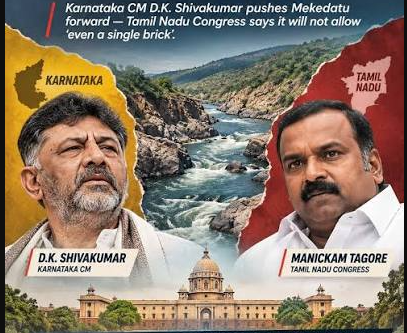
NEW DELHI, Nov 14: In a Congress versus Congress war of words, the Tamil Nadu Congress chief Manickam Tagore on Saturday strongly criticised the Congress chief minister of the neighbouring Karnataka DK Shivakumar for pushing for the construction of Mekedatu Dam “ignoring the interests of Tamil Nadu farmers.”
Congress is a partner in the Tamiliga Vettri Kazhagam (TVK)-led alliance ruling Tamil Nadu. The Congress MP has also warned that the Tamil Nadu unit of the Congress would fight tooth and nail against the project in Karnataka at every level to protect the state’s rights.
Mr Shivakumar, however, brushed aside his party colleague’s objections and said Mr Tagore was opposing the Mekedatu dam only because he did not know the full facts. “If he comes with a delegation to Karnataka, I will take him to the proposed dam site and he will be convinced that Mekedatu in reality will be more beneficial to Tamil Nadu than perhaps Karnataka,” he said.
Strongly criticising Mr Shivakumar for his “stubborn stand” on the Cauvery water dispute, Mr Tagore, MP, said Mr Shivakumar’s remarks that no one could stop Karnataka from constructing Mekedatu dam was “utterly unacceptable” as it was against the interests of the farmers in Tamil Nadu.
The reaction came a day after Chief Minister Shivakumar, in the presence of Prime Minister Narendra Modi, urged the Centre to expedite statutory clearances for the proposed Mekedatu project. “Sir, you just saw the dam on the Cauvery. The Supreme Court has delivered a clear verdict to all of us that Mekedatu has to be built in Karnataka, and no one can stop it. We want you to help us legally,” the Karnataka Chief Minister had said on Friday when Mr Modi was visiting Mysuru.
Responding to his remarks, Tagore took to social media platform X and accused Shivakumar of making statements that disregard the Supreme Court’s ruling and the final award of the Cauvery Water Disputes Tribunal. “It is deeply condemnable that Karnataka Chief Minister DK Shivakumar, in the presence of Prime Minister Narendra Modi in Mysuru, said, ‘No one can stop the construction of a dam at Mekedatu’, and that the central government must give its final approval for it.
“The Karnataka Chief Minister continues to adopt a stubborn stance, blatantly violating the Supreme Court ruling and the Cauvery Water Disputes Tribunal’s final award. This statement, which goes against the principle of federalism and seeks to destroy the livelihoods of Tamil Nadu’s farmers, is utterly unacceptable,” Tagore said.
He further argued that Karnataka, being an upper-riparian state, could not independently take up a project that could affect the water rights of Tamil Nadu, which is situated downstream in the Cauvery River basin. He also urged the Centre not to grant any clearance for the proposed dam without obtaining the consent of the lower-riparian states.
“Granting approval for the Mekedatu project without Tamil Nadu’s consent is not only illegal but will also severely affect the lives of farmers in the delta districts,” he said. He said it was the Centre’s “responsibility” to “prevent Karnataka from laying even a single brick at Mekedatu.” “On behalf of the Tamil Nadu Congress, we will never allow this project; we will go to any lengths to fight to protect our state’s rights,” he said.
Reacting to his party colleague’s objection, Shivakumar reiterated that dam cannot be stopped and added that Tagore didn’t know the full facts. “No one can stop the construction of a dam at Mekedatu. It is the duty of Manickam Tagore to protect his state. But he doesn’t know the actual facts. If he comes to Karnataka with his delegation, I will take him to the dam site and show that it is in their interest,” the chief minister stated.
The ruling TVK government has also strongly criticised Shivakumar’s remarks, with Law Minister CTR Nirmal Kumar accusing the Karnataka CM of making controversial statements ahead of every election. “He (DK Shivakumar) makes such controversial remarks before every election. The TVK government and CM Vijay will never allow the Mekedatu project. We have filed petitions before the court. Compared to previous governments, we are taking stronger legal steps. They cannot even lay a single brick for the Mekedatu project because they do not have forest approval or environmental clearance,” Kumar said.
In Tamil Nadu, Opposition DMK also upped the ante against the Vijay government after Shivakumar’s Friday assertion. Former chief minister MK Stalin urged the state government “to take the necessary action on the Cauvery issue, which is a matter of life and death for Tamil Nadu, rather than remaining silent any longer.” The DMK has also demanded an all-party meeting on the issue.
The proposed reservoir, located in the Ramanagara district (now Bengaluru South), aims to supply drinking water to Bengaluru and generate 400 MW of power, with Karnataka assuring that Tamil Nadu’s allocated share of Cauvery water will not be compromised.
The Tamil Nadu government, however, continues to strongly oppose the project, citing concerns over water sharing, while Shivakumar maintains Karnataka will proceed with its preparations to submit a revised detailed project report.
The proposed Mekedatu dam is planned on the Cauvery river near Kanakapura, Shivakumar’s hometown in Karnataka. The project is intended to meet Bengaluru’s drinking water requirements. It is also expected to act as a buffer during droughts, helping ensure that adequate water is available for Tamil Nadu.
However, Tamil Nadu has consistently opposed the project, arguing that it could affect the state’s share of Cauvery water and harm farmers who depend on the river, particularly in the delta districts. The latest exchange has brought the disagreement into the open within the Congress, with a leader from Tamil Nadu challenging the position taken by the party’s government in Karnataka.
The political backdrop was also notable last Friday, when PM Modi and Congress leader Shivakumar travelled together on the Metro. Their interaction during the ride drew attention, even as the Mekedatu project remained a contentious issue between the two states.