




Manas Dasgupta
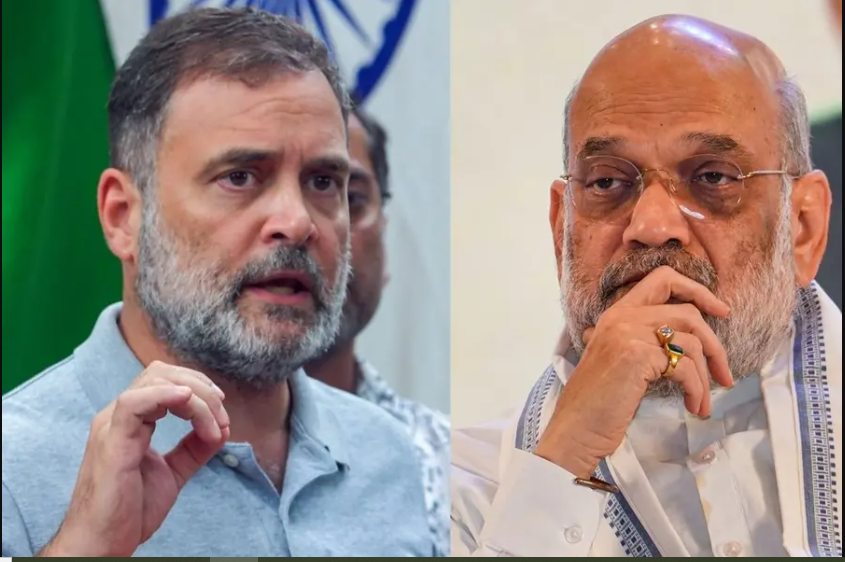
NEW DELHI, July 29: Much of what the Leader of the Opposition in the Lok Sabha Rahul Gandhi said while participating in the debate on the anti-paper leak bill was drowned in the din triggered by his allegation that the union home minister Amit Shah had issued orders to the police to open fire against the student protesters with the government hitting back calling the LoP a novice in the government administration as well as in Parliamentary affairs.
The Minister of State in PMO Jitendra Singh, who had piloted the bill, lashed out at Rahul Gandhi saying he lacked administrative knowledge. Contesting Gandhi’s claim that Amit Shah ordered police to fire at the protesters, Singh said only a magistrate or a sub-divisional magistrate (SDM) can give such an order.
“Leader of Opposition has no idea of how administration works. Orders to open fire in any situation can only be given by a magistrate and not by any minister,” Singh said in the Lok Sabha. Singh also refuted Mr Gandhi’s allegations and insisted that no shots were fired on the protesters. “It was repeatedly clarified that no shots were fired; tear gas was used. Since no shots were fired, the question of issuing an order does not arise. The authority to issue such an order rests with the magistrate, not the minister,” he stated.
Earlier speaking in the Lok Sabha during a discussion on the new law to curb paper leaks, Rahul Gandhi trained guns at the home minister blaming him for the crackdown on the protesters. The confrontation peaked when Rahul Gandhi took a direct swipe at Mr Shah, claiming his absence from the House was a sign of “fear.” Alleging that Shah “ordered” the attacks on students, Gandhi said: “The Home Minister now doesn’t have the courage to face Parliament and speak on the assault of students.”
He was countered by Parliamentary Affairs Minister Kiren Rijiju who urged Gandhi not to make “allegations” against the Home Minister. “On what basis have you said this? This is highly objectionable. You should apologise,” Rijiju said. The House was adjourned twice due to the uproar over Gandhi’s remarks and government’s counter.
Speaking with reporters in the Parliament House complex later, Gandhi said, “There can be just two options; the Home Minister gave the order for firing (at protesters), the other is that the Home Minister did not know that there will be firing.” “In the first case, he is culpable. In the second case, he is incompetent, there can be no other option.” “Why is he not coming to the House? Supposedly the brave home minister of India, why is he not in the House? If he has not done anything, why is he not coming? It is my right to speak in Parliament and I should have this right,” Gandhi said.
Later hitting out at Rahul Gandhi at a press conference, the BJP national spokesman Sambit Patra said, “Rahul Gandhi alleged that Kiren Rijiju and Rajnath Singh interrupted him, while he himself was not given an opportunity to speak. First of all, the two or three objections raised by Kiren Rijiju were entirely justified. Those objections were regarding the use of the unparliamentary word ‘idiot’, which, under the rules of Parliament, cannot be used on the floor of the House.
As the Parliamentary Affairs Minister, it was his responsibility to seek clarification on that. Kiren Rijiju’s demeanour, body language, and choice of words reflected decency, humility, and composure. He was not angry. In a calm manner, he said, ‘We want to hear you. Please do not use the word “idiot,” because the House functions according to parliamentary rules.’
“Defence Minister Rajnath Singh made only one appeal. He said, ‘Rahul ji, please speak,’ and appealed to the members of the Treasury Benches to listen to Rahul Gandhi carefully. What greater example of democratic tradition could there be than that?” Patra said.
He also demanded an apology from Mr Gandhi for his “intentions to create chaos from his actions.” He said Rahul Gandhi tried to catch political mileage from the Cockroach Janta Party (CJP) protest and reiterated the government’s claim that no shots were fired at the students during the Jantar Mantar protests. He asked Rahul Gandhi to show any cartridge if firing had taken place. He asked Gandhi where he saw the Home Minister talking to the policemen.
Mr Gandhi had alleged that students protesting in Delhi were subjected to police brutality, claiming they were fired upon with pellet guns and assaulted during the demonstrations. He said he had seen AIIMS medical certificates documenting the injuries and cited videos that allegedly showed a police officer slapping a minor.
Calling the treatment of the students a “fundamental issue,” Gandhi also alleged that the Bajrang Dal was being mobilised to intimidate protesters and deter them from participating in similar demonstrations in the future.
Contending that the Delhi Police is controlled by the Ministry of Home Affairs and the forces used to disperse protesters in Delhi are also under the ministry’s ambit, Rahul Gandhi attacked Mr Shah claiming that he ordered the action on students.
He further added that the home minister is incapable if he was not aware of the brutal force used against protesters, and if he was, he was “culpable.” He also claimed to have seen students with pellet injuries and police charging lathis with nails at students during the protests in Delhi.
In the Lok Sabha, he had also alleged that the Opposition was not being allowed to speak in the Lok Sabha, accusing the government of stifling dissent during the debate on the Anti-Paper Leak Bill.
His remarks came after heated exchanges in the House during the discussion on the anti-paper leak amendment bill. Gandhi claimed that Opposition voices were being curtailed while the Treasury benches were given a free hand, adding to the political confrontation that has marked the Monsoon session.
Supporting Mr Gandhi’s stand, the RJD MP Manoj Jha asked, “It was claimed that pellet guns were fired on the Home Minister’s orders… Under whose jurisdiction does the Delhi Police fall? If batons studded with nails were used, if pellet guns were fired, or if barricades were even electrified—did low-level Delhi Police officers do this on their own?” Mr Jha said outside Parliament.
Mr Gandhi also launched a sharp attack on the RSS, accusing it of influencing the education system and shaping what students are taught. “The soul of the system has been captured by the RSS. Dharmendra Pradhan never ran the Education Ministry. The man and organisation that run the ministry are called the RSS.
“They [students] have to buy this nonsensical history that RSS fantasises about. Pradhan is the symbol. Your real enemy is the RSS. They are the people who want you to be an andhbhakt,” Mr Gandhi said. Mr Gandhi said he was “very excited” and “reassured” by the student protests over the NEET paper leak issue and described them as an expression of the youth.
He said, “I was very excited and reassured by what the future of this country did on our streets. This was not anger, not violence, not hatred; this was an expression, deep expressions of the youth of this country, of the future generation of this country.”
“All parties should respect this expression, including my friends in the BJP. If my friends in the BJP were to go and ask their own children about what their brothers and sisters were doing, they would find agreement among their own children. There is nothing wrong with what happened, and every Indian should be proud,” he said.
Mr Gandhi said a conversation with a group of students gave him perspective on how young people view education and knowledge. “A good starting point would be a conversation I had with some students, young girls, which gave me a very interesting perspective,” he said.
Recalling the interaction, Mr Gandhi said he asked a student what it meant to be a student. “The question I asked the girl was that you said you were a student — what does that mean? Does it mean you study in a college and a school and you read books? She said a student is someone who has an open mind [and] an open heart. A student is someone who accepts that he does not know everything. Whatever he knows will be superseded by new knowledge. He knows the universe is dynamic. He also understands that knowledge is constantly changing. The most important quality, she said, that a student has is humility,” he said.
Mr Gandhi said the student also described another category of people who believed they knew everything. “They are absolutely convinced that they know everything. They believe that the universe is static and they believe that knowledge emerges from inside them. They are arrogant. They don’t listen, they don’t respect other people’s truth,” the leader of opposition (LoP) said and used a word, which was objected to as “unparliamentary” by the Chair.
The remark triggered an uproar in the House, with Speaker Birla asking Mr Gandhi to focus on the debate. Mr Rijiju also objected to the use of the “unparliamentary” word. Mr Gandhi said he was attributing the term to a student and was not referring to any member of the House. Speaker Birla said unparliamentary expressions would be expunged from the proceedings.
Mr Gandhi further said the student told him that the hallmark of a student was that they “wear the truth on their chest,” while the other category needed to create an image. “And as that image is not true because … is trying to pretend he is God, he has to create this image,” he said. “I asked about the third category — andhbhakt. He is absolutely convinced that … is God,” Mr Gandhi said. He said the framework came from an 18-year-old student and argued that the protests, though centred around examinations, reflected wider concerns about the education system.
Meanwhile, the controversy over a truck loaded with stones found parked near Jantar Mantar ahead of the July 20 march to Parliament, was found to had been one that was seized by the Delhi Police four days earlier and was in police custody when it appeared at the protest site and later outside the Indian Youth Congress (IYC) office.
The Delhi Police, however, said claims alleging that the truck was deliberately deployed near Jantar Mantar or outside any political party office were “false and misleading.” According to media reports, on July 20, the CJP founder Abhijeet Dipke had pointed out a truck loaded with stones parked near the protest site and demanded an explanation from the Delhi Police on how it crossed the police cordon and reached the site. “It could have been used to frame the protesters or incite violence,” Mr Dipke said. However, the police did not respond to his queries.
As per the media report quoting police, the truck was found outside the IYC office on Raisina Road on July 25 and had reportedly been parked there since July 21. The State president had also pointed out the truck parked outside their office for multiple days.
According to the report, the truck loaded with stones was taken into the custody of the Delhi Police after it collided with a van on July 16 at the Firoz Shah Road-Kasturba Gandhi Marg crossing. Both vehicles were brought to the malkhana (storage facility) of the Sansad Marg police station.
The report quoted an officer at the Sansad Marg police station as saying that the truck was parked right outside the station until July 20. After a video of it being parked at the protest site went viral, the police took the truck to Bhalswa, emptied it, brought it back and parked it at the same spot again.
The investigating officer in the crash gave a different account. He said the truck was initially shifted because of the protest and had remained in the malkhana after the video went viral. However, the officer did not respond to questions on how it reached the IYC office. A third version was given by the Station House Officer of the Sansad Marg police station, who claimed that the truck had been emptied on July 19 and that the viral video was “an old one.”
The Delhi Police, in a statement, said, “The truck was seized on July 16 in connection with FIR No. 65/2026 following a road accident involving the truck and an EECO van, in which six persons were injured earlier that day.”
“The vehicle was initially parked near the Parliament Street police station for safe custody due to space constraints. Considering the law and order arrangements for the ‘Chalo Sansad’ march, it was later emptied and shifted to a safer location in the early hours of July 20, after the owner was instructed,” the statement added.
The Delhi Police rejected allegations linking the vehicle to any conspiracy against protesters and advised citizens not to circulate unverified information.
When asked what the “safer location” was, New Delhi Deputy Commissioner of Police Sachin Sharma said the truck had never actually reached the protest site. It had been “away from the protest site” and still was parked there, without revealing the exact location. The van too, he said, had been parked “near the police station” since its seizure. “The statements given by the police officials in the said report are factual and verifiable. There are no contradictions,” the DCP said. When asked what a truck was doing in a zone restricting entry, he said approved vehicles could enter with permit.