




Manas Dasgupta
NEW DELHI, Nov 18: Several independent journalists who were covering the opposition rally in Delhi in October demanding the resignation of the Chief Election Commissioner (CEC) Gyanesh Kumar, have contradicted the Delhi police claim before the Supreme Court that the bona fide journalists were not restricted from their works or harassed by the police in trying to control the situation.
“We are not reel makers, we are journalists,” was the emphatic response from several independent journalists on Delhi police affidavit in the apex court that social media content creators, reel-makers and other individuals carrying cameras and microphones could not be equated with bona fide journalists and were not entitled to the protections extended to accredited media persons.
In its affidavit filed before the court, the Delhi Police Commissioner defended the force’s actions during the October protests, arguing that the presence of YouTube reel-makers and social media influencers at protest sites had made it “difficult” for personnel to distinguish journalists from protesters. The affidavit claimed that the confusion had led to the inadvertent removal of journalists during crowd-control operations. It also maintained that the guidelines issued by the police applied to media persons carrying proper identity cards.
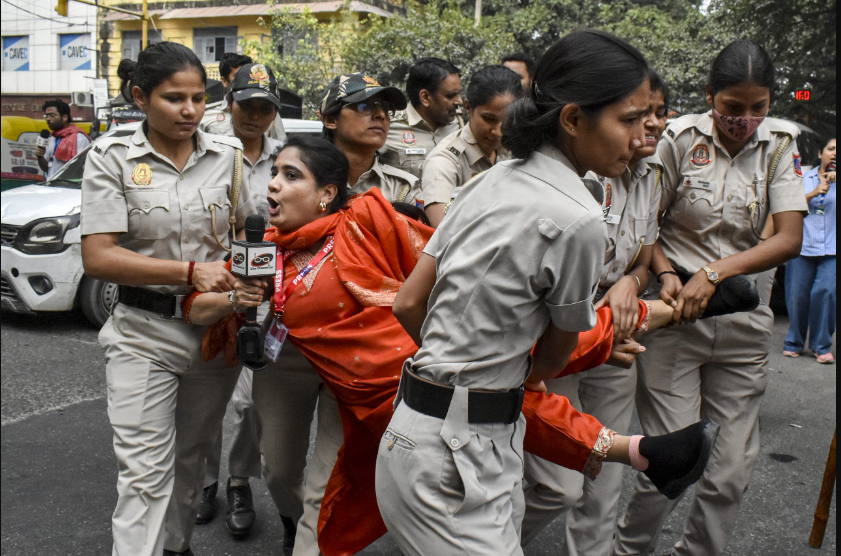
About the alleged manhandling of the women journalists, the Delhi Police told the Supreme Court that there was no strict rule that only women police officers must “handle” women in crowd-control operations. The police was responding to allegations of manhandling women protestors and journalists by male police officers during the protests. The allegations were made in petitions by Network of Women in Media, India, represented by advocate Aarthi Rajan, and others like the Delhi Union of Journalists, Free Speech Collective and the Kerala Union of Working Journalists. The affidavit came in response to a batch of petitions alleging that journalists covering the protests against Mr Kumar had been manhandled, harassed and detained by the police.
The affidavits were filed on reports by the Committee to Protest Journalists (CPJ) that at least 43 journalists were temporarily detained, and in some cases assaulted, while covering protests against CEC Gyanesh Kumar over allegations of voter-list manipulation in Delhi, Ahmedabad and Pune on October 10, 2026, and October 11, 2026.
The non-profit organisation said at least 39 journalists were detained in New Delhi, where the main protests broke out, over the course of two days, based on its review of news reports, direct interviews, and verified social media posts by editors, journalists and their newsrooms.
“Four more journalists were detained while covering solidarity protests in other cities, including Alt News correspondent Kinjal in Ahmedabad and Scroll’s Divya Aslesha in Pune on October 10. In Mumbai, police detained The Quint’s Swati Chopra and Mohit Manwani at Shivaji Park on October 11, while they covered a solidarity protest,” it said.
The CPJ said the police continued detaining journalists “even after Supreme Court justices won assurances from Solicitor-General Tushar Mehta on October 11 that lawyers, journalists, and other professionals would not be impeded in their professional duties.”
“Authorities also seized at least five phones, pressured at least one journalist to delete footage, and drove some to holding sites up to 65 kilometres away,” the report said. It said at least five journalists were struck by the police, according to their own accounts or their outlets.
As per the report, the Delhi Police, on October 10, 2026, temporarily detained Scroll’s Ayush Tiwari and Shoaib Daniyal; Business Standard’s Anushka Bhardwaj; Newslaundry reporters Ashwine Kumar Singh, Astha Savyasachi and Anmol Pritam and intern Anshu; Reuters’ Saurabh Sharma; Navbharat Times’ Hritik Joshi and Rahul Charas; BOOM’s Jagriti Trisha; Shivang Shukla of Mo, India Today’s digital video platform; Molitics’ Amaan Rastogi; The Quint’s Sarthak Jaiswal; Reporter TV’s Roshni Rajan and Farza TM; independent journalists Shrishti Khanna and Prashant Pundir; No Noise Stories’ Vivek Gupta; and Alt News intern Agniva Ray. Most of them were carrying press cards, it said, adding that Bengali-language newspaper Ei Samay’s Shaptadeep Saha was also detained.
On October 11, 2026, the report said, the police detained Indian Express Hindi reporters Shashwat, Siya and Vijay; Hindustan’s Ashish Singh; Nayab World’s Nitin Katiyar; Ulta Chasma founder Pragya Mishra; and independent journalists Nidhi Suresh and M. Rajshekhar. “Despite wearing press cards, Peek TV journalists Vedanta Agarwal and Sara Khan were filming police detaining protesters when officers dragged them away and detained them,” the report said.
Ms Khan said a male police officer grabbed her by the neck and pushed her towards a female officer. Police detained independent journalist Shyam Meera Singh after he was heckled and abused by Hindu right-wing activists, the report said, adding that Mr Singh’s X account was subsequently withheld in India.
The report said at least three journalists from Malayalam-language news channels were also detained on October 11, 2026, and released hours later. Asianet News reporter Sajin A. was detained and released after about half an hour, the outlet’s Delhi head, Prashanth Raghuvamsam, confirmed to CPJ.
The police “grabbed 24 News reporter Suhail Mohammed by the neck and forced him into a police vehicle while he was filming.” The outlet reported that its video journalist V.S. Rahul was also detained, his camera snatched, and microphone thrown away.
“That evening, police dragged The Caravan’s assistant multimedia producer Ryan Thomas into a detention bus on Janpath Road as he filmed a detention with his press card visible, hit him repeatedly on the head when he refused to delete his footage, slapped him, and prodded him in the stomach with a gun butt in a police car before letting him go at Connaught Place,” the CPJ said. The CPJ said it emailed the Delhi Police for comment but did not immediately receive a response.
The affidavit filed by the Delhi police contradicted the claims of assault and harassment of journalists. On the manhandling of women journalists, the Delhi police in its affidavit said the legal requirement that only women police officers could arrest or carry out searches on women was not a mandate in crowd-control situations.
“With regards to the allegations of manhandling of women journalists, it is respectfully submitted that the requirement of women personnel handling women is not a statutory mandate in the context of crowd-control operations, in the same manner as it is expressly prescribed under the Bharatiya Nagarik Suraksha Sanhita 2023 in relation to searches and arrests,” the police said.
The police said the deployment of women personnel in a crowd-control situation was an “operational consideration” depending on various factors, including the need to maintain propriety, avoid unnecessary confrontation and defuse tensions at a protest site, particularly if there were women participants.
The mere presence or involvement of male police personnel in crowd-control operations during the CJP protest cannot, itself, be construed as misconduct. There is no legal bar on a male police officer from acting as a first responder. Nor is he stopped from assisting a woman police officer in the discharge of her duties. “Such decisions have to be taken at the fraction of a second,” the police affidavit said.
The affidavit said an October 11 direction of the apex court to the Delhi Police to not “hinder” journalists, lawyers and other professionals in the discharge of their professional duties did not extend to reel-makers, social media influencers or unruly elements who break the lawful directions of the police at the site of a prohibited assembly.
The police said it “fully respects the role of the press.” However, there were individuals masquerading as journalists by using a camera and a microphone. The protest site, which the police repeatedly said was “illegal,” was replete with ‘content creators’ for YouTube.
The affidavit said though the police had found it difficult to distinguish between journalists and reel-makers, the latter were neither obstructed nor hindered unless they posed a risk to public order and law.
The Delhi Police pointed out that the current laws, guidelines and rules did not consider reel-makers, creative or otherwise, or content-creators as ‘working journalists.’ The police said it was yet to be determined if “reel-makers can be elevated to the status of journalists or reporters.” The police said the lack of a clear distinction in law hampered the police in its duties to maintain law and order, especially in an unprecedented situation when thousands marched to the Parliament in July as part of an “unauthorised” protest. The July protests were against question paper leaks in the NEET-UG 2026.
The affidavit said the police have consistently maintained restraint though people with cameras and microphones defied orders to keep a reasonable distance from “operational areas.” The police denied any attempt on their part to obstruct or interfere with journalists engaged in their professional pursuits. Anybody apprehended on account of mistaken identity had been immediately released in verification of identity, the police said.
“The police action was directed solely towards dispersing and removing the protestors from the illegal protest sites and restoring public order, and was neither intended nor directed towards detaining, restraining or obstructing any media personnel in the lawful discharge of their professional duties,” the Delhi Police maintained.
Some of the independent journalists who were present on the ground say the police’s argument conflates the format in which news is presented with the nature of the work itself. They argue that journalism cannot be restricted to those employed by established media organisations or carrying institutional credentials, particularly when an increasing number of reporters are documenting events and reaching audiences through digital platforms.
Bindu Gujjar, an independent journalist from Delhi who has been documenting caste and gender-related issues, said independent journalism had emerged partly because of the gap between what was unfolding on the ground and what was being reported by mainstream media organisations.
“When we started out, independent journalism was a new concept for us too. It took years for people within the industry, and eventually others, to start understanding what we were doing and we are still not there yet,” she said.
Ms Gujjar said independent journalists had often found themselves outside the traditional media ecosystem, not necessarily by choice, but because institutional opportunities and ideological differences limited the spaces available to them. She said their sustained presence at protest sites had helped bring out accounts and visuals that might otherwise have gone undocumented.
“We realised there was a gap between what was happening on the ground and what was being published by larger institutions. We were on the ground all the time and had the footage. That meant the public could see what was actually happening,” she said, adding that independent reporters had played an important role in documenting protests and countering misleading narratives.
For Ms Gujjar, the growing use of short-form video is a change in the medium, not a dilution of journalism. She cautioned that dismissing independent journalists as “reel-makers” could have serious consequences for the profession. “Those who use terms such as ‘reelbaaz’ to insult and demotivate independent journalists will be responsible for the murder of journalism in this country,” she said.
Abhay Mandhare, 24, a Delhi-based independent journalist who reports in Marathi through his Instagram page, ‘Marathi Abhay’ said growing dependence on YouTube and social media for news had also made independent platforms more influential, particularly in shaping public opinion.
“The government has realised that they can no longer control the narrative as they were able to do for print and TV by cutting down Ads or access. So they are trying to gatekeep social media platforms at a time when audiences were moving away from conventional media,” he said. He said his page, which had around 5,000 followers before July, had grown to 13,000 followers, with his videos reaching three to four million views a month after he began putting out more ground reports.
Mr Mandhare, who graduated from the Indian Institute of Mass Communication (IIMC), said the limited opportunities available to journalism graduates had also contributed to the emergence of independent digital reporters. “There is a significant gap between the number of journalism graduates and the opportunities available to them. Many people are pushed towards starting their own channels because they cannot find opportunities in established organisations. Instead of questioning their legitimacy, the government should look at that gap and address it,” he said.
Harsh Mamnani, who runs the Instagram page ‘Kahaniistaan’, said making organisational press cards the benchmark for recognising journalists was exclusionary, particularly for young independent reporters. He pointed out that freelancers need 15 years of full-time journalistic experience to qualify for PIB accreditation, leaving many young reporters without a conventional way of establishing their credentials.
“If you are not associated with a newsroom and do not have a PIB card, how are you supposed to prove that you are a journalist? The Delhi Police does not get to decide who a journalist is,” he said, adding that independent reporters often stayed on the ground longer and produced primary documentation that mainstream newsrooms and researchers subsequently relied on.
“The two are complementary in that sense, and calling one lot ‘reel makers’ seems like a divide-and-rule tactic to alienate them from accessing institutional support. Several peers and I were harassed and threatened by police while covering the October protests, and because we don’t have newsroom legal teams backing us, there is a constant fear of who will step in if we are detained,” he said. “Even if you call them reel-makers, does that give the State the right to harass or detain citizens exercising their right to free speech under Article 19?” he asked.
Sabah Gurmat, an independent journalist based in Delhi who previously worked with a prominent digital media platform, said the police could not decide who qualified as a journalist based on the format in which their work was published. “It is not for the police to decide that someone is not a journalist simply because they post a reel. The police have no leg to stand on when making that distinction,” she said.
Ms Gurmat, who was covering the protests from October 2, said she had herself narrowly escaped detention. She recalled police personnel repeatedly questioning credentials of independent reporters and telling her that they did not consider her a journalist.
Kadambini Sharma, another independent journalist who formerly worked with a range of media platforms, described the police’s argument as a “lazy” attempt to avoid making a distinction between people creating social media content for entertainment and those undertaking serious journalistic work. “I understand that there are content creators who make videos for fun, and the police may find it difficult to distinguish between them and journalists. But that does not mean all independent journalists can be clubbed together as reel-makers,” she said.
Ms Sharma said some of the most significant investigative stories in recent years had emerged from independent journalists, and dismissing their work on the basis of the platform they used undermined the seriousness of their reporting. “When you call it reel-making, you take away from the seriousness of the journalism and the importance of the work. Suddenly, these journalists become dispensable,” she said.
Smita Sharma, who runs Instagram and YouTube channels under the name ‘Smita Sharma Journalist’, said the changing media landscape had made it increasingly difficult to define journalism through institutional affiliation alone.
“Many so called ‘content creators’ are doing much more important work and investigative reports on range of issues. There are also independent journalists with years of experience who have switched to digital platforms from traditional newsrooms to be able to tell powerful stories. There is no one-size-fits-all definition of who a journalist is today,” she said.