



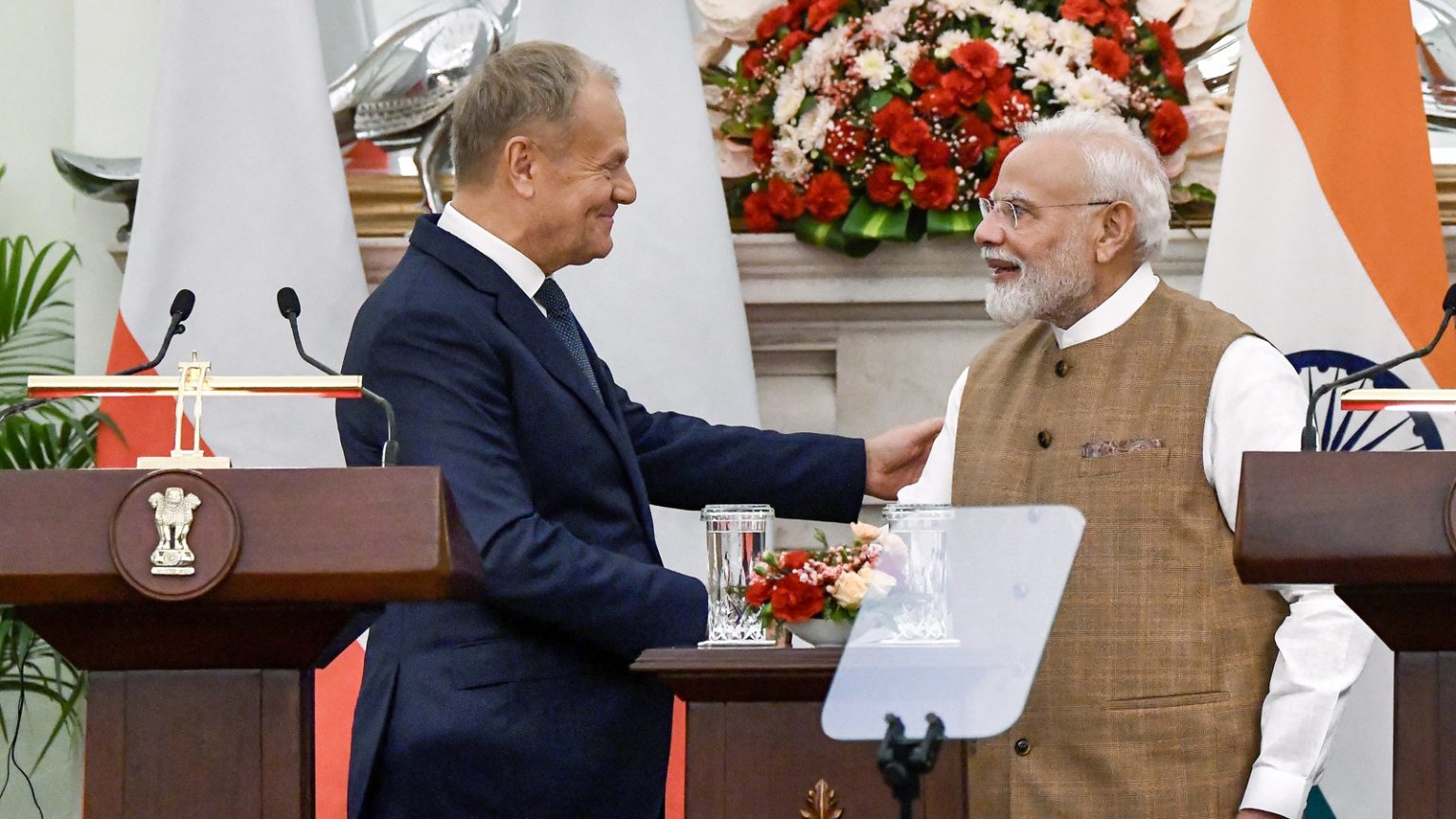

New Delhi: India and Poland on Thursday set a target of doubling bilateral trade by 2030 and agreed to expand cooperation in defence, emerging technologies, critical minerals and connectivity following talks between Prime Minister Narendra Modi and his Polish counterpart Donald Tusk.
In a joint statement issued after their meeting, the leaders reaffirmed their commitment to translating the India-Poland Strategic Partnership into concrete, time-bound and mutually beneficial outcomes. They also proposed a Defence Industry Dialogue and agreed to hold a dialogue on counter-terrorism.
The Polish Prime Minister is on an official visit to India from October 21 to 23, accompanied by a high-level delegation that includes around 100 leading CEOs and industry representatives.
The leaders reviewed progress since PM Modi’s visit to Poland in August 2024, when bilateral ties were elevated to a Strategic Partnership and the Action Plan for 2024–2028 was adopted. They endorsed the plan’s mid-term review conducted by External Affairs Minister S. Jaishankar and Polish Deputy Prime Minister and Foreign Minister Radosław Sikorski in Warsaw in September.
On economic cooperation, PM Modi invited Polish companies to expand investment and operations in India, citing its market, skilled workforce and growing manufacturing and innovation ecosystem. Polish PM Tusk highlighted Poland’s role as a gateway for Indian businesses seeking access to Central and Eastern Europe and the wider European market.
The leaders welcomed the India-Poland Business Forum held during the visit and encouraged partnerships in industrial machinery, defence, infrastructure, pharmaceuticals, mining, critical minerals, energy and information and communication technologies. They also agreed to resume the bilateral working group on agriculture to strengthen trade and cooperation.
Both sides called for the early signing and ratification of the India-European Union Free Trade Agreement and its timely implementation to open markets, promote investment and strengthen critical value chains.
Recognising the role of digital technologies in growth and public service delivery, the leaders agreed to pursue collaborative research in artificial intelligence, semiconductors and quantum technologies, while strengthening startup partnerships and links between research institutions and businesses.
Defence cooperation featured prominently in the discussions. The leaders welcomed the outcomes of the eighth Joint Working Group on Defence meeting held in Warsaw in September and agreed to maintain regular exchanges between their defence establishments.
The proposed Defence Industry Dialogue would encourage business engagement and explore commercially viable partnerships in technology, co-development, co-production and other forms of industrial collaboration, where mutually agreed.
Both sides also expressed hope that an agreement on the mutual protection and exchange of classified information would be signed soon. They identified cybersecurity, defence innovation and critical and emerging technologies as areas for closer cooperation.
In space, the leaders encouraged stronger institutional and industry engagement to identify specific joint projects. They also highlighted opportunities in battery recycling, rare earth mineral refining, geology and mining. A memorandum of understanding on geology, mining and critical minerals is under negotiation.
On connectivity, the two countries agreed to explore opportunities to enhance direct flights and encouraged talks between their civil aviation authorities. They also identified scope for cooperation in shipping, maritime security and ports, noting the importance of the India-Middle East-Europe Economic Corridor in improving connectivity and diversifying supply chains. The leaders further agreed to develop scientific cooperation in polar affairs.
Education and cultural exchanges formed another part of the agenda. The leaders encouraged deeper university partnerships, student and faculty exchanges and collaborative research. They noted Poland’s tradition of scholarship in Indology and Sanskrit, the ICCR Chair of Indian Studies at Jagiellonian University in Kraków and the presence of Polish language teachers at Indian universities.
An agreement covering culture, science and higher education is expected to be concluded soon. A cooperation agreement between the National Archives of India and Poland’s state archives authorities has been concluded and is awaiting signature.
The leaders recalled the historical links forged when India sheltered thousands of Polish women and children during the Second World War. They welcomed the two editions of the Jam Saheb Memorial Youth Exchange Programme, including the latest held in October 2026, and recalled Poland’s assistance to more than 2,000 Indian students stranded in Ukraine during Operation Ganga.
On global issues, India and Poland called for structural reform of the United Nations, including expansion of the Security Council in both permanent and non-permanent categories. Poland expressed support for India’s membership of a reformed and expanded Council and reiterated its backing for India’s candidature for a non-permanent seat for 2028–29.
The leaders expressed deep concern over the war in Ukraine and its humanitarian consequences. They called for a comprehensive, just and lasting peace consistent with international law and the UN Charter, including respect for sovereignty and territorial integrity. They also noted the war’s effects on global food and energy security, particularly in the Global South.
Both sides unequivocally condemned terrorism, including cross-border terrorism, and said it could not be justified on any grounds. They strongly condemned the April 22, 2025, terrorist attack in Pahalgam, Jammu and Kashmir, and called for concerted action against terrorists and entities designated by the UN Security Council’s 1267 sanctions committee.
They urged countries to eliminate terrorist safe havens and infrastructure, disrupt financing networks and work towards the early adoption of the Comprehensive Convention on International Terrorism at the UN.
The leaders reaffirmed support for a free, open, peaceful and prosperous Indo-Pacific, freedom of navigation and the peaceful resolution of disputes under international law. India invited Poland to join the Indo-Pacific Oceans Initiative.
They also welcomed the first foreign ministers’ meeting between India and the Visegrad Group—Poland, Hungary, the Czech Republic and the Slovak Republic—and pledged to strengthen cooperation through the V4+India format.
On climate and energy, the leaders supported closer cooperation in clean energy, sustainable technologies and climate-resilient development. India welcomed Poland’s announcement that it would join the Coalition for Disaster Resilient Infrastructure and invited it to join the International Solar Alliance and the Global Biofuels Alliance.
The Polish Prime Minister thanked PM Modi for the hospitality extended to his delegation and invited him to visit Poland.
[DD News]