



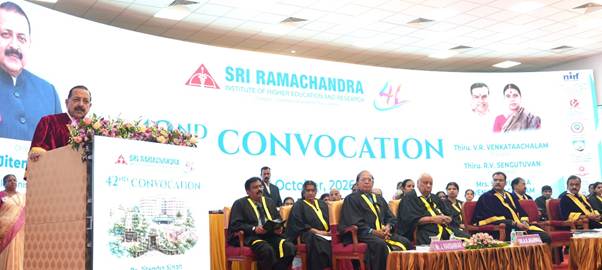

Chennai: Union Minister Dr Jitendra Singh, who is also a Professor of Medicine and Diabetes, today said that the world is entering an era of AI-guided, gene-driven precision medicine, with India emerging among the front-line providers of advanced healthcare solutions.
Addressing the 42nd Convocation, as chief guest, before awarding Medical degrees at Sri Ramachandra Institute of Higher Education and Research (SRIHER), Chennai, he said the next generation of medical professionals would have the privilege of using enabling technologies while facing the challenge of integrating them optimally with clinical practice. He stressed that the future of medicine would depend on combining technological advances with sound clinical judgement, while strengthening preventive healthcare to address the growing incidence of lifestyle diseases among younger people.
The Minister addressed the graduating students, faculty members and other dignitaries in the presence of Chancellor V. R. Venkatachalam, Pro-Chancellor R. V. Singhrutawarand other senior members of the institution. Congratulating undergraduate, postgraduate and super-specialty graduates, as well as gold medallists, Dr. Jitendra Singh expressed satisfaction at the institution’s growth and its contribution to medical education and research. He also conveyed his wishes for the speedy recovery of Vice-Chancellor Dr. Uma, who was unable to attend.
Drawing on his experience as a clinician spanning nearly four decades, Dr. Jitendra Singh traced the transformation of medical practice, from an earlier focus on communicable diseases to the growing burden of lifestyle-related disorders such as diabetes and cardiovascular diseases. He said that both communicable and non-communicable diseases continue to challenge healthcare systems, even as increasing life expectancy brings new medical demands. The emergence of chronic conditions at younger ages makes prevention, early intervention and long-term disease management increasingly important.
The Minister said that Diabetes and cardiovascular diseases, once more commonly associated with older age groups, are increasingly affecting younger people. A person developing diabetes at the age of 30 may have to live with its consequences for several decades, he said, making the protection of vital organs and prevention of complications essential responsibilities for doctors, families and patients. He stressed that preventing long-term disorders among young people is critical to protecting India’s human potential and achieving the vision of Viksit Bharat 2047.
Referring to the rapid advancement of artificial intelligence, genomics and other frontier technologies, Dr. Jitendra Singh said that tomorrow’s medical professionals would practise in an environment increasingly shaped by AI-assisted healthcare and gene-driven precision medicine. He said these technologies would open new possibilities for diagnosis, treatment and personalised care, while placing a corresponding responsibility on doctors to integrate them effectively into clinical practice. The challenge, he said, would be to make optimal use of emerging technologies while preserving the clinical orientation and judgement essential to patient care.
Dr. Jitendra Singh said India has made significant progress in indigenous medical research and is increasingly contributing to global healthcare innovation. Referring to India’s development of an indigenous DNA vaccine against COVID-19, he spoke about the country’s growing capabilities in vaccine research, including ongoing work on diseases such as dengue and malaria. He also referred to advances in gene therapy for haemophilia, demonstrating how Indian research institutions are contributing to the development of solutions for complex medical conditions.
The Minister also referred to indigenous drug development, including nafithromycin for the treatment of community-acquired bacterial pneumonia, and advances in nuclear medicine research involving conditions such as acute lymphoblastic leukaemia and fatty liver disease. These developments, he said, reflect the expanding capacity of India’s scientific and medical institutions to pursue new therapeutic approaches and strengthen the country’s contribution to healthcare research.
Emphasising the importance of translating scientific advances into clinical outcomes, Dr. Jitendra Singh invited SRIHER to expand its engagement with national research initiatives in emerging fields such as genomics, biomanufacturing and nuclear medicine. He said collaboration between government research institutions, universities, hospitals and industry can help combine scientific expertise with clinical experience, accelerate innovation and facilitate the development of effective and affordable healthcare solutions.
The Minister referred to the growing opportunities for research and innovation in advanced scientific fields, including nuclear medicine, and encouraged the institution to build on its research capabilities, clinical expertise and startup ecosystem. He said closer collaboration between researchers, medical professionals and technology developers would be important in advancing new therapies, medical technologies and precision healthcare.
Speaking about the potential of genomics, Dr. Jitendra Singh said that integrating genomic information with clinical outcomes could help doctors increasingly tailor treatment to individual patients, taking into account their genetic profiles, lifestyles and environmental factors. As precision medicine advances, he said, medical professionals would need to combine emerging scientific knowledge with clinical experience to ensure that new technologies translate into meaningful improvements in patient care.
Concluding his address, the Minister stressed that preventing long-term disorders, particularly those increasingly affecting younger people, must become a collective national priority. Protecting the health and productive potential of India’s youth will be essential to achieving Viksit Bharat 2047 of PM Narendra Modi’s dreams, he said, calling for sustained efforts in prevention, medical research, technological innovation and responsible clinical practice.
[PIB]