



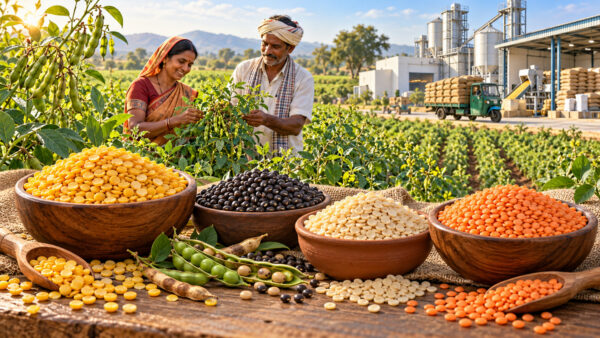

New Delhi: India’s effort to become self-reliant in pulses is taking shape across farms, procurement systems and processing units. A year after its launch, the Mission for Aatmanirbharta in Pulses is combining better seeds, assured procurement, expanded cultivation and digital monitoring to increase domestic production and reduce dependence on imports.
Launched on October 11, 2025, the six-year mission has an allocation of ₹11,440 crore for 2025-26 to 2030-31. Its goal is to raise annual pulses production to nearly 350 lakh tonnes by 2030–31, with productivity reaching 1,130 kg per hectare.
For the world’s largest producer of pulses, the initiative has significance beyond agricultural output. Pulses contain 20-25% protein – more than double that of wheat and nearly three times that of rice – and remain central to Indian diets and nutritional security. They also contribute to agricultural exports and farmers’ livelihoods.
The mission’s approach links production with the support needed to make cultivation remunerative: quality seeds, reliable markets, processing capacity and timely payments.
A particular focus is on tur, urad and masoor. Climate-resilient varieties and improved seed quality are intended to help farmers increase output, while a cluster-based approach covering 489 districts will intensify production.
Over six years, the mission envisages distributing 87.5 lakh free seed kits and 126 lakh quintals of certified seeds. It also aims to expand pulse cultivation by 35 lakh hectares, taking the targeted area to 310 lakh hectares by 2030-31.
Domestic production has already shown growth. According to the third advance estimates, India produced 274.09 lakh tonnes of pulses in 2025-26, compared with 256.83 lakh tonnes in 2024–25.
The cultivated area increased from 277.20 lakh hectares to 286.46 lakh hectares over the same period, while average productivity rose from 926 kg to 957 kg per hectare.
Major pulse-growing states include Madhya Pradesh, Maharashtra, Rajasthan, Uttar Pradesh, Gujarat, Andhra Pradesh, Karnataka, Jharkhand, Odisha and West Bengal.
Alongside this expansion, the value of pulse imports declined by 31.52%, from ₹46,427.60 crore in 2024–25 to ₹31,793.59 crore in 2025–26.
Exports increased 13.40% in value, from $855 million to $969.53 million, with export volume reaching 10.01 lakh tonnes in 2025-26. China, the United Arab Emirates, Bangladesh, the United States and Sri Lanka were among the major destinations.
Price security forms an important part of the mission. The Minimum Support Price for urad increased from ₹7,400 per quintal in 2024–25 to ₹8,200 in 2026–27, a rise of ₹800, or 10.81%.
For tur, the MSP rose by ₹900, or 11.92%, from ₹7,550 to ₹8,450 per quintal. Masoor’s support price increased by ₹300, or 4.48%, from ₹6,700 to ₹7,000 per quintal over the same period.
The National Cooperative Consumers’ Federation of India Limited (NCCF) and the National Agricultural Cooperative Marketing Federation of India Limited (NAFED) have been authorised to procure 100% of tur, masoor and urad offered by willing, registered farmers for four years, from 2025-26 to 2028-29.
The release cites an NCCF dashboard snapshot dated June 17, 2026, showing procurement of 10.55 lakh tonnes across nine states and direct MSP payments of ₹7,047 crore. It reports that 4.69 lakh farmers benefited out of 7.74 lakh registered farmers.
Separately, the release lists Kharif 2025-26 procurement at 7.89 lakh tonnes, worth ₹6,431 crore, benefiting 3.66 lakh farmers. It also reports Rabi 2026-27 procurement of 23.51 lakh tonnes, with MSP payments of ₹14,217 crore to 10.20 lakh farmers.
Overall pulses procurement, according to the release, increased from 18,39,504.77 tonnes in 2024–25 to 31,40,883.92 tonnes in 2025-26.
Beyond cultivation and procurement, the mission aims to establish 1,000 pulse processing units, or dal mills. Of these, 528 have been allocated to states and Union Territories in the first phase.
Another 23 pulse processing units have been approved under the Creation and Expansion of Food Processing and Preservation Capacities component of the Pradhan Mantri Kisan SAMPADA Yojana. Eighteen of these approved projects have been completed.
Expanding pulses cultivation in rice-fallow areas is another priority. Against the six-year target of 87.5 lakh seed kits, 9.25 lakh kits were distributed during Rabi 2025–26.
Digital tools are intended to connect these interventions and improve oversight. A three-tier steering committee network monitors planning and implementation at the national, state and district levels.
The Krishi Mapper application supports geo-fencing, land geo-tagging and real-time tracking of seed-variety demonstrations and yields. The Seed Authentication, Traceability and Holistic Inventory portal, known as SATHI, tracks the seed lifecycle and automates the supply chain from production through certification to sale.
AgriStack and the Digital Crop Survey combine farmer IDs, Soil Health Card analytics and verified plot surveys to support targeted nutrient delivery and accurate harvest forecasts. Platforms such as e-Samriddhi and Vistaar support direct payments, access to real-time market information and domestic price stability.
As the mission enters its second year, its central task is to sustain production gains while ensuring farmers have the confidence and infrastructure to expand cultivation. The ₹11,440-crore programme brings together the successive stages of the pulse economy – from seed selection and sowing to procurement and processing – in pursuit of greater nutritional security, stronger farm incomes and lower import dependence by 2030-31.
[DD News]