




Virendra Pandit
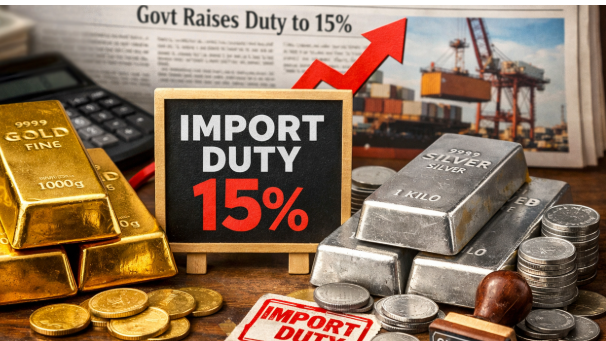
New Delhi: Barely 24 hours after Prime Minister Narendra Modi appealed to the people, twice, to postpone gold buying for a year, the Union Finance Ministry raised import duty on precious metals by 15 percent, effective Wednesday, the media reported.
According to a government notification, import duty on gold and silver has been increased from 6 per cent to 15 per cent, and on platinum from 6.4 per cent to 15.4 per cent.
Similar changes have also been made to other related items such as gold/silver dore, coins, findings, etc. “This has been done as a policy measure aimed at safeguarding macroeconomic stability, conserving foreign exchange, and moderating non-essential imports during a period of heightened global uncertainty arising from the ongoing West Asian crisis,” an official said.
Macroeconomics
Customs duty on precious metals has historically been calibrated in response to prevailing macroeconomic and external-sector conditions. During periods when external pressures moderated, foreign exchange reserves strengthened, and macroeconomic stability improved, customs duty rates on precious metals and related products have also been rationalised downward.
In the Union Budget 2024–25, customs duties on gold and silver were reduced from 15 per cent to 6 per cent, and on platinum from 15.4 per cent to 6.4 per cent, “reflecting a more comfortable macroeconomic and external-sector position at the time. Therefore, such duty calibrations have remained responsive to evolving economic and external conditions,” the official said.
Conserving forex, protecting CAD
The fresh increase in import duty on precious metals is part of a broader strategy aimed at conserving foreign exchange, protecting the current account, prioritising essential imports, and strengthening India’s economic resilience amid evolving global uncertainties.
“The measure represents a balanced, proportionate, and nationally responsible response to extraordinary external conditions while maintaining due regard for macroeconomic stability and long-term economic resilience,” he said.
The West Asian crisis has triggered volatility in global crude oil markets and international shipping routes. India, the world’s third largest oil and gas importer, remains vulnerable to elevated energy prices and supply-side disruptions, which can increase the import bill, exert pressure on inflation, and the Current Account Deficit (CAD), calling for a prudent management of external sector. Historically, customs duty adjustments have been used as a policy instrument to support macro-economic stability and effectively manage CAD-related pressures during periods of global volatility.
“India’s foreign exchange resources must therefore be prioritised towards essential imports such as crude oil, fertilisers, industrial raw materials, defence requirements, critical technologies, and capital goods. These imports directly support economic activity, food security, infrastructure, manufacturing, exports, and national security,” the second official said.
Economic discipline
The latest measure is also aligned with the broader national economic discipline emphasised by the Prime Minister in the context of the evolving global situation. He urged the people twice, on Sunday and Monday, to reduce avoidable foreign travel expenditure, promote domestic alternatives, conserve fuel, and support national economic resilience through responsible consumption choices. In this broader context, “moderation in discretionary precious metal imports may be viewed as part of a wider collective effort to strengthen economic stability during a period of uncertainty,” he said.
Gold rallies
On Wednesday, gold prices gained, with domestic futures crossing the Rs.1.63 lakh mark on the Multi-Commodity Exchange (MCX), supported by geopolitical tensions, a record low in the rupee, and continued safe-haven buying.
MCX Gold opened with a sharp gap-up and traded above Rs. 1,63,000 after breaking out of a medium-term consolidation range, while COMEX Gold hovered near the USD 4,700-4,730 per ounce zone.
The rally in domestic bullion was further amplified after the Indian government raised the total import duty on gold and silver to 15 per cent from 6 per cent. Market participants said the higher levy could push up local prices further even as international bullion prices remain volatile.
The rupee weakened 32 paise to close at a fresh all-time low of 95.63 against the US dollar after trading in the 95.43-95.74 range intraday. Analysts expect the currency to trade with a weakening bias in the 95.45-95.90 band, with persistent dollar demand and geopolitical uncertainty continuing to pressure the domestic unit.