




Virendra Pandit
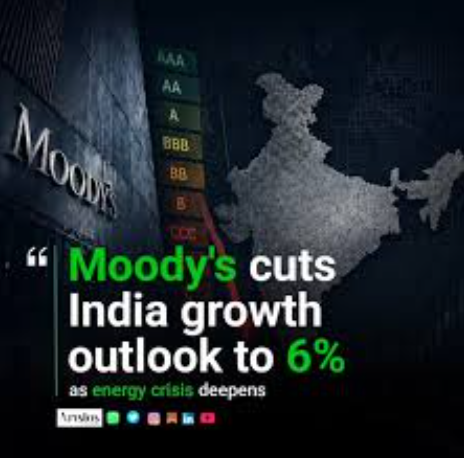
New Delhi: Citing subdued private consumption, capital formation, and industrial activity amid higher energy costs cited as reasons, global agency Moody’s Ratings on Tuesday slashed India’s GDP growth forecast for year 2026 by 0.8 percentage points to 6 per cent, the media reported.
In its Global Macro Outlook May update, it said over the next six months, the impact from higher energy prices and fuel and fertilizer-related shortages will vary widely across countries, reflecting differences in exposure and resilience.
“The global outlook remains highly uncertain amid an increasingly prolonged confrontation and fragile ceasefire between the US and Iran, We estimate growth losses ranging from around 0.8 ppt for India,” Moody’s said.
For calendar year 2027, the agency slashed GDP growth estimates by 0.5 percentage points to 6 per cent for India, reflecting lingering headwinds that gradually fade as shipping flows stabilise and energy supplies improve, allowing underlying economic activity to recover.
Moody’s said India is “particularly vulnerable” to high oil prices given its heavy reliance on imported crude and LNG. India imports about 90 per cent of its energy requirements.
As a net grain producer, agricultural exports will benefit in the near term from higher prices, but higher fuel and fertilizer costs would weigh on government finances, potentially constraining planned capital spending.
Coal powers about 70 per cent of India’s electricity generation, while non-fossil sources (solar, wind, hydro) continue to expand.
“Our central scenario projection of 6 per cent growth in both 2026 and 2027, following 7.5 per cent growth in 2025, reflects more subdued private consumption, capital formation, and industrial activity amid tighter financial conditions and higher energy costs,” Moody’s said.
Persistently high energy costs would keep inflation elevated, compress profits, weaken investment and strain public finances, while major central banks remain on hold but ready to tighten financial conditions, if necessary, it added.
The US-based rating agency said the long-drawn-out negotiations between US and Iran, ongoing shipping blockades and the risk of military escalation threaten the ceasefire’s durability.
Against this unstable backdrop, the global economy faces another potential energy and food-price shock, particularly if transit flows to and from the Gulf remain constrained, Moody’s said, adding the magnitude of growth and inflation effects hinges on the duration of the Strait of Hormuz’s closure.
India imports 60 per cent of its LPG usage and of that, 90 per cent flows through the now-closed Strait of Hormuz. Several Asian economies are actively diversifying their supplier mix by expanding oil imports from existing partners and exploring new sources.
India is importing more Russian crude, while Japan and Korea are shifting incrementally toward US barrels, Moody’s said.
It also said economies face a mix of shared and idiosyncratic challenges from the fallout. Strategic reserves offer only short-term protection as physical global energy shortages will become increasingly binding within months. Asia-Pacific is the most exposed region.
“China is partly insulated by its reliance on coal and renewables, while India remains vulnerable,” Moody’s said.