Hantavirus: Spain braces for more as the US plans rescue of Americans on the ship










Virendra Pandit
New Delhi: Residents of Spain’s Canary Islands panicked on Saturday, expecting an unpredictable situation as civil guard officers inspected the area where passengers from the Dutch-flagged MV Hondius luxury cruise ship would arrive within hours at the port of Granadilla in Tenerife, the media reported.
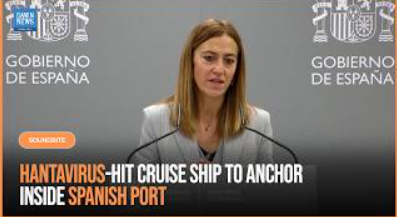
Spain’s Canary Islands braced for the worst for the incoming hantavirus-stricken cruise ship carrying 140 passengers and crew on the MV Hondius vessel, which will be ‘completely isolated’ and evacuated.
The cruise ship was hit by a hantavirus outbreak early this week and is en route to Spain’s Canary Islands, where it plans to drop off 140 passengers and crew so they can be evacuated after weeks stranded at sea.
Passengers will be taken to a “completely isolated, cordoned-off area”, said the head of Spain’s emergency services, Virginia Barcones.
The US rescue efforts
The United States said on Friday it was organising an evacuation flight for Americans on a hantavirus-struck cruise ship that has sailed to the Canary Islands, which are part of Spain.
“The Department of State is arranging a repatriation flight to support the safe return of American passengers on this ship,” a State Department spokesperson said.
WHO
World Health Organization (WHO) chief Tedros Adhanom Ghebreyesus will be on the island to help coordinate their evacuation.
While three people have died since the outbreak, and five passengers who left the ship are known to be infected with hantavirus, cruise operator Oceanwide Expeditions said on Friday there were no people with symptoms of a possible infection on board the ship.
The WHO considers the risk to the wider public from the outbreak as low.
“This is not a new COVID,” said WHO spokesman Christian Lindmeier. “The virus is not that contagious that it easily jumps from person to person.”
Hantavirus is usually spread by the inhalation of contaminated rodent droppings and is not easily transmitted between people. But the Andes virus detected in the cruise ship outbreak may spread between people in rare cases. Symptoms usually show between one and eight weeks after exposure.
Health authorities across four continents are tracking down and monitoring more than two dozen passengers who disembarked the ship before the deadly outbreak was first detected on May 2. They were also scrambling to trace others who may have come into contact with them.
Some Spanish residents expressed concern that the passengers’ arrival would create a health risk on the island and that not enough measures were in place to contain it.
Iustitia Europa, an anti-establishment Spanish group that rose to prominence by challenging COVID-era restrictions, called for the MV Hondius to be barred from reaching Spanish shores.
“The Canary Islands cannot become Europe’s health laboratory … We demand transparency, responsibility, and protection for Spaniards to avoid repeating the mistakes of the past,” the group posted on X.
Protests
Spanish passengers feared that they will be ostracised once on land. “We’re scared by all the news that’s coming out, by how people are going to receive us,” said one of the passengers.
“You see what’s out there and you realise you’re heading into the eye of a hurricane,” said another passenger. “Many people forget that in here there are more than 140 passengers. In reality, there are 140 human beings.”
Once the ship reaches Tenerife, the largest of Canary Islands off the West African coast, passengers will be evacuated in small boats to buses only after their repatriation flights are ready to take them, Spanish officials said. They will then be transported in isolated and guarded vehicles, with the parts of the airport they travel through being cordoned off.