



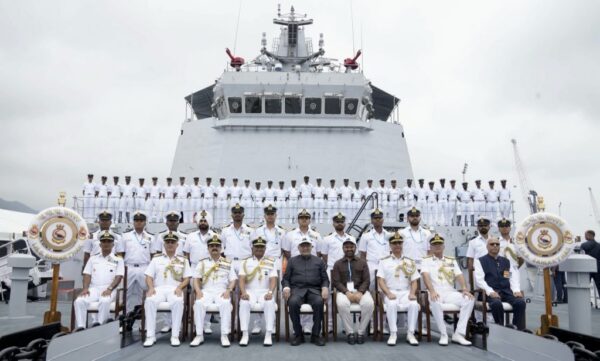

Karwar (Karnataka): Vice-President C. P. Radhakrishnan on Friday commissioned INS Samarthak, the Indian Navy’s first indigenous multi-purpose vessel built by a private shipyard, at the naval base in Karwar, Karnataka, marking a significant milestone in India’s efforts to strengthen domestic warship construction and defence self-reliance.
Built by Larsen and Toubro (L&T) at its Kattupalli shipyard in Tamil Nadu under the government’s Make in India initiative, the vessel has more than 75 per cent indigenous content and is designed to support a wide range of naval operations, including maritime surveillance, weapons trials and unmanned systems deployment.
The commissioning ceremony was attended by Chief of the Naval Staff Admiral Krishna Swaminathan, Karnataka Labour Minister Santosh Lad, senior naval officers and other dignitaries.
The Vice-President’s office said, “Vice-President Shri C. P. Radhakrishnan today commissioned INS Samarthak, the Indian Navy’s first indigenous Multi-Purpose Vessel, at Karwar, Karnataka.”
“With over 75% indigenous content, INS Samarthak reflects India’s growing self-reliance in defence manufacturing and will support trials of next-generation weapons, sensors and unmanned systems,” the Vice-President’s office said in a post on X, describing the commissioning as a significant milestone towards a technologically advanced and self-reliant Indian Navy.
Addressing the gathering, Radhakrishnan said the commissioning of INS Samarthak demonstrated India’s growing industrial, technological and shipbuilding capabilities.
He said self-reliance in defence manufacturing was no longer merely an aspiration but was increasingly becoming a reality, contributing to India’s strategic autonomy and the vision of a developed and self-reliant India articulated by Prime Minister Narendra Modi.
Highlighting India’s maritime heritage, the Vice-President recalled the naval traditions of Chhatrapati Shivaji Maharaj and the Chola dynasty, which had extended India’s maritime influence across the Indian Ocean and Southeast Asia.
He commended the Indian Navy for safeguarding national sovereignty and maritime interests, while acknowledging its role as a first responder and preferred security partner in the Indian Ocean Region.
Radhakrishnan highlighted the Navy’s contributions to anti-piracy operations, the evacuation of Indian nationals and humanitarian assistance and disaster relief (HADR) missions.
Referring to INS Samarthak’s operational capabilities, the Vice-President said the vessel would serve as a versatile platform for testing and evaluating next-generation weapons, sensors and emerging maritime technologies.
He said the ship would also support maritime surveillance and reconnaissance, offshore patrols, target launch and recovery operations, unmanned systems deployment and disaster relief missions.
According to Radhakrishnan, such platforms would enable the Navy to respond more rapidly to technological developments and translate indigenous innovations into operational capabilities.
The Vice-President also underscored the strategic importance of Karwar, noting that its deep natural harbour and proximity to the Arabian Sea make it a vital component of India’s maritime security infrastructure.
He highlighted the ongoing development of naval infrastructure under Project Seabird, which is expanding the Navy’s capacity to base and sustain warships and submarines while generating economic opportunities in the region.
Radhakrishnan further emphasised the growing collaboration among the Indian Navy, defence public sector undertakings, private shipyards, the Defence Research and Development Organisation (DRDO), academic institutions, micro, small and medium enterprises (MSMEs) and start-ups.
He appreciated L&T’s contribution to the project and acknowledged the efforts of naval designers, production authorities, shipyard professionals, engineers, technicians, suppliers and ancillary industries involved in developing indigenous naval capabilities.
Ahead of the commissioning, the Indian Navy spokesperson highlighted the vessel’s indigenous development and operational versatility in a post on X.
“A new milestone in indigenous warship construction!” the spokesperson said.
“The #IndianNavy is set to commission #Samarthak at Naval Base, Karwar, on 16 Oct 26. Built by @larsentoubro under the #MakeInIndia initiative, she is the first of four Multi-Purpose Vessels being inducted into the Navy,” the post read.
The spokesperson added, “Designed for maritime surveillance & patrol, Samarthak will also support a range of missions, including LIMO, trials, autonomous systems operations and HADR, strengthening the Navy’s operational versatility and self-reliance.”
Addressing the commissioning ceremony, Admiral Swaminathan described the vessel’s induction as an important milestone in India’s pursuit of Aatmanirbharata, highlighting the increasing participation of private industry in naval shipbuilding.
He said INS Samarthak was designed, engineered and constructed entirely in-house at L&T’s Warship Design Centre and shipyard.
“Samarthak is the first major or big warship contracted to and constructed by a private shipyard to be commissioned into the Indian Navy,” the Navy chief said.
The vessel is equipped with an advanced dynamic positioning system, enabling it to launch and recover targets used during naval exercises at sea.
It will also serve as a trials platform for indigenous weapons, sensors and emerging technologies, helping accelerate their integration into operational naval systems.
“These capabilities are particularly vital in today’s rapidly evolving technological milieu, where shortening the journey from prototype to production is critical to maintaining the operational edge at sea,” Admiral Swaminathan said.
The Navy chief said the ship’s endurance and ability to support other vessels at sea would help sustain naval operations across geographically dispersed areas for extended periods.
INS Samarthak is also equipped with heavy-towing facilities, medical infrastructure and firefighting systems, enabling it to assist vessels in distress and respond to maritime emergencies.
Its capabilities include low-intensity maritime operations, humanitarian assistance and disaster relief, non-combatant evacuation missions, salvage operations and conversion into a limited hospital ship when required.
The vessel’s integrated combat suite incorporates indigenous sensors, weapons and electronic systems designed for operations in challenging maritime environments.
Admiral Swaminathan said the ship would strengthen the Navy’s operational readiness, support the adoption of emerging technologies and reinforce India’s role as a first responder and preferred security partner in the region, in line with the national vision of MAHASAGAR.
He congratulated L&T’s management and workforce, the Navy’s warship production teams, MSMEs, equipment manufacturers and other industry partners associated with the project.
The Navy chief also stressed the importance of drawing lessons from the vessel’s construction to improve build quality and reduce delivery timelines for future warships.
“Even a very successful maiden achievement can give us useful pointers to strengthen our efforts in the long term,” he said.
Addressing the commissioning crew, Admiral Swaminathan urged personnel to establish high operational standards and shape the vessel’s service record through professionalism and dedication.
The ship’s crest features an Indian elephant emerging from the waves, symbolising strength, intelligence and agility. Its motto, “विजयार्थम् एकनिष्ठता”, translates to “Victory is Our Sole Aim.”
Senior officers from the Indian Navy and Ministry of Defence, along with representatives of the defence industry, also attended the event.
[DD news]