




Manas Dasgupta
NEW DELHI, Nov 3: The opposition parties indefinitely protesting against the Chief Election Commissioner (CEC) Gyanesh Kumar came under flak from the Supreme Court on Tuesday which observed that no one can occupy a site indefinitely to hold a protest and even the designated sites for such activity should have a definite time period.
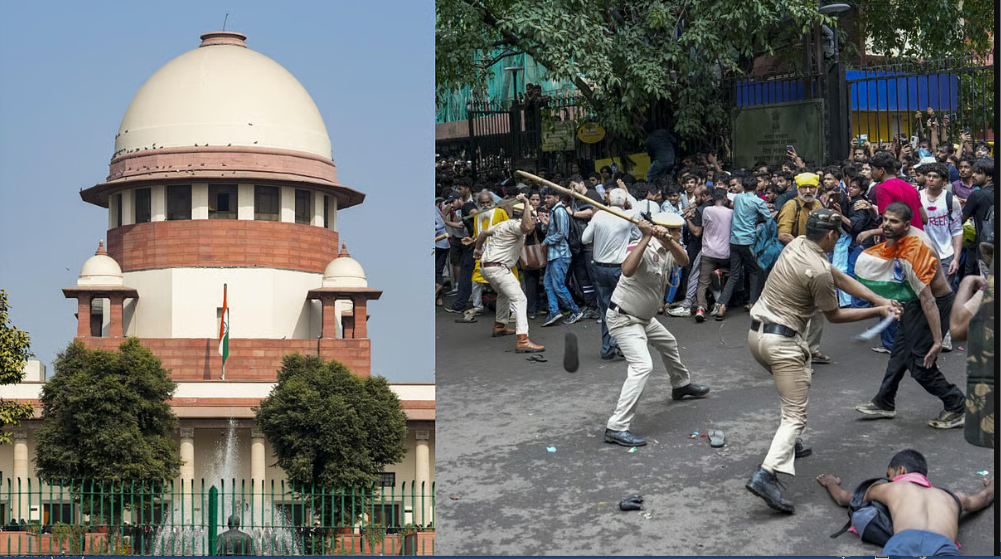
The observations came during a hearing on the massive protest sponsored by the Cockroach Janta Party (CJP) against alleged NEET paper leaks in central Delhi’s Jantar Mantar last month and the recent one at Ramlila Maidan organised by the Opposition parties and others against the Election Commission of India.
A soothing remark, however, also came from the court which observed that the protests were not entirely hostile to business, pointing out that there was also “protest economy” that generates brisk earnings for enterprising hawkers and vendors at demonstration sites.
A Bench headed by Chief Justice of India Surya Kant expressed sympathy for the right to livelihood of the small traders, hawkers, push cart vendors, noting that their right competed with the right to expression of the protestors. The court said there was a need for balance. The tag of a designated protest site was removed from Jantar Mantar by the government and three alternative sites including Ramlila Maidan were announced last month.
“Right to protest is constitutionally recognised. Right to trade is also. By ‘trade’ we do not mean commercial establishments, but those who do it as the sole source of livelihood, like the daily wagers, the subjiwala, etc. Where can they go?” Chief Justice Kant observed.
The government’s top lawyer Tushar Mehta told the Supreme Court that whoever gives the call for a protest should take responsibility for any consequence as a result of their actions. “You cannot occupy a site for all times to come. There are other protesters also. Where will farmers or lawyers go? Everyone has a right to protest,” Chief Justice of India Surya Kant said and sought responses from the Centre and others on a petition by trader organisations seeking a halt to protests during the festival season.
Mehta informed the Supreme Court that permission for the July 20 protest was given only for one day, but the protesters occupied the place and even marched to parliament. “Parliament is not just another political building. You cannot march to parliament. You cannot march to the Supreme Court,” he said.
The bench was hearing a batch of petitions including the one filed by traders and on issues of alleged mass detention, police brutalities, closure of metro stations and internet shutdown. The bench also comprising justices Joymalya Bagchi and V Mohana told the trader organisations to make the organisers of the anti-CEC protest parties to their petition over loss of business.
Praveen Khandelwal, MP and Secretary General of Confederation of All India Traders (CAIT), welcomed the significant intervention by the Supreme Court. Khandelwal said the observations made by the Supreme Court underline the importance of maintaining a constitutional balance between the fundamental right to peaceful protest and the equally important right of citizens to carry on their occupations and earn their livelihoods.
Some 50 lakh people live in areas near the protest site and all shops remained closed and there was nobody in Connaught Place, senior lawyer Mukul Rohatgi said on behalf of traders. No court can determine issues unless traders’ bodies make all protesting organisations parties, it said. “We have lost thousands of crores. Nobody is able to do business in Connaught Place. Thousands of auxiliary workers connected to these businesses are without a jobs as sales is down in the middle of the festive season,” Mr Rohatgi said.
On October 15, the bench had sought responses from the Election Commission and others on a plea filed by Congress MP Rahul Gandhi and 12 Opposition leaders over alleged large-scale voter deletions and SIR irregularities.
The opposition INDIA Bloc’s Sunday rally at the Ramlila Maidan had caused massive disruptions across Central Delhi leading to heavy traffic jams and widespread commercial losses. According to the Chamber of Trade and Industry (CTI), around 2.5 lakh of 3 lakh shops across 25 major wholesale and retail markets remained closed or were heavily impacted during the rally just ahead of Diwali. The organisation claimed that prominent markets including Chandni Chowk, Sadar Bazar, Connaught Place, Karol Bagh, and Kashmiri Gate were among the worst affected during the peak shopping period ahead of the festival.
CTI Chairman Brijesh Goyal and other trade organisations estimated total business losses between Rs 10,000 crore and Rs 12,000 crore. The business community expressed deep resentment against the opposition and Congress leader Rahul Gandhi. CTI reportedly wrote four separate letters to Gandhi on October 24, October 27, October 28, and November 1, requesting him to postpone the rally or change the venue to safeguard festive trade. Despite this, the rally went ahead as scheduled.
Traders’ associations in Delhi had written to Samajwadi Party chief Akhilesh Yadav and Trinamool Congress supremo Mamata Banerjee, seeking their intervention to postpone the INDIA bloc’s November 1 rally at Ramlila Maidan until after Diwali.
Solicitor General Tushar Mehta, for the Union government, referred to how the Cockroach Janta Party (CJP)-linked NEET-UG paper leak protestors had sought permission for a peaceful demonstration at Jantar Mantar only for a day on June 20, but had refused to leave. The demonstration had ultimately culminated in violence after the protestors took out a ‘Sansad Chalo’ march to the Parliament on July 20 without taking any permission from the authorities.
“Everybody has a right to protest… But everybody must adhere to conditions of permission. You cannot occupy a protest site indefinitely. There are other protestors too… Where will they go?” Chief Justice Kant asked. Mr Mehta submitted that the organisers of protests or bandh calls must take responsibility for the losses caused to others.
Senior advocate N. Hariharan, appearing for CPI(M) State secretary M.A. Baby along with advocate Subhash Chandran, questioned whether the authorities were suddenly having second thoughts about designating Ramlila Grounds as a designated site now.
“So, where are we supposed to protest now as citizens? Protest is a democratic process. At every protest site, there are push cart vendors, hawkers and small traders doing business… Democracy works like that,” senior advocate P.V. Dinesh, appearing for the Kerala Union of Working Journalists, submitted.
Justice Bagchi pointed out that essentials like food and water usually are supplied to protestors at the site by hawkers and vendors. “There would be ample food… There is a protest economy… Like in melas, there is a lot of business done… ‘Mela economy’,” Justice Bagchi observed orally.
Justice Bagchi asked the traders whether they had made the protest organisers a party in their case. Mr Rohatgi replied in the negative, while calling for a two-month ban on protests during the festive season. The court issued notice on the plea, also seconded by the New Delhi Traders Association, but refused to pass any interim order without hearing the other stakeholder — the protest organisers.