



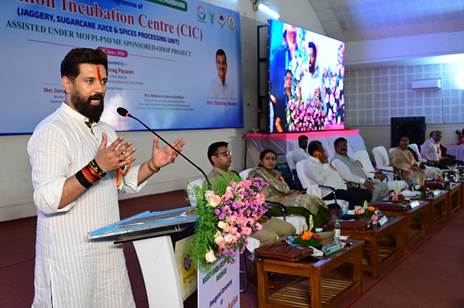

New Delhi: Under the Atmanirbhar Bharat Abhiyan, an advanced Common Incubation Center (CIC) established at the College of Food Technology, Vasantrao Naik Marathwada Krishi Vidyapeeth (VNMKV), Parbhani, with financial assistance from the Ministry of Food Processing Industries (MoFPI), Government of India, New Delhi, and in collaboration with Vasantrao Naik Marathwada Krishi Vidyapeeth, Parbhani and the State-Level Nodal Agency of the Agriculture Department, Government of Maharashtra, was inaugurated on June 28, 2026 by Union Minister for Food Processing Industries, Shri Chirag Paswan.
On this occasion, a special interaction and guidance session by the Minister was organized at the Golden Jubilee Convocation Hall of the university. Minister of State for Public Health and Family Welfare, Water Supply and Sanitation, Energy, Women and Child Development, Public Works (Public Undertakings), and Guardian Minister of Parbhani District, Smt. Meghana Tai Bordikar, was specially present for the event. The program was presided over by Vice Chancellor Prof. (Dr.) Indra Mani. Distinguished guests included Rajya Sabha Member Shri Ramrao Wadkute, Lok Sabha Member Shri Sanjay Jadhav, Director of Agricultural Processing Planning, Government of Maharashtra Shri Vinaykumar Awate, Acting District Collector and CEO of Zilla Parishad Smt. Natisha Mathur (IAS), Superintendent of Police Shri Pankaj Kumawat (IPS), and Director of Education Dr. Bhagwan Asewar.
During his inaugural address, Union Minister Shri Chirag Paswan expressed happiness after witnessing the enthusiasm of the participants present at the event. He said that the responsibility of every citizen has increased in building a Developed India (Viksit Bharat). He stated that Prime Minister Shri Narendra Modi has entrusted him with the responsibility of this ministry, and he is carrying out this responsibility with equal enthusiasm and dedication. Seeing the enthusiasm at the university inspired him to interact directly with the audience.
He further said that India is an agriculture-based nation, and agriculture remains the primary source of income for the country. Therefore, continuous efforts will be made to increase farmers’ income through the food processing industry. Initially, India focused on increasing agricultural production, and today the country has become self-reliant in production while also exporting to many countries. However, there is now a need to add value to agricultural produce and convert it into higher-value products.
He noted that traditionally, Indian households processed products like curd, papad, and pickles effectively at home, and in the same way, modern agricultural produce should also undergo processing. He emphasized that food processing is essential to increasing agricultural income and should receive greater encouragement.
The Minister pointed out that many farmers own small landholdings but have larger financial needs, forcing them to sell their produce at lower prices due to inadequate storage facilities. He said it is necessary to strengthen farmers’ capacities so they can store, process, and add value to their produce, thereby increasing income.
He emphasized that the industrial sector has immense strength and that youth should aspire to become job creators rather than job seekers. The Ministry of Food Processing Industries is implementing various schemes aimed at empowering stakeholders from production to marketing. Food wastage remains a serious issue, and processing is the most effective solution to minimize such losses. Expansion of the food processing sector is essential, and cooperation from state governments is equally important.
He appreciated the work of the Chief Minister and Deputy Chief Minister of Maharashtra, stating that Maharashtra has performed exceptionally well under the PMFME Scheme (Pradhan Mantri Formalisation of Micro Food Processing Enterprises Scheme) and has secured a leading position in the country. He further stressed that to make Indian agricultural products globally competitive, it is necessary to reduce the use of chemical fertilizers and adopt organic farming practices. Quality processed products must also be developed. He said initiatives like the “Khet Bachao Abhiyan”, being implemented under the leadership of Prime Minister Narendra Modi, will greatly benefit this objective.
While addressing students, he advised them that regardless of the field they choose, they should never compromise on the quality of their products. Only quality products survive for the long term and build a lasting identity. Many successful brands are built through years of hard work, but compromising on quality for short-term gain can destroy years of effort within moments. Therefore, he urged students to remain committed to maintaining quality standards.
He further stated that every product carrying the label “Made in India” must meet all standards of excellence and be globally competitive. He reiterated the Prime Minister’s vision that Indian farmers have the potential to become the food bank of the world.
In conclusion, he said that Vasantrao Naik Marathwada Krishi Vidyapeeth was established based on the visionary thinking of former Maharashtra Chief Minister Late Vasantrao Naik. The university has made invaluable contributions in agricultural education, research, technology development, and agricultural extension. He appealed to the university, the department, and the nation to carry forward this legacy and further enhance India’s reputation in the agricultural sector.
(PIB)