




Virendra Pandit
New Delhi: Even after its near bankruptcy, zero credibility, and military-terror diarchy, Pakistan lost none of its cunningness and exhibited its triplicity to the US, Saudi Arabia, and even Iran during the ongoing West Asian crisis, the media reported.
But Islamabad lost the game to the UAE which forced it to repay the USD 3 billion worth of debt last month, and also reportedly deported thousands of Pakistanis, mainly Shias.
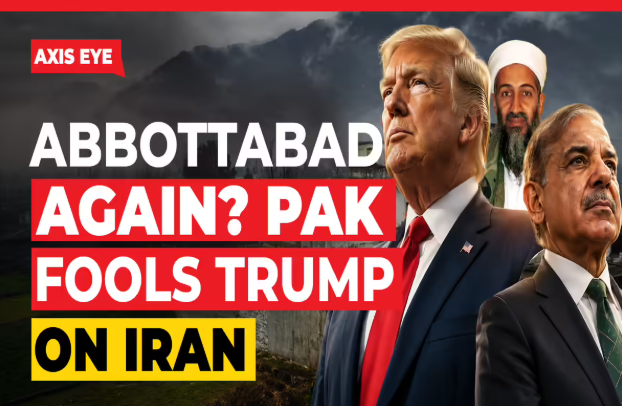
Reports have now revealed how Pakistan, which had signed a defence pact with Saudi Arabia in 2025—purportedly against Israel but actually against Iran—secretly permitted Tehran to park its aircraft on Pakistani soil while it simultaneously ‘mediated’ between the US and Iran during the ongoing war.
This is reminiscent of Pakistan hiding Osama bin-Laden at Abbottabad for years before the global terror chief was killed in a US operation in 2011.
Triple-crossed and fooled, the US believes that the movement of civilian and military assets to Afghanistan and Pakistan, respectively, was part of Tehran’s attempt to insulate some of its remaining military and aviation assets from potential American and Israeli strikes, even as officials publicly served as brokers for de-escalation.
According to recent media reports, including claims from CBS News, Pakistan allowed Iranian military aircraft to park at the Nur Khan Airbase near Rawalpindi to shield them from potential US strikes. While Pakistan confirmed some Iranian aircraft were present, they denied it was to protect them from attacks. Location: The aircraft, including a reconnaissance RC-130, were reported to be at the Pakistan Air Force base in early April 2026, following a ceasefire announcement.
Backlash in the US
This revelation has triggered a massive backlash in Washington, with US lawmakers questioning Islamabad’s so-called ‘neutrality’ in the mediation process. Lindsey Graham, a senior Republican senator and a close ally of US President Donald Trump, in a post on X, called for a reassessment of Pakistan’s diplomatic role in the crisis.
“If this reporting is accurate, it would require a complete re-evaluation of the role Pakistan is playing as mediator between Iran, the United States and other parties.”
“Given some of the prior statements by Pakistani defence officials towards Israel, I would not be shocked if this were true,” Graham added.
Exposed, Pak denies!
Pakistan’s foreign ministry labelled the reports “misleading and sensationalised,” stating the aircraft were there for, or in connection with, diplomatic and logistical support, not for hiding.
A senior Pakistan told CBS that such claims were implausible because the facility is located in a densely populated area.
“The Nur Khan airbase is right in the heart of (the) city, a large fleet of aircrafts parked there can’t be hidden from (the) public eye.”
Neighbouring Afghanistan, however, accepted that an Iranian civilian aircraft belonging to Mahan Air was parked at Kabul airport for a while during the war. An Afghan civil aviation official said that Iranian civilian aircraft landed in Kabul shortly before the war started and remained parked there for a while because the Iranian airspace was closed amid conflict.
It said the same aircraft was later shifted to Herat airport near the Iranian border for safety reasons after Pakistan launched attacks on Kabul in March during tensions with the Taliban-led government over allegations of Afghan Taliban offering a safe haven for the terror group Tehreek-e-Taliban Pakistan (TTK).
The Afghan official added that the Mahan Air plane was the only Iranian aircraft present in the country.
Taliban’s chief spokesman Zabihullah Mujahid, also denied the presence of any Iranian aeroplanes in Afghanistan. “No, that’s not true and Iran doesn’t need to do that,” he said in a statement to CBS.
Neutrality?
This is not the first time that questions have been raised about Pakistan’s independent diplomatic stance and its neutrality in the so-called mediation process. Earlier, a Financial Times report suggested that while Pakistan tried to project itself as a peacemaker, it was the White House that pushed Islamabad to broker a temporary ceasefire with Iran. The report suggested that Islamabad was not a neutral broker but rather a convenient channel for the US to push the temporary ceasefire deal.
Israel, America’s biggest West Asian ally, has also questioned Islamabad’s role in the peace process, expressing deep concern over growing links between Gaza-based Hamas and Pakistan-based terrorist groups, including Lashkar-e-Tayyaba.
The latest controversy came Islamabad’s way as it attempts to balance ties with both Washington and Tehran, as well as Saudi Arabia, while trying to keep close strategic and military cooperation with a suspicious China.
Citing a Stockholm International Peace Research Institute (SIPRI) study, CBS reported that China supplied nearly 80 per cent of Pakistan’s major arms imports between 2020 and 2024.
The report noted that while Islamabad has tried to position itself as a “stabilising intermediary,” it has avoided moves that could alienate either Iran or China, Tehran’s closest international ally.
Meanwhile, tensions between the US and Iran remained high, with the US rejecting the latest Iranian proposal to end the war. The plan reportedly included demands for US war reparations, recognition of Iranian sovereignty over the Strait of Hormuz and the removal of American sanctions, according to Iran’s state-run broadcaster.