



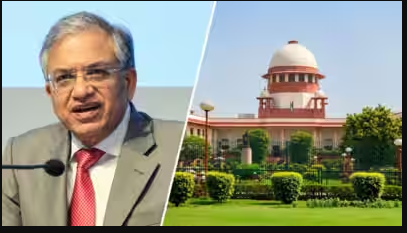

Manas Dasgupta
NEW DELHI, Oct 5: The Supreme Court on Monday refused to pass an order to restrain the Chief Election Commissioner (CEC) Gyanesh Kumar from functioning based on the newspaper reports but made it clear that it can reverse the decisions taken by the Election Commission of India if these were found to had been taken unilaterally and not unanimously or by majority.
A bench headed by Chief Justice Surya Kant and Justices Joymalya Bagchi and V Mohana took note of the submissions of senior advocate Vikas Singh and issued the notice and issued notice to the Election Commission, seeking their response on the allegations that Chief Election Commissioner took decisions unilaterally in the poll body, without consensus from the two other Election Commissioners.
The Public Interest Litigation (PIL), filed by Patna resident Rakesh Kumar Singh and others, urged the top court to determine whether the CEC Gyanesh Kumar has been individually exercising powers that legally belong to the Election Commission as a whole, and, if so, to declare those actions unauthorised and take appropriate legal action.
The bench said the decisions of the Election Commission have to be either unanimous or by majority and that it presumed that this is how all decisions were taken and it could not pass an order based on a newspaper report and would need a response from the Election Commission before deciding if Mr Gyanesh Kumar single-handedly exercised powers constitutionally designated for the entire multi-member poll panel.
“If it is found that the decisions were taken neither unanimously nor by a majority, they could be stayed,” the court said, adding it “cannot unilaterally conclude that all decisions were taken unilaterally,” cautioning it cannot put the cart before the horse.
The controversy follows a report in a section of the media saying Election Commissioners Sukhbir Singh Sandhu and Vivek Joshi formally raised objections on at least 14 occasions over 10 months over decisions on electoral rolls, voter registration, and the poll body’s technology systems.
The Election Commission, however, rejected the suggestion that the reported objections amounted to institutional dissent over final decisions. The poll panel said operational queries, inputs and suggestions raised during the draft stage were part of its standard administrative and decision-making process. It maintained that the decisions regarding the schedule of the SIR exercise were unanimous. The court said it required certified information on whether the decisions in question were taken unanimously or by a majority.
“You are relying on the newspaper report?” the court asked the petitioner. “The Election Commission has not denied the news report allegations,” the petitioner claimed. “Newspaper report may be 100% correct, partially correct or incorrect. We cannot pass an order on that basis today. We would definitely want their response. If we find there were instances where law wasn’t followed, we can undo it,” the court said. “After notice, if they come and show that ABC decisions were taken without unanimity, we will take those decisions back,” the court said.
The top court has sought the responses from the election commission and the election commissioners in a week on the plea challenging the manner in which the poll panel led by CEC Gyanesh Kumar took decisions allegedly without the approval of two Election Commissioners. In addition, the top court has also issued a notice to the Union Government.
Senior advocate Vikas Singh, appearing for the petitioners Shailendra Mani Tripathi, Rakesh Kumar Singh and Sudhakar Singh, argued that the Election Commission was a multi-member body and decisions must be taken either unanimously or by majority.
Singh sought an interim order suspending the CEC and urged the court to direct that decisions be taken unanimously, or at least by majority, while the matter remains pending. “The law regarding the appointment and powers of the Election Commissioners has now been amended. No case can be filed against the CEC or Election Commissioners for acts performed during their tenure. They have also been given the power to determine the procedure for conducting their business.
“I am arguing today only about how the Election Commissioners have been given protection that even the Prime Minister does not have. “My demand is that the CEC be suspended,” Singh said.
The court also declined to pass any immediate order, saying that 10 days would not make a significant difference and that if anything was found to have been done incorrectly, it could later be set aside. “Nothing significant will happen in 10 days. If something has been done incorrectly, we can always set it aside later.
Singh also sought directions to preserve the records related to the decisions under challenge, but the court did not pass any order on the request. The matter will be heard again next week.
Singh relied on the 1993 amendments to the election law to contend that, as far as possible, decisions of the Commission were required to be taken unanimously. He also referred to the Chief Election Commissioner and Other Election Commissioners Act, 2023, particularly Section 18, which provides for majority decision-making in case of a difference of opinion.
“There is a distinction. The unanimity relates to transaction of business and allocation of work, while functioning can be by majority,” Singh submitted. The bench, however, questioned him on what had changed from the 1993 legal position. Singh said the 2023 law had also introduced Section 16, which conferred a level of immunity on the CEC and election commissioners that was “unheard of” including protection extending beyond their tenure.
“A protection while in office is understood,” the bench observed. Singh, however, pressed for an interim order suspending Kumar, saying the credibility of the Election Commission was at stake. “We are facing a very grave situation. We have been known in the world for conducting free and fair elections but here the CEC’s working…” he said. When Singh pressed for immediate intervention, saying “the country will burn” without an interim order, the bench said it could annul a decision subsequently if it was found to be unlawful.