



Virendra Pandit
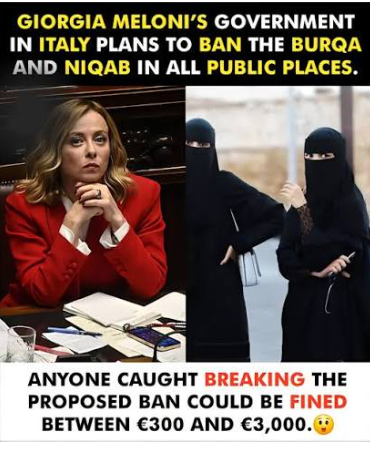
New Delhi: Italian Prime Minister Giorgia Meloni has proposed to ban burqas and niqabs in public places, including schools, the media reported on Monday.
Her announcement came on Sunday at an event organised by the youth wing of her Brothers of Italy party. The proposals will first go to her government for a decision and require parliamentary approval within 60 days to become law.
The government would also determine a maximum number of foreign students allowed in a class. Parents of foreign students experiencing serious difficulties integrating into the school system would be required to learn Italian.
PM Meloni said people who come to Italy and want to build their future there should learn the Italian language, understand Italian culture and respect the country’s rules.
“A measure will soon be presented to a Cabinet meeting to legally establish a maximum number of foreign students per class. It also requires parents of foreign students facing serious difficulties integrating into the school system to learn Italian and bans burqas and niqabs in schools,” she told an annual gathering of the youth wing of her party.
“If there is only one child in a class who doesn’t understand Italian, that child will likely be able to learn the language and integrate quickly with the help of classmates and teachers. However, if the number of children who don’t understand the language becomes large – or even the majority – that is no longer integration; it is neglect,” she added.
Meloni did not specify the maximum number of foreign students per class would likely have.
Foreign students
Foreign students number 11.6% of those enrolled in Italian schools — nearly 12 in every 100 students — according to Fondazione ISMU, a research institution.
Her announcement concerns schools and integration, rather than introducing a new work visa, student visa or residence-permit category.
The proposal specifically refers to burqas and niqabs, which are full-face coverings of Muslim women and girls. Italy does not currently have a specific nationwide law expressly banning burqas or niqabs.
A 1975 law prohibits the use of helmets or garments that make identification difficult without a justified reason. A 2008 ruling by Italy’s highest administrative court clarified that full-face coverings could be worn for religious or cultural reasons, provided the face is revealed when identity verification is required.
The new school proposal would therefore create a specific restriction in the education setting if it is approved and enacted.
Al Jazeera reported that Italy’s League party, which is part of PM Meloni’s governing coalition, has separately submitted legislation proposing broader restrictions on garments that make identification difficult. That is a separate legislative initiative from her school proposal.
She has also proposed a legal limit on the number of foreign students in each classroom.
However, Italy already has a 30% limit on foreign students in a class and school since 2010.
The challenges ahead
The proposals have already drawn questions from Italy’s education and legal communities. Salvatore Curreri, professor of constitutional law at the University of Enna, said that Article 34 of Italy’s Constitution makes schools open to everyone and described schools as an important tool for integrating children of foreign nationals. He cautioned that a measure could become excessive if it forced children and their families to move far from their existing communities.
Antonello Giannelli, president of Italy’s National Association of School Principals, highlighted the practical difficulty of imposing a numerical cap. If a school is located in an area where foreign students make up a large share of the local child population, schools cannot simply reject children living in the neighbourhood, he argued.