



Virendra Pandit
New Delhi: As Chinese President Xi Jinping’s three-day US visit began on Thursday, India and the US discussed “sanctions” that could be levelled against countries that engage economically with Russia and Iran, with Washington saying it remains well-positioned to help regional partners address their energy security challenges.
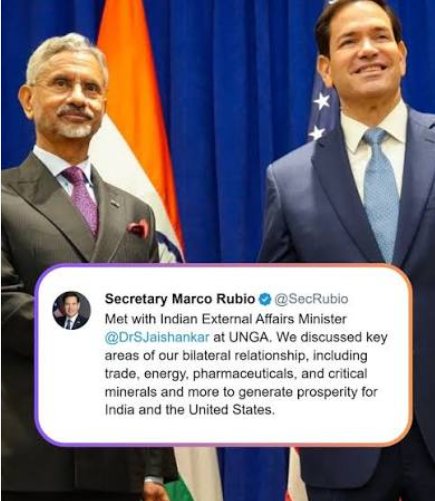
US Secretary of State Marco Rubio met with External Affairs Minister S Jaishankar in New York on Wednesday on the margins of the 81st session of the UN General Assembly, the media reported.
Rubio and Jaishankar “exchanged views on developments in the Middle East and beyond. The two also discussed sanctions that could be levelled against states that engage economically with Russia and Iran. The Secretary emphasized that the United States remains well-positioned to help regional partners address their energy security challenges,” a statement from the US State Department said.
Strategic partnership
The two diplomats reaffirmed the important role of the U.S.-India strategic partnership that continues to play in promoting a safe, secure, and prosperous Indo-Pacific.
In his meeting, Dr. Jaishankar reiterated India’s “interests and concerns” over the Russia sanctions act signed by President Donald Trump and also discussed the situations in the Gulf and Ukraine with the US.
“Good to meet @SecRubio of the US #UNHighLevelWeek,” Dr. Jaishankar said on X.
“Reiterated India’s interests and concerns with regard to SRIA. Also discussed the Gulf and Ukraine situations,” he said, referring to the Lindsey O’ Graham Sanctioning Russia and Iran Act of 2026.
Regional priorities
Earlier, Rubio said it was “great to meet” with Dr. Jaishankar in New York.
“Together, we are building on the U.S.-India strategic partnership and coordinating on key regional priorities and upcoming multilateral efforts,” Rubio said.
Last Friday, Trump signed the Lindsey O’ Graham Sanctioning Russia and Iran Act of 2026, which authorises and expands statutory sanctions, tariffs, and prohibitions on Russia and extends existing sanctions on Iran.
The law is named after the late Senator Lindsey Graham, who had proposed a sanctions bill imposing 500 per cent tariffs on countries for buying Russian oil.
Trump warns Russian oil buyers
In his address to world leaders at the United Nations on Tuesday, Trump said he signed the “powerful new law” that provides him with “enormous new tariff authorities” on major buyers of Russian oil, including India and China.
“If necessary, I will have to use them. It’s time to stop the killing,” Trump said in his address to the General Debate of the UN General Assembly on Tuesday.
India has said it remains firmly committed to ensuring energy security for its 1.4 billion people, and it will continue to do so through diversified sourcing.
Impact of sanctions on India
Rubio and Dr. Jaishankar discussed the potential implications of sanctions targeting Russia, a key energy supplier to New Delhi.
Under the new law signed last week, President Trump can impose tariffs on countries that purchase Russian crude. The move is designed to further curb Russian oil exports that help finance the Kremlin’s war in Ukraine, now in its fifth year.
Dr. Jaishankar “reiterated India’s interests and concerns with regard to SRIA,” according to a post on X after the meeting. Rubio meanwhile “emphasised that the United States remains well-positioned to help regional partners address their energy security challenges,” the State Department said in a statement.
India, the world’s third-biggest crude buyer, has relied on Russia for more than half of its imports in some months recently to help counter high prices and continued disruptions to Middle East supplies. Moscow has said it’s willing to supply India with as much oil as it needs.
While still Russia’s top buyer of seaborne crude, India’s refiners have started leaning on the US, Brazil, Canada, Venezuela and Africa for additional and more varied supplies.
But domestic anger in India is building over the sanctions law and threatens to throw up another hurdle to a broader trade agreement between New Delhi and Washington that remains in limbo.
Russia and India’s relations date back decades to the Cold War era, when the Soviet Union provided military backing and arms to the then-non-aligned New Delhi at a time when Washington was closely tied with neighbouring Pakistan.
That has made for some awkward moments over Ukraine following the Kremlin’s unprovoked attack on its neighbour, just as New Delhi tries to bolster ties with Western nations which power India’s overseas sales.
The US now accounts for roughly a fifth of India’s exports, making it by far New Delhi’s biggest market.
Dr. said he and Rubio “also discussed the Gulf and Ukraine situations.” The State Department said they “reaffirmed the important role the U.S.-India strategic partnership continues to play in promoting a safe, secure, and prosperous Indo-Pacific.”
Ties between the US and India had come under strain earlier in Trump’s current term over tariff tensions and the president’s claims that he helped mediate an end to fighting between India and Pakistan last year, an account New Delhi has repeatedly disputed.