




Virendra Pandit
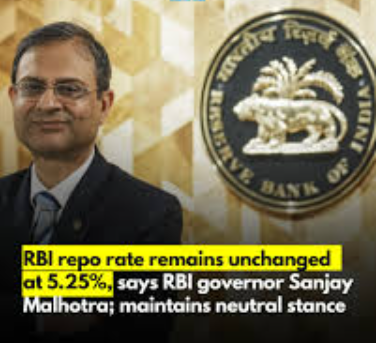
New Delhi: Reserve Bank of India (RBI) Governor Sanjay Malhotra on Friday announced the decision of the central bank’s Monetary Policy Committee (MPC), keeping the repo rate unchanged at 5.25%, as it adopted a cautious approach in view of the ongoing West Asian conflict posing challenges for inflation as well as economic growth.
It also raised the limit for investments by Non-Resident Indians (NRIs) and Overseas Citizens of India (OCIs) in equity instruments.
The six-member MPC’s three-day deliberations concluded on Friday.
Meanwhile, the RBI has lowered GDP growth projection to 6.6% from 6.9% earlier for the current fiscal (2026-27) and raised CPI inflation projection to 5.1% for FY27, higher from earlier estimate of 4.6%.
The central bank’s decision came in view of upside risks to inflation and downside risks to growth amid the West Asian conflict, which prompted the RBI’s rate setting panel to keep the policy repo rate on hold at 5.25%.
The RBI also announced measures to attract dollar inflows, including expanding the specified securities under the Fully Accessible Route (FAR) route, and incentivising PSUs to tap ECBs for a limited period.
Partial pass-through of energy prices and other input costs has increased risks to inflation and growth, the media reported.
Rising inflation could be a drag on purchasing power of households, he added. The monetary policy stance continues to be neutral.
The risks to inflation and growth stem from a spike in global fuel and commodity prices, supply chain disruptions, financial markets volatility, weather-related disruptions and a depreciating rupee.
The RBI, on its part, revised the retail inflation projection upward and GDP growth projection downward.
In its second meeting of FY27, the MPC left the repo rate, which was last cut in December 2025 from 5.5% to 5.25%, unchanged. With this, the MPC has been on hold in three meetings on the trot – February, April and June 2026.
Malhotra noted that the adverse implications of the extended disruption in supply chains and elevated energy prices are reflected in the moderation of growth and increase in inflation projections from the April policy.
“There are considerable risks to the MPC’s baseline assessment of inflation and growth due to the uncertainty about the duration and intensity of the conflict, magnitude of its spillover effects and the pace of restoration of supply chains,” he said.
Additionally, the food outlook remains uncertain on account of the subnormal south-west monsoon forecast and El Niño.
“Although risks of higher inflation have amplified, the MPC felt it would be prudent to wait for greater clarity to emerge. Accordingly, the MPC voted to keep the policy rate unchanged,” the Governor said.
“At the same time, the MPC will continue to remain data-dependent and closely monitor the developments, including supply side pressures getting embedded in the general price level and inflation expectations. The MPC also decided to retain the neutral stance,” he added.
NRIs/OCIs
The RBI also doubled the individual investment limits for Non-Resident Indians (NRIs) and Overseas Citizens of India (OCIs) in listed Indian companies from 5% to 10% and raised the aggregate ceiling from 10% to 24%. This change also extends to all individual Persons Resident Outside India (PROIs) without requiring SEBI registration.
Rupee rises/USD
The rupee appreciated 50 paise to 95.24 against the US dollar after the RBI liberalised norms for FPI investment in government securities.
Forex traders said the announcements in the RBI policy boosted investor sentiments after the central bank asserted that the country’s forex reserves provide sufficient buffer against external shocks.
At the interbank foreign exchange market, the rupee opened at 95.72, then touched 95.24 in intraday trade, registering a rise of 50 paise from its previous close.