




Virendra Pandit
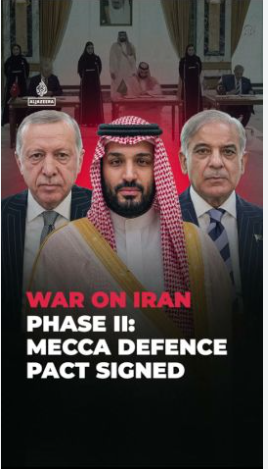
New Delhi: With the nearly six-month-long war against Iran making little headway despite wanton destruction across West Asia, and a dysfunctional ‘truce’ with Iran, US President Donald Trump is likely to ‘outsource’ the conflict to three Sunni nations—Saudi Arabia, Pakistan and Turkiye, the last one being a NATO member as well—who signed a tripartite defence deal in Mecca last week.
In June, Trump had signed an interim “Memorandum of Understanding” with Iran, which called for a halt to all military operations and set a 60-day deadline for an agreement to permanently end the war. The deadline ended on Monday, and the two sides are further apart than they were then, the media reported.
Soon after the inking of the Mecca Joint Defence Agreement on August 7—some call it the “Islamic NATO”—the US President welcomed the move and assured it of all help to restore peace in West Asia.
But the Mecca Pact has also exposed fault lines between Saudi Arabia and the UAE, on one hand, and the UAE and Pakistan, on the other. The resulting war of words has drawn India and Israel into the debate, with Saudi voices questioning the UAE’s defence ties with both non-Muslim powers.
Criticism
Prominent Emirati voices are questioning why Riyadh needed a new security partnership with powers outside the region when the Gulf Cooperation Council (GCC), a six-nation political, economic and security bloc, already exists. Saudi Arabian commentators have in turn questioned Abu Dhabi’s defence ties with India and security cooperation with Israel.
The GCC members are Saudi Arabia, the UAE, Qatar, Kuwait, Bahrain, and Oman. It was created in 1981 after the outbreak of the Iran-Iraq war to coordinate its members’ political, economic and security policies and has gradually developed mechanisms for joint military cooperation between member states.
Its members have a Joint Defence Agreement, under which an attack on any GCC state is considered an attack on all, with the bloc repeatedly stressing that the security of its members is “indivisible.” The GCC also has a Unified Military Command and mechanisms for coordinating defence policy and responding to regional threats.
It is against this backdrop that Dubai-based political analyst and former aide to UAE President Mohammed bin Zayed Al Nahyan, Abdulkhaleq Abdulla, questioned the logic of the Mecca pact. “So, who is the enemy of the countries of this alliance?” He did not say it was a group of Sunni countries.
He virtually rejected pan-Islamic or trilateral alliances in favour of pure national interest. “He whose sect is more important than his homeland, there is no safety for him… He whose nation, Arab or Islamic, is more important than his homeland, there is no safety for him,” Abdulla posted on X.
His criticism drew a sharp response from Saudi Prince Abdulrahman bin Musaid, who defended Riyadh’s right to pursue its own strategic interests and asked.
The Mecca deal
The fresh deal was signed in Mecca by Saudi Crown Prince and PM Mohammed bin Salman, Turkish President Recep Tayyip Erdogan, and Pakistan Prime Minister Shehbaz Sharif. Under the pact, an attack on one of these three countries will be treated as an attack on all three.
It brings together oil-rich Saudi Arabia, nuclear-armed Pakistan and Turkey, which has NATO’s second-largest military and a rapidly expanding defence industry. Its architects are trying to bring more countries into the fold, such as Egypt, Qatar, Kuwait, Jordan, Azerbaijan and Syria.
The “Islamic NATO” appears to have reopened tensions between Saudi Arabia and the UAE, two of the Gulf’s biggest economies and once iron brothers. While they remain allies on paper, Riyadh and Abu Dhabi have increasingly pursued divergent foreign-policy objectives, with Saudi Arabia drawing closer to Turkey and Pakistan, while the UAE has strengthened its security and strategic partnerships with Israel and India.
The Saudi-UAE faultline is stark in Yemen. Riyadh has backed the internationally-recognised government in Sana while Abu Dhabi has supported Yemen’s Southern Transitional Council (STC). On its part, Iran has its own proxy in the Houthis.
The Saudi response soon turned the criticism back on Abu Dhabi, with Saudi commentators pointing to the UAE’s own security partnerships outside the GCC, in particular those signed with India and Israel (a country which Riyadh has yet to recognise).
India does not have a joint defence treaty with the UAE, but the two countries have maintained formal defence cooperation since a 2003 MoU, expanding into joint exercises, defence exchanges and a Strategic Defence Partnership framework signed in January 2026, covering military technology, co-production, maritime security and counter-terrorism.
The exchanges marked a sharp escalation in the public dispute, with Saudi commentators effectively arguing that Abu Dhabi could not question Riyadh’s decision to pursue security partnerships outside the GCC while maintaining its own extensive defence and strategic ties with India and Israel.
The MoU with Iran
The MoU with Iran called for a halt to all military operations and set a 60-day deadline for an agreement to permanently end the war and resolve the longstanding dispute over Iran’s nuclear activities. It also called for the Strait of Hormuz to be reopened but gave Iran a vaguely defined role in facilitating traffic, leaving open the possibility it could charge fees after the 60-day deadline. Iran has seized on that clause to claim control over the waterway.
Only a week after the deal was signed, Iran began firing on vessels using a route along the coast of Oman, on the other side of the strait, that is overseen by the US military and intended to bypass Tehran’s control.
The US responded by striking Iran, which retaliated by attacking Arab countries hosting American forces, like Jordan, Kuwait and Bahrain. The US cancelled waivers issued as part of the deal that had allowed Iran to sell its oil internationally and Trump restored a blockade of Iran’s ports.
Each side accused the other of violating the June agreement, of which almost nothing remains.
The fighting eventually died down. A related truce in Lebanon between Israel and the Iran-backed Hezbollah has mostly held, even as Israeli troops occupy large areas in the country’s south. Lebanon’s “territorial integrity and sovereignty” were to have been ensured under the June deal.
Iranian officials say they stopped negotiating with the US in June, while acknowledging that messages have been relayed by intermediaries. Trump says the talks have continued, occasionally claiming progress after pulling back from threatening major strikes.
Pakistan, which played a key role in brokering the June agreement, noted last week that the deadline was Monday while expressing hope it would be extended.
Iran thinks it can force Trump to give up the strait. Earlier this month, Tehran issued a list of demands for reopening the strait, including the lifting of the American blockade, the withdrawal of US forces from around Iran and the payment of reparations for damage inflicted in the war started by the US and Israel on February 28, 2026.
Even then, Iran has said it would control the strait – and potentially charge fees – through an agreement it is negotiating with Oman, and that the strait will not go back to being an open, toll-free waterway as it was before the war.
But the Iran war has become Trump’s Achille’s heel. He would like to honourably exit from the Strait of Hormuz, and the Iran war, before the impending November midterm elections to US Congress. Iran knows this, and is pushing him to the wall.
The “Islamic NATO’ may, therefore, become his proxy in the ongoing war against Iran!