



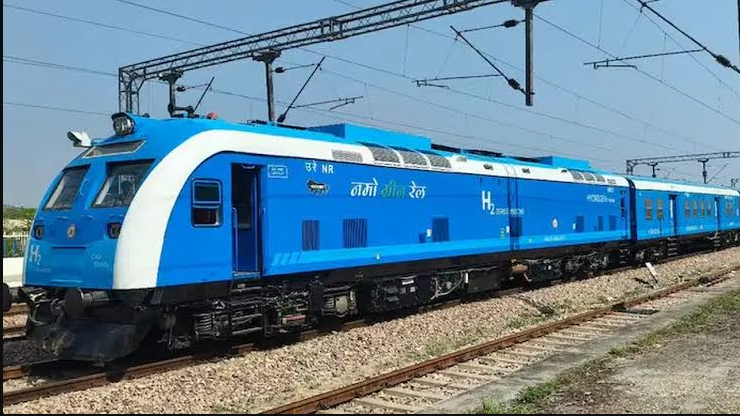

NEW DELHI, June 26: A trial run of a hydrogen train was completed between Delhi and Jind on Friday. Prior to this, a trial run had been conducted between Sonipat and Jind.
It marks the first time a hydrogen train trial has been conducted between Delhi and Sonipat and it focused on emergency braking distance and oscillation.
The trial run of the train was tested at a top speed of 120 kmph on the Jind-Sonipat section, marking a major milestone in Indian Railways’ efforts to introduce hydrogen-powered trains and reduce carbon emissions.
Visuals showed the hydrogen train departing from Jind as railway officials monitored its performance during the final phase of testing. The successful trial run of the train is seen as an important step before the train enters passenger service after completing the remaining regulatory and operational formalities.
The hydrogen train is equipped with several safety systems, including hydrogen leak detectors, flame detection equipment and continuous monitoring technology. These safety systems are designed to quickly identify and respond to any potential issues during operations.
This new train has been developed as part of Indian Railways’ broader strategy to reduce dependence on fossil fuels and promote cleaner transport.
In May this year, the Railway Ministry granted approval to start operations of the country’s first hydrogen-powered 10-coach DEMU train at a maximum speed of 75 kmph between Jind and Sonipat under the Northern Railway zone. The train will use hydrogen fuel cells to generate power instead of diesel or electricity-based traction.
Its total power output is 1,200 kilowatts and it will function on Distributed Power Rolling Stock (DPRS) technology, under which power is distributed across the train instead of being concentrated in a single locomotive.
The ministry’s approval followed technical sanction from the Research Designs and Standards Organisation (RDSO) and safety testing by the Commissioner of Railway Safety (CCRS). The sanction letter, addressed to the General Manager of Northern Railway, directs compliance with the Final Speed Certificate as well as other maintenance norms issued by the RDSO and all safety parameters prescribed by the CCRS.
Officials said the ministry’s approval does not mean the immediate start of operations, as several compliance processes and verification stages were yet to be completed. According to the letter, the General Manager of Northern Railway Zone must submit all compliance reports related to conditions laid down not only by RDSO and CCRS, but also by other statutory authorities such as the Petroleum and Explosives Safety Organisation (PESO) and an international safety certification and inspection organisation.
“PESO has granted a licence for filling and storage of Compressed Hydrogen Gas (CHG) in Hydrogen Storage System from Hydrogen Generation Unit for dispensing purpose as automotive fuel at Jind, Haryana. Compliance of all the conditions/ stipulations as mentioned therein shall be strictly ensured,” the ministry’s letter said.
“Various sensors (leak detectors, flame detectors, etc) provided on ground hydrogen production, storage and dispensing facility are prone to failure due to dust accumulation. Necessary schedule for regular clearing shall be ensured for failsafe operation,” it added.
(Manas Dasgupta)