



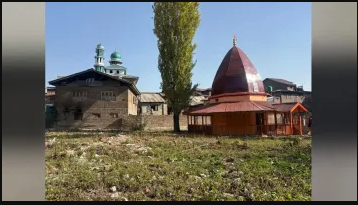

NEW DELHI, Oct 28: An ancient temple, believed to be more than 700 years old, in Srinagar’s Fateh Kadal area, which was once considered a hub of militancy, is being restored after decades of neglect.
The Shri Durgeshwari Temple in Bana Mohalla is regaining its former appearance as local residents, well-wishers and members of the Kashmiri Pandit community have joined hands to preserve the historic religious site. The restoration carries deep emotional and religious significance for Kashmiri Pandit families who have shared a centuries-old connection with Bana Mohalla and Fateh Kadal. The initiative is also an example of community participation in preserving Kashmir’s cultural and religious heritage.
The Shri Durgeshwari Temple is distinctive because it is clearly visible from all directions and is located near a mosque in a predominantly Muslim neighbourhood. Until the 1990s, the area was home to a sizeable Kashmiri Pandit community.
During those years, the sound of the azaan from the mosque blended with prayers and the sound of conch shells from the temple. The coexistence of these religious traditions reflected the atmosphere of harmony and brotherhood that once defined the neighbourhood.
After militancy began in the 1990s, the temple fell into ruins. The temple once housed large idols of Lord Ganesha and Goddess Durga, along with an ancient Shivling that remains at the site. After 36 years, members of the Kashmiri Pandit community have come together to restore the temple without government assistance. Their aim is to bring the structure back to its original architectural appearance.
Painting and lighting work has been completed, and CCTV cameras have also been installed. The temple has now regained much of the appearance it had before the 1990s. Once the restoration is complete, the idols of Lord Ganesha and Goddess Durga will be reinstalled.
The historic temple complex once housed a school called Durga Pathshala, where thousands of Hindu and Muslim children studied together until the 1990s. The primary school was attended by children from both the local Kashmiri Pandit and Muslim communities and was once regarded as one of the finest schools in Kashmir. Presently, however, only its outer walls remain, while the interior has been reduced to ruins. Its condition reflects the painful consequences of the exodus of Kashmiri Pandits, which also affected several ancient temples and schools across the Valley.
For Kashmiri Pandit families, the temple is much more than a place of worship. It connects them to their ancestral roots, traditions and memories of life in the neighbourhood. The restoration initiative began in September 2026 under the leadership of Shashi Tikkoo, who initially took up the temple repair work. Gradually, the effort grew into a collective community initiative, bringing together local residents and well-wishers to revive and protect the historic site.
Residents have welcomed the work, saying the place that had once become deserted is beginning to regain its old vibrancy. They hope the restoration will be completed soon. Artisans working on the temple have also expressed happiness at being part of the project. They said working on the temple feels as meaningful as working on their own mosque, bringing them immense satisfaction.
Local residents have expressed a heartfelt desire for Kashmiri Pandit families to return to the neighbourhood. Recalling the bonds they shared before the exodus, one resident said, “We tell them, you are our brothers, please come back. You are our sisters, please come back. Some of them even used to feed me milk. They were like mothers to me. They would seat me on their laps and carry me around. I remember all of it.
“We studied in the same school with Kashmiri Hindus and spent our childhood together. After they left, everything became deserted. It is a sight that truly breaks your heart. However, things have improved now, and we will welcome them wholeheartedly if they return,” the resident added.
Mr Shashi Tikkoo said a WhatsApp group was created to mobilise support and coordinate the restoration work. A water connection was arranged, while electrical work, lighting, cleaning, repairs and painting helped significantly improve the temple’s condition. Those involved in the initiative have thanked local residents and other well-wishers for their contributions and support. The work has been driven by community participation, with the aim of preserving the temple’s historic character and restoring it as a place of worship.
(Manas Dasgupta)