



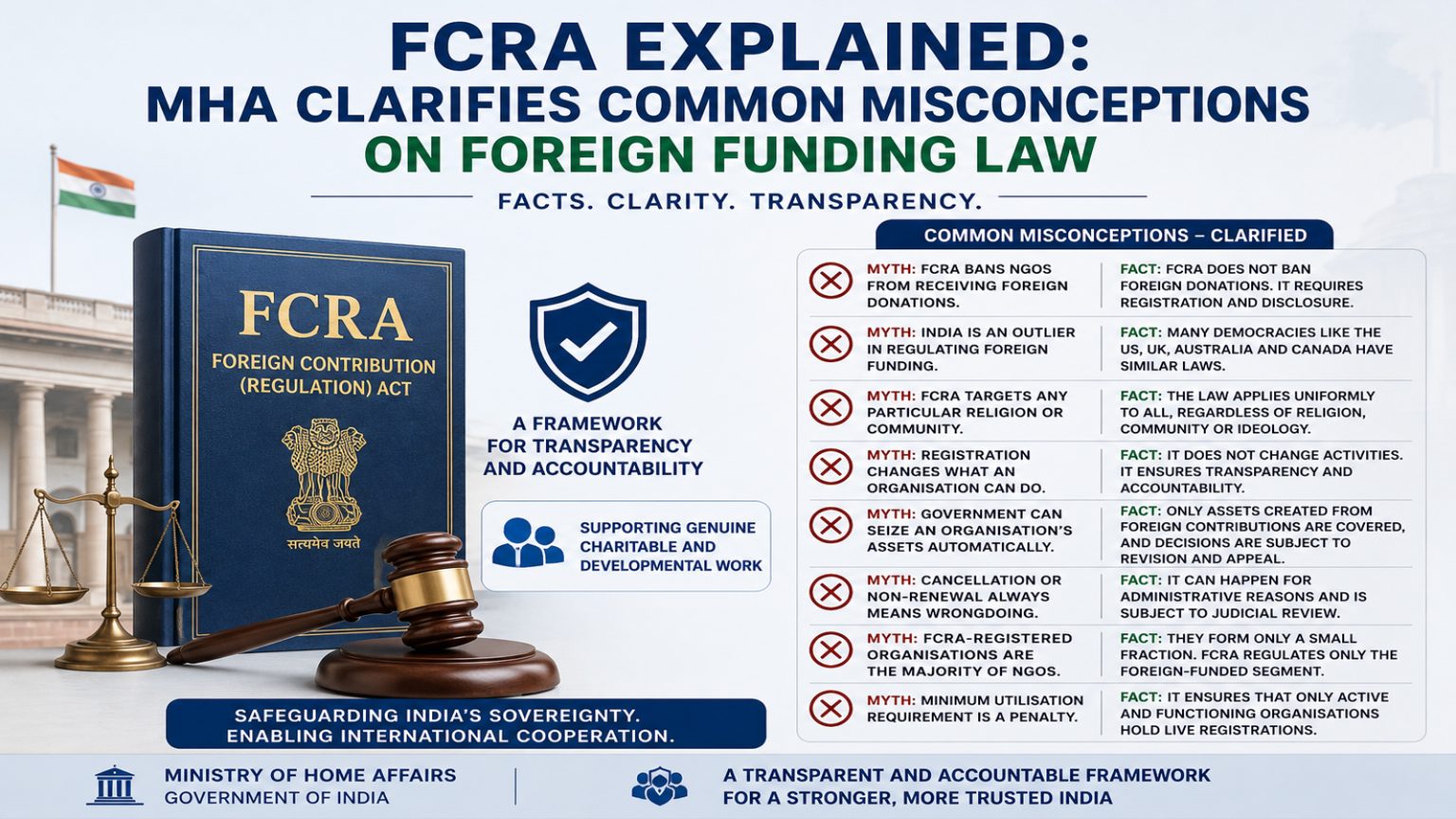

New Delhi: The Ministry of Home Affairs has sought to address several commonly held misconceptions about the Foreign Contribution (Regulation) Act (FCRA), stating that many concerns arise from incomplete understanding of the legislation rather than its actual provisions.
According to the Ministry, one of the most common misconceptions is that the FCRA bans NGOs from receiving foreign donations. It clarified that the law instead requires organisations to obtain registration or prior permission and comply with disclosure requirements. During 2024-25, approximately 16,200 registered associations received around ₹22,963 crore in foreign contributions, demonstrating that the framework regulates rather than prohibits foreign funding.
The Ministry also rejected the view that India is an outlier in regulating foreign funding, noting that comparable legal frameworks exist in countries such as the United States, Australia, the United Kingdom and Canada, while the European Union is developing a similar system.
Addressing concerns that the Act targets religious organisations or particular communities, the Ministry stated that the law applies uniformly irrespective of religion, community or ideology. Faith-based welfare activities, including maintenance of places of worship, religious education and charitable work by organisations of all faiths, remain eligible for foreign funding.
The Ministry further clarified that registration under the FCRA does not alter the activities an organisation is permitted to undertake. Instead, the framework requires transparency and disclosure regarding foreign contributions and their utilisation.
Another misconception addressed relates to the proposed 2026 amendments. The Ministry said the government would not automatically seize an organisation’s assets. Only assets created from foreign contributions come within the proposed vesting framework after lawful cessation of registration. Such vesting is initially provisional, with restoration if registration is renewed, while decisions remain subject to revision and judicial appeal.
The Ministry also clarified that cancellation or non-renewal of FCRA registration does not necessarily indicate wrongdoing. Many cases arise from administrative reasons such as failure to file annual returns, renew registrations or maintain designated accounts, and all such decisions remain subject to judicial review.
It also explained that FCRA-registered organisations constitute only a small fraction of India’s NGO sector and that the law regulates only the foreign-funded segment of civil society. Similarly, the minimum utilisation requirement introduced under the 2026 amendments is intended to ensure that only active and functioning organisations continue to hold live FCRA registrations.
The Ministry concluded that the FCRA is intended to provide a transparent and accountable framework for foreign contributions while protecting India’s constitutional institutions and enabling genuine developmental partnerships.
(DD News)