



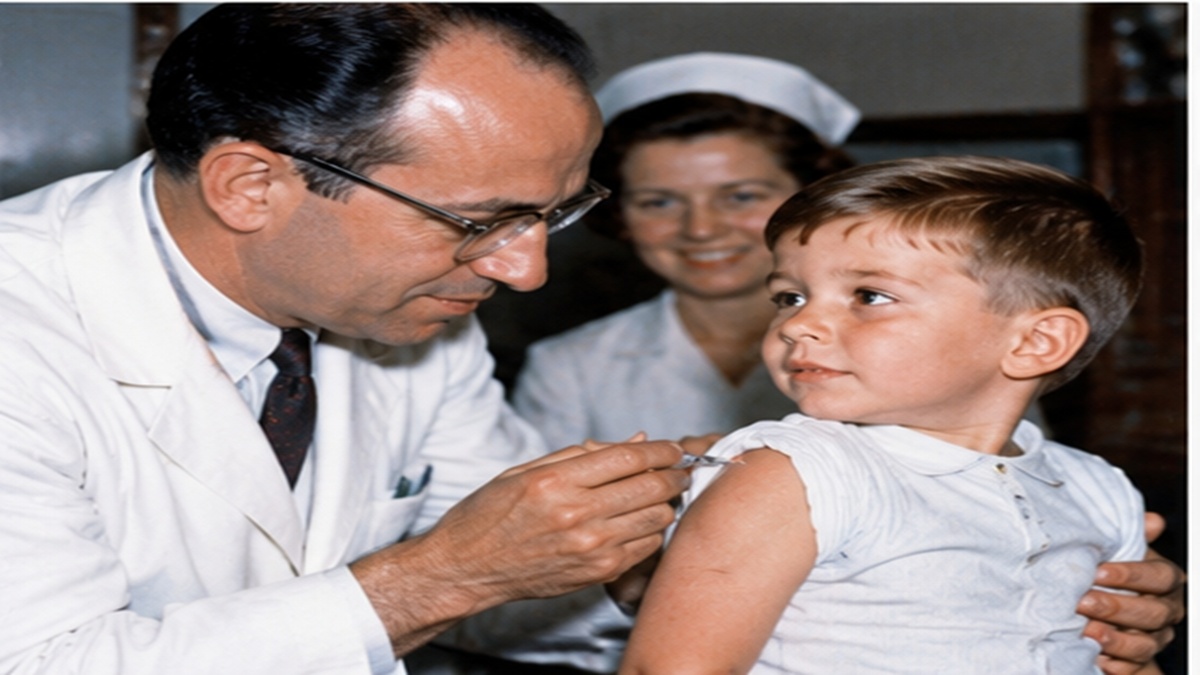

United States: In the mid-twentieth century, polio remained a serious health challenge for many countries of the world. This infectious disease particularly affected children. This in many cases led to permanent paralysis of the hands and feet and endangered life if the breathing muscles were affected. It was at such a time that American physician and scientist Dr. Jonas Salk developed an effective vaccine to prevent polio with his knowledge, diligence and scientific approach. On April 12, 1955, the results of his vaccine test were announced. The vaccine was found to be safe and effective, giving new momentum to the global fight against polio. Salk’s contributions were not limited to medical science alone. He stressed on linking his discovery to the larger public interest. His life exemplifies that the real success of scientific research lies in securing human life and the welfare of society. His work is an inspiring example of struggle, determination and dedication to humanity.
Birth, Family, and Education
Jonas Edward Salk was born on October 28, 1914 in New York City, USA. His parents Daniel and Dora Salk were Russian-Jewish immigrants. Despite the economic condition being normal, his parents considered education as an important means of progress. Salk, the eldest of three brothers, became the first member of his family to receive a college education. He attended Townsend Harris High School in New York and earned a bachelor’s degree in chemistry from the City College of New York. After this, he completed his medical studies at New York University School of Medicine and received a medical degree in 1939. It was during his studies that his interest developed in the treatment of diseases, as well as in understanding their causes and preventive measures. He went on to work at Mount Sinai Hospital and furthered his interest in the study of infectious diseases through medical research.
Beginning of scientific research
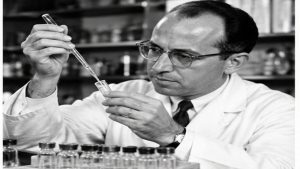
Physician and scientist Thomas Francis Jr. played an important role in shaping Salk’s scientific life. In 1942, Salk joined research at the University of Michigan and worked on the influenza (flu) vaccine. During this time, he understood the virus, the body’s immune system and the process of developing a vaccine. At the same time, he recognized that the efficacy of a vaccine is determined by experiments and scientific evidence and it is also necessary to be safe. This experience proved useful in the development of the polio vaccine in the long run. In 1947, he was appointed director of the Virus Research Laboratory of the School of Medicine of the University of Pittsburgh. Here he started work on the polio vaccine. For this research, he received financial support from the National Foundation for Infantile Paralysis, which later became famous as the March of Dimes.
The Challenge of Polio and the Need to Prevent It
Poliomyelitis is a contagious viral disease that primarily affects children, although adults can also be affected by it. Many infected people do not show symptoms, but in some cases the virus can cause muscle weakness or permanent paralysis by damaging the nervous system. In severe cases, the breathing muscles are affected, requiring special medical attention. In the mid-twentieth century, especially in the US, the polio outbreak caused widespread concern. Many children had to stay in the hospital for a long time, while critical patients had to resort to an ‘iron lung’ machine to help them breathe. Families were insecure due to the lack of effective vaccines. At that time, scientists were researching different methods of rescue. Some were engaged in making a vaccine from a live, but weakened virus, while Salk chose to develop a vaccine based on an inactivated virus. He believed that the inactivated virus could prompt the body’s immune system to recognize the virus and develop protection against it without causing disease.
Attempts to develop a vaccine from inactivated viruses
Jonas Salk and his team developed the vaccine taking into account three major strains of the poliovirus. For this, the virus was inactivated with the help of formaldehyde, so that its ability to cause disease was eliminated, but the body’s immune system could recognize it and react. The scientists were challenged to prove that the vaccine made from the inactivated virus is safe for large scale use with adequate protection. Salk furthered the research through tests in the laboratory. This achievement also contributed to his team, previous virus research, collaborators, scientific institutions and financial support. This discovery demonstrates that individual leadership along with collective effort and earlier research also play a crucial role in scientific progress.
Initial Testing and Scientific Caution
Jonas Salk was serious about the safety and effectiveness of the new vaccine. During the initial trials, he tested the vaccine on himself, his wife and a few volunteers, including children. These trials found evidence of an immune response against the poliovirus, which was an encouraging sign for further research. However, trials conducted on a limited number of people could not declare the vaccine safe and effective for the entire population. This required extensive and systematic testing. Salk and his colleagues prepared for a large-scale test for this purpose. His working style was based on experimentation, observation and scientific evidence. This process demonstrates that it is imperative to gather evidence of effectiveness and assess the potential risks before using a new drug or vaccine.
The Historical Test of the Year 1954 and the Declaration of 1955

In 1954, extensive trials of Jonas Salk’s polio vaccine began, with about 1.8 million children from the US, Canada and Finland participating. Other groups were also included in the trial for comparison with children who received the vaccine. The children who participated in this campaign were called ‘Polio Pioneers’. Doctors, health workers, teachers, parents and volunteers contributed significantly. For such a large trial, the health of the children was monitored, data collection, and the results were carefully analyzed. The campaign highlighted the importance of collaboration between scientists and the public in public health. On April 12, 1955, University of Michigan scientist Thomas Francis Jr. announced the results of the test. Salk’s vaccine was found to be safe and effective and was approved for use in the US on the same day. This announcement gave new hope to prevent polio and gave a huge impetus to the vaccination campaign.
Vaccine Effectiveness and Contribution to Polio Control
The widespread use of Jonas Salk’s vaccine led to a significant decline in polio cases in the US. According to the historical account of the Salk Institute, before vaccination, more than 45 thousand cases were reported in the country every year, which decreased to 910 by 1962. This change reflects the impact of vaccination. Salk’s vaccine was given by injection, while later scientist Albert Sabin developed an oral vaccine based on a live, but weakened virus, which could be given in the form of drops. Both vaccines played an important role in polio control. Scientists, governments, health workers and international organizations contributed to the global campaign against polio through routine immunization and surveillance. The disease was found to be under control in large parts of the world, although the risk remained in some areas. Therefore, vaccination and eradication efforts are still necessary today. India was certified polio-free in 2014 with the World Health Organization’s South-East Asia Region. This achievement was a result of widespread vaccination, hard work of healthcare workers, and community participation. This was contributed by various public health measures, including oral and inactivated polio vaccines.
पेटेंट का प्रश्न और मानवता के प्रति दृष्टिकोण
जोनास साल्क ने अपने पोलियो टीके का पेटेंट नहीं कराया और उसके व्यापक जनहित में उपयोग को प्राथमिकता दी। पत्रकार एडवर्ड आर. मरो के साथ साक्षात्कार में पेटेंट संबंधी प्रश्न पर उनसे जुड़ा प्रसिद्ध कथन सामने आया “क्या आप सूरज का पेटेंट करा सकते हैं?” यह विचार विज्ञान को मानव कल्याण से जोड़ता है। जीवन बचाने वाली खोजों का लाभ अधिकाधिक लोगों तक पहुंचना महत्वपूर्ण है। हालांकि, टीके की व्यापक उपलब्धता के लिए सुरक्षित उत्पादन, गुणवत्ता नियंत्रण, वितरण और प्रभावी टीकाकरण व्यवस्था भी आवश्यक हैं। साल्क के शोध ने पोलियो के खिलाफ वैश्विक अभियान को मजबूत आधार दिया और सार्वजनिक स्वास्थ्य के क्षेत्र में वैज्ञानिक उपलब्धियों की भूमिका को रेखांकित किया।
साल्क इंस्टीट्यूट और बाद के शोध
Even after the success of the polio vaccine, Jonas Salk continued research. With the aim of understanding the processes of life in depth, he worked towards the establishment of the Salk Institute for Biological Studies in La Jolla, California. The institute started in 1963 and became an important centre of biological and biomedical research. Salk considered basic research to be the basis for future discoveries. In the last years of his life, he also researched potential HIV/AIDS vaccines and immunological measures. While there was no success in developing an effective preventive vaccine, their effort shows a continued commitment to scientific challenges.
End Times and Scientific Legacy
Jonas Salk died on June 23, 1995 in La Jolla, California, at the age of 80. His role in developing an effective polio vaccine was historic. He gave a new direction to science by setting up research institutes and giving priority to human welfare. His life teaches that scientific success requires talent, patience, hard work and honesty to test, production, distribution and public participation.
Dedication to science, research, and human welfare
The life of Jonas Salk is an inspiring example of scientific curiosity, constant effort, and human service. He made a historic contribution in developing an effective polio vaccine, bringing relief to children and families who had been living in fear of the disease for decades. Their discovery accelerated polio control efforts and reinforced the importance of vaccination. Salk’s achievement demonstrates that scientific success is made possible by years of study, rigorous experiments, collaboration, and verification of evidence. He gave the message of public interest by linking science with human welfare. His life continues to inspire research, collaboration, and addressing health challenges based on scientific evidence.
[DD News]