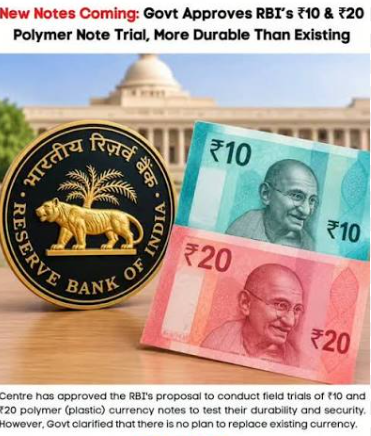
Banknotes: Govt approves introduction of polymer notes of Rs. 10, Rs. 20 for field trials




Virendra Pandit
New Delhi: The Government of India has approved the introduction of one billion pieces of polymer banknotes of Rs.10 and Rs. 20 for field trials, Parliament was informed on Tuesday.
However, the government clarified that it has no plans to replace the existing currency notes.
The RBI, with the recommendation of its central board, had sent a proposal to the government in terms of Section 25 of the Reserve Bank of India Act, 1934, for introduction of one billion pieces each of Rs. 10 and Rs. 20 polymer banknotes for field trials and also for regular issuance of polymer banknotes in these two denominations after successful completion of field trials, Finance Minister Nirmala Sitharaman said in a written reply to the Rajya Sabha, the media reported.
“The proposal has been approved by the government. As per the RBI, these polymer banknotes are proposed to be issued along with paper substrate-based banknotes,” she said.
The RBI has informed that the procurement process is presently at an initial stage, she said.
Therefore, she said, at this point of time, it would not be possible to practicably determine the exact timeframe for introduction of polymer banknotes or the expenditure likely to be incurred thereon.
Replying to another question, Sitharaman said the average retail inflation, measured by the Consumer Price Index (CPI), has declined steadily from 5.4 per cent in 2023-24 to 4.6 per cent in 2024-25 and further to 2.1 per cent in 2025-26.
Owing to the commodity price shock and elevated global energy prices stemming from the West Asia crisis, a seasonal pickup in vegetable prices, and the expected unfavourable El Nino conditions, retail inflation rose to 3.9 per cent in Q1 of 2026-27, she said.
However, she said, it is still below the central bank’s inflation target of 4 per cent.
“The 56th meeting of the Goods and Services Tax (GST) Council has brought in a two-rate structure with a standard rate of 18 per cent, a merit rate of 5 per cent and a special de-merit rate of 40 per cent for a select few goods and services (but inclusive of earlier compensation cess rate, and hence with no increase in overall tax burden),” she said.
This resulted in rationalisation of rates on many goods and services from 28 per cent to 18 per cent, 18 per cent to 12 or 5 per cent, and from 12 per cent to 5 per cent/nil.
In addition, she said, with a view to reduce input costs, boosting domestic manufacturing, promoting export competitiveness and supporting strategic sectors, the government announced in Union Budget 2026-27, rationalisation of Basic Customs Duty (BCD) on a host of goods with effect from February 2, 2026.
Additional measures to contain price pressures in essential commodities include a reduction in BCD on crude palm oil, crude soybean oil, and crude sunflower oil; a reduction in the agriculture infrastructure and development cess on masur; and a reduction in central excise duty on petrol and diesel by Rs.10 per litre in March 2026, she said.
In addition to the reforms in indirect taxes, the government has increased individuals’ disposable income by exempting annual incomes up to Rs. 12 lakh (Rs.12.75 lakh for salaried individuals, after the standard deduction) from income tax.
These measures have supported household consumption, as evidenced by the share of private final consumption expenditure in GDP remaining broadly stable at 56.5-56.7 per cent (base year 2022-23), she said.
Moreover, as per the latest GDP estimates released by the Ministry of Statistics and Programme Implementation, per capita Private Final Consumption Expenditure (PFCE) recorded a robust growth of 6.8 per cent in 2025-26, up from 4.8 per cent in 2023-24.
Nevertheless, Sitharaman said, the government continuously monitors the price situation in the country and undertakes fiscal, administrative and supply-side measures, as warranted by evolving economic conditions, to protect the purchasing power of households, particularly low- and middle-income households.