




Manas Dasgupta
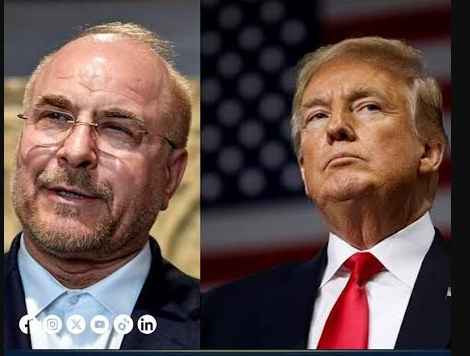
NEW DELHI, Nov 15: Iran’s top negotiator Mohammad Bagher Ghalibaf, who is also the speaker of the Iranian Parliament, on Sunday cautioned the United States that if it made “one more mistake” of new strikes, the Iranian armed forces would determine the geography of the battlefield and not the US “wishes or intensions.”
Amidst the US President Donald Trump alternating between threats of escalating the war with a fresh attack and winding down hostilities, Ghalibaf also said Iran would not remain in a state of “neither war nor peace,” warning the US against new strikes.
“We do not care whether the US chooses the path of negotiations or war. If it accepts our seven reasonable conditions, the door to an agreement will be open,” he told an open session of the Parliament on Sunday. If the US makes another mistake, Iran’s powerful Armed Forces will determine the geography of the battlefield, not their wishes or intentions. The smoke of a new war will affect many others,” he said.
In his opening remarks, Ghalibaf said a new missile city was unveiled while the conflict continued with the US. He said this signifies a shift in the region’s strategic equations. He also hailed Iran’s aerospace force, saying it has deprived the “Zionist regime of sleep,” referring to Israel.
Ghalibaf also targeted the US Treasury Secretary Scott Bessent over his recent remarks, saying his “unethical language” has shown the desperation that the US is facing. However, Ghalibaf underlined that Iran continues to face inflation, unemployment and price fluctuations.
“Fully protecting the livelihoods of people who have resisted one of the greatest wars in history for more than eight months is the minimum and most fundamental duty of all of us as officials,” he stressed. “If inflation sometimes makes an increase in the price of a product unavoidable, the existence of multiple prices for the same product has nothing to do with inflation and is the result of inadequate market supervision,” he added.
The war in the West Asia began on February 28 when the US and Israel launched joint strikes on Iran, killing the country’s supreme leader, Ali Khamenei, along with senior military commanders. In response, Tehran struck American bases in the West Asia and shut the Strait of Hormuz, the world’s most vital energy conduit, which sent the oil prices across the world skyrocketing.
On June 17, Trump and his Iranian counterpart, Masoud Pezeshkian, signed a 14-point deal to end the war. The agreement provided for an immediate cessation of military operations, including in Lebanon, and committed both countries to pursuing a final agreement within 60 days.
Trump, however, on July 8, said the deal was “over”, and Tehran also suspended the memorandum of understanding a week later, accusing Washington of “violating all its commitments.” Since then, Trump has reiterated that he’s in no rush to reach a deal.
Trump has told senior advisers in recent days that he may hold off on attacking Iran if the US faces no new provocations from Tehran or the Iran-backed Houthis in Yemen, media report said on Saturday. In phone calls over the past two weeks, he asked for opinions from Saudi Crown Prince Mohammed bin Salman and Turkish President Tayyip Erdogan, who both urged him not to resume attacks on Iran.
Trump told bin Salman on October 31 that he was planning to attack after the US midterm elections, but the crown prince pleaded for him to hold off, arguing that economic sanctions against Tehran were working. The US military is also ready to escalate if needed, sources said.
A third aircraft carrier is moving into the West Asia in the coming days to replace one of the two currently operating in the region. Trump could also opt to bomb Iran’s underground nuclear facilities, but the US has already struck those facilities, and it is unclear whether further strikes would be successful.