




Virendra Pandit
New Delhi: Amid controversies, Tata Trusts Chairman Noel Tata on Saturday expressed concern that a proposed public listing of Tata Sons could fundamentally alter the group’s traditional business philosophy, warning that a wider shareholder base may eventually place profits ahead of philanthropy, the media reported.
“My worry is that listing, which is what some people are proposing, will change the Tata way. And one day, if we have 30,000-40,000 shareholders, profit may take precedence over philanthropy. And I think that will fundamentally change the Tata way of working,” he said at the HT Leadership Summit 2026.
Noel said Tata Trusts would work with regulators and other stakeholders to find a solution that preserves the group’s founding ethos.
“Tata Trusts will play a constructive role with regulators and others to try and find a solution which keeps the Tata way the way it is,” he said.
The remarks come against the backdrop of an intensifying tussle between Tata Trusts and the Tata Sons board over the holding company’s ownership structure and leadership.
Tata Trusts, which controls about 66 per cent of Tata Sons – the holding company of the USD 165 billion Tata Group – has opposed a public listing, while the Shapoorji Pallonji Group, its second-largest shareholder with an 18.37 per cent stake, has backed a stock market float to unlock value from its investment.
The dispute gained momentum after the Reserve Bank of India (RBI) rejected Tata Sons’ September 2026 application to surrender its registration as a core investment company, effectively closing a route the group had pursued to avoid mandatory listing as an upper-layer non-banking financial company.
At a September 17 board meeting, Tata Sons decided to initiate steps towards listing in line with RBI regulations and approved a fresh five-year term for Chairman N. Chandrasekaran, reversing his August decision not to seek reappointment after February 2027.
Noel Tata opposed both decisions, with the Trusts subsequently questioning the legality of Chandrasekaran’s reappointment. The board approved his reappointment by a 4:1 vote.
Emphasising continuity in the group’s philosophy, Noel on Saturday said its ownership structure and institutional character had helped preserve its values across generations.
“The owner cannot die, the owner cannot be bought and the owner cannot retire. There is continuity in what happens the Tata way,” he said.
The group has historically combined commercial operations with philanthropy and nation-building, with Tata Trusts playing a central role in its institutional framework.
On the group’s strategic direction, Noel said there was no question about its broad objectives, but greater discipline was needed in executing large projects and allocating capital.
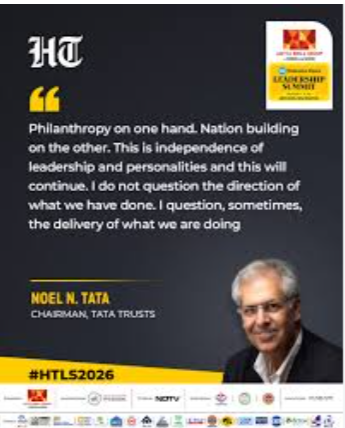
“Philanthropy on one hand. Nation building on the other. This is independence of leadership and personalities and this will continue. I do not question the direction of what we have done. I question, sometimes, the delivery of what we are doing,” he said.
“The question is, do we have the discipline when we execute projects, and not the direction? How will projects with a long gestation period succeed if we don’t have discipline? And how will we allocate capital to those projects?” he said.
“So, very clearly, the direction is fine, but we also need discipline in the execution of these very large projects,” he added.
Highlighting the group’s role in India’s industrial development, Noel said Tata companies were participating in emerging sectors such as semiconductors and electric vehicle batteries.
“We are partners in India’s development,” he said, adding that the group was undertaking its first semiconductor project and setting up its first EV battery plant.
Noel also spoke about the growth of Tata’s retail business, particularly Trent, which operates the Westside and Zudio brands.
He said Zudio was launched in 2016 to cater to consumers at the bottom of the economic pyramid by offering aspirational products at affordable prices.
“It was not that this aspiration for better product was only in the top metros or with the wealthy. The aspiration went down all the way. So, we said, how can we address in a way the bottom of the pyramid? So, in 2016, we launched Zudio to address this bottom of the pyramid with an aspirational product,” he said.
The format started with air-conditioned stores of around 6,000 square feet, with prices beginning at Rs. 199, he said, adding that the starting price point had remained unchanged over the past decade.
On Westside, Noel said the decision to adopt a private-label model gave the company control over the entire value chain, from fabric and product design to retailing.
He said Westside, which began with doubts over whether such a retail format could succeed in India, now operated around 320 stores and was looking at expanding to more than 500.
Attributing the growth partly to rising consumption, he said demand had increased across socio-economic categories and markets over the past decade.
Noel also said the opportunity to address the needs of underserved sections of society had made a deep impression on him after taking over as chairman of Tata Trusts, adding that the experience had given him greater humility about the scale of social challenges in India.
Tata Trusts vice-chairman Venu Srinivasan and other trustees, backing a stock market listing of Tata Sons, are understood to favour greater transparency, stronger corporate governance and a clearer ownership structure for India’s largest business conglomerate.
They argue that listing would subject the holding company to greater public and regulatory scrutiny, institutionalise decision-making and reduce uncertainty over succession and governance in a group whose businesses span multiple sectors. A public listing could also provide a market-determined valuation of Tata Sons and give investors greater visibility into the financial and strategic decisions of the group.
In a November 11 letter to fellow trustee Darius Khambata, Srinivasan and fellow vice-chairman Vijay Singh cited examples such as Novo Nordisk, Hershey, Lundbeck and Demant to argue that companies can remain anchored by charitable foundations while being publicly traded.
They also pointed to listed Tata companies, including TCS, Tata Steel, Tata Power and Tata Motors, which have undertaken long-gestation investments and nation-building projects without compromising their institutional character.
The Trusts would continue to retain their shareholding in Tata Sons and receive dividends to fund philanthropic activities, they argued, adding that greater disclosure would bring discipline rather than constrain the group’s long-term ambitions.