




Virendra Pandit
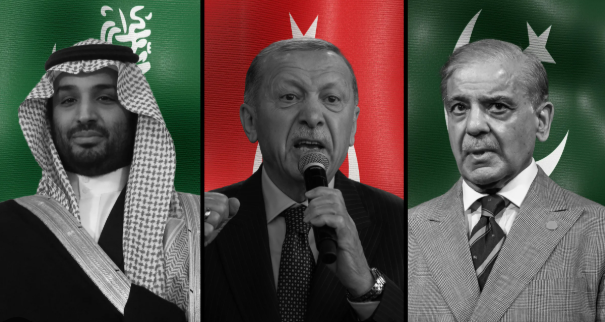
New Delhi: Amid mounting Houthi attacks across its territory, Saudi Arabia and its two Sunni partners—Pakistan and Turkiye—have decided to ‘activate’ their tripartite Mecca Pact and deploy rapid force in the Kingdom, the House of Islam, the media reported on Tuesday.
As the ongoing two-front conflict flared up following the US-Iran war in its north and the Houthi attacks in the south, Saudi Arabia had signed the tripartite Makkah Joint Defence Agreement (Mecca Pact) on August 7, 2007. Some Islamists had hoped and even invited other countries to join this “Muslim NATO.”
Modelled like NATO’s collective security approach, the deal declared that an armed attack against any one of the three signatory member states will be considered an attack against all of them. The Mecca Pact was essentially an expansion of a similar bipartite pact, signed in September 2025, between Saudi Arabia and Pakistan, now including Turkiye as well.
According to reports on Tuesday, as the Iran-supported Houthis intensified attacks, the three nations have officially ‘activated’ the pact’s collective deterrence measures and rapid military deployment plans following an emergency committee meeting.
The Strategic Political and Defence Committee (SPDC) of the trilateral alliance held an emergency meeting in Riyadh on Monday to address the security developments and threats facing Saudi Arabia, Dawn reported, quoting Pakistan’s Foreign Office (FO).
The Mecca Pact establishes a framework for collective deterrence.
“The committee decided to move immediately to the practical implementation of the collective defence commitments and to take the necessary measures to provide the agreed military forces and capabilities and ensure their rapid deployment in the kingdom,” Dawn reported quoting the Joint Statement issued after the meeting.
The statement did not give any details or schedule of troop deployment, nor did it specifically name the Houthis as a threat.
Pakistan’s Deputy Prime Minister Ishaq Dar, Defence Minister Khawaja Asif, and Chief of Army Staff Field Marshal Asim Munir attended the meeting from Pakistan’s side.
Khawaja Asif, in a telephone interview to Geo News, said that Pakistan and Turkiye had a “presence in theatre,” but only Saudi troops were involved in combat operations—apparently fearing reprisals from the Houthis against Islamabad.
“Whatever assistance they require is being provided. But right now, the Turkish and Pakistani armies are playing a supportive role,” he said, noting that Pakistan was involved in reconnaissance.
The three partners also condemned the attempted targeting of the holy cities of Mecca and Madina, as well as the continuing attacks targeting cities and civilian and economic facilities in Saudi Arabia, the statement said.
The FO said Pakistan and Turkiye commended the Saudi armed forces for their vigilance, readiness and professionalism in countering threats and attacks and safeguarding the kingdom’s security and territorial integrity.
The SPDC meeting was held as Yemen’s Saudi-led coalition government launched a major military campaign on Sunday to recapture territory held by the Houthis, the report said.
Thereafter, they agreed to activate “deterrence measures” under a mutual defence pact and rapidly deploy forces to the Gulf kingdom to counter attacks by Yemen’s Houthis.
The decision was announced on Monday after the three countries’ defence and foreign ministers held an emergency meeting in Riyadh. It marked the first time the alliance has been invoked since it was signed two months ago.
The agreement declares that an attack on any of the three nations will be treated as an attack on all, mirroring a central provision of NATO’s founding treaty.
“The committee agreed to activate collective deterrence measures, within the framework of the Alliance, in response to the attacks and all those responsible for them,” Khalid bin Salman, Saudi Arabia’s defence minister, said in a social media post.
He said the alliance had “reaffirmed the solidarity and unity of our countries, in confronting the heinous attacks against the Kingdom, and holy sites”.
‘Deterrence through credibility’
A separate joint statement published by Pakistan’s Foreign Ministry said the three countries would “provide the agreed military forces and capabilities and ensure their rapid deployment” to Saudi Arabia.
The commitments, the joint statement said, would be carried out under “approved arrangements” and in accordance with each country’s laws.
The announcements came hours after forces aligned with Yemen’s internationally recognised government launched a counter-offensive to retake territory the Houthis captured last month. The Yemeni forces, who are backed by Saudi Arabia, said they have retaken the port city of Mocha on the Red Sea and are now in control of the strategic Bab al-Mandeb strait.
The Saudi-led coalition has confirmed its participation in the Yemeni government offensive, saying 100 of its fighter jets are providing air support.
The Houthis, meanwhile, claimed an attack on the King Khalid International airport in Riyadh and the Aramco refinery in coastal Rabigh.
The group also said it hit a series of sites, including an airport, an airbase and other critical locations.
There was no confirmation from Riyadh on the Houthi claim.
The Mecca Pact
The Mecca Defence Alliance emerged as a response to intensifying conflicts in the region, triggered by the United States and Israel’s war on Iran since February 2026.
The defence pact was signed in August 2026, shortly before the Houthis launched their offensive in Yemen, which has included attacks against Saudi targets.
The three members of the alliance combined have nearly 1.4 million active troops, about 3,400 military aircraft, 6,000 tanks and more than 340 naval assets, according to the 2026 Global Firepower Index.
The agreement initially offered few details about each country’s military obligations, though steps to formalise the alliance followed.
After the Houthis fired a barrage of missiles towards Saudi Arabia in early September, Khawaja Asif said an attack on the kingdom could set the pact in motion.
“If there is unprovoked aggression, or a spillover of whatever is happening in Yemen into Saudi Arabia, definitely the Mecca agreement will become operational,” he told Geo News.
Until Monday, however, the alliance had taken no action. Analysts had said that Pakistan and Turkiye were reluctant to abandon their roles as mediators in the US-Israel war on Iran.