




Manas Dasgupta
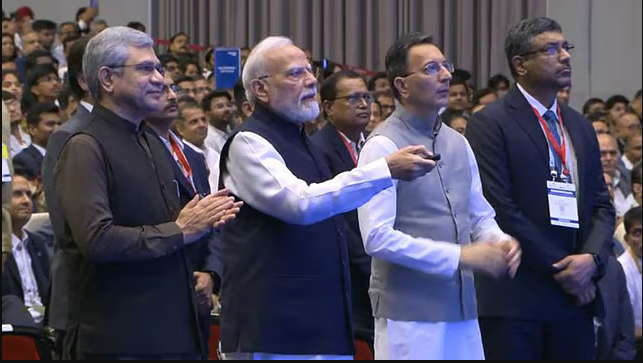
NEW DELHI, Sept 17: Prime Minister Narendra Modi on Thursday inaugurated the fifth edition of SEMICON India 2026 at Yashobhoomi Convention Centre in New Delhi, marking the start of a three-day national convention on the country’s semiconductor and electronics ecosystem.
Addressing the event, Mr Modi said India’s chips were now reaching customers, and the country was taking steps to become a preferred destination for semiconductor manufacturing. He also said India should aspire to be among the early leaders in emerging technologies and asserted that the government was committed to a predictable and responsive policy environment.
“India Semiconductor Mission 2.0 expanded outlay to USD 13.5 billion from USD 8 billion in the first phase. So far, 12 chip-making projects have been approved; the next phase will see this increase further. The world needs new and trusted locations for chip manufacturing, and India is preparing itself for this,” he said.
This year’s theme is ‘Silicon to Systems: Building the Ecosystem.’ It aims to bring together the entire value chain of the semiconductor and electronics sector. Companies from India, policymakers, investors, researchers, startups, and thousands of students from more than 650 educational institutions across the country participated virtually.
SEMICON India 2026 will feature more than 600 participating companies and is expected to attract around 50,000 visitors, with representatives from 52 countries, more than 400 executives and over 150 speakers.
The event will focus on industry engagement, policy direction and international partnerships. India’s electronics manufacturing sector has expanded significantly over the last 11 years, with electronics goods production increasing nearly six-fold and mobile phone exports rising 127 times between 2014-15 and 2024-25, according to government data.
Reiterating the government’s commitment to a predictable and responsive policy environment, the Prime Minister also said the development over the past 15 days shows how fast India is progressing today. “If we look at just the past 15 days, it gives us an idea of the direction in which India is moving and the speed at which it is progressing. Just 10 days ago, the Global Fintech Fest was held in Mumbai. Discussions there focused on inclusive finance through agentic AI, tokenisation and quantum technology.
During the same period, around 3,000 kilometres of dedicated freight corridors in India became fully operational. I am talking about these 10 days of September, not about something from the past. This will accelerate movement across the country, improve logistics, and give new strength to manufacturing,” the Prime Minister said.
Citing first-quarter GDP growth, the Prime Minister said the Indian economy was expanding rapidly, and so is the world’s confidence in the country. “India’s quarterly GDP report was released in September itself, and even during this challenging period, India achieved 7.8 per cent growth. During the same period, Japan’s credit rating agency upgraded India’s sovereign rating. This happened after nearly three decades, around 35 years.
“On one hand, India’s economy is growing. On the other hand, the world’s trust in India is also increasing. Friends, another major picture of this trust was seen at the BRICS Summit, which concluded three days ago. India successfully hosted the summit, and the adoption of the New Delhi Declaration with everyone’s consensus is another major testament to the world’s trust in India,” PM Modi said.
“From the manufacturing of various compound semiconductors to integrating silicon photonics into the ecosystem, all of this is essential for AI-enabling infrastructure, and we must move forward together in this direction,” the Prime Minister said.
The country’s electronics manufacturing strategy is driven by the vision of AtmaNirbhar Bharat and making India a global manufacturing hub. The Government has adopted a structured and targeted policy for electronics manufacturing across the entire value chain, including semiconductors.
Electronics goods production increased from around Rs 1.9 lakh crore in 2014-15 to around Rs 12 lakh crore in 2024-25, registering a six-fold increase. Exports of electronics goods rose from Rs 38,000 crore to around Rs 3.3 lakh crore during the same period, an eight-fold increase.
Mobile phone production increased from Rs 18,000 crore in 2014-15 to Rs 5.45 lakh crore in 2024-25, a 28-fold rise. Mobile phone exports increased from Rs 1,500 crore to Rs 2 lakh crore, while the share of imported mobile phones fell from 75 per cent of total demand to 0.02 per cent. The Government launched the Semicon India Programme in January 2022 to promote the development of a complete semiconductor manufacturing ecosystem in India, covering design, fabrication, assembly, testing, packaging and module manufacturing.