




Virendra Pandit
New Delhi: Why is no country helping Saudi Arabia meet the Houthis’ menace?
The US has backed out, saying it was focusing on the Iran war. Turkiye and Pakistan, who signed the so-called Mecca Joint Defence Pact with the Saudis only on August 7, are looking the other way—except condemning in the “strongest terms” the Iran-supported, Yemen-based terror outfit. Their bravado of expanding this pact into a “Muslim NATO” has disappeared in thin air.
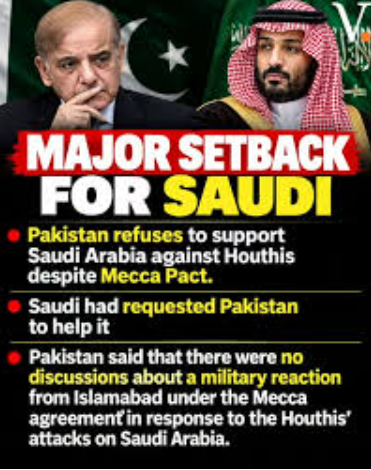
Pakistan, which had separately signed another defence deal with Saudi Arabia in September 2025, has virtually refused to be drawn into the conflict—lest the Houthis, which have already warned Islamabad, or Tehran launch a fierce attack on a failed, bankrupt, begging country.
Furious, the ditched Saudis have turned to their ancient enemy, Israel, for help. The Saudi-led Gulf Cooperation Council (GCC) has merely called the Houthis “terrorists.” Nothing more, nothing less.
But why have so many countries refused to pull the Saudis’ chestnuts out of Houthis’ fire?
The answer lies in the prohibitive cost of a modern war. No one wants to pay a dime merely to save the Saudis who, in the past, have financially rescued thankless countries like Pakistan.
Who knows this better than Russia, which launched a war against Ukraine on February 24, 2022, and finds it difficult to make an honorable exit. With its ‘war objectives’ remaining unfulfilled and economy in a shambles, it is forced to continue the conflict despite losing a million soldiers and others. Ukraine is also forced to continue the war for almost the same reasons.
The same applies to the USA. President Donald Trump and Israeli Prime Minister Benjamin Netanyahu went hammer-and-tongs against Iran on February 28, 2026. Despite wanton destruction inside Iran and half-hearted peace efforts, the war continues unabated. After a few weeks, Israel quietly backed out, focusing only on the Lebanon-based Hezbollah terror outfit, which, too, is seen as Iran’s proxy.
Washington is now realizing its folly. The US has not only refused to help the Saudis because of the high cost, it has also advised Turkiye and Pakistan to help Jeddah! In short, the Saudis have been left to fend for themselves. The US is already running short of weapons.
The US war against Iran has cost the Department of Defense more than USD 38 billion through August 1, and will continue costing up to USD 3 billion a month or more depending on the intensity of the conflict, according to an assessment released on Tuesday by the nonpartisan Congressional Budget Office (CBO).
It said the war is expected to contribute to inflation into the first quarter of 2027, making inflation roughly 0.5 percentage points higher than they had previously estimated. That’s driven largely by the reduction of oil and natural gas shipments through the Strait of Hormuz and disruptions to shipping through the Red Sea.
The estimate, prepared in response to a request for information from the top Democrat on the House Budget committee, Rep Brendan Boyle, largely aligns with a previous estimate from Defence Secretary Pete Hegseth, who pinned the costs at USD 37.5 billion, according to his Senate testimony.
The estimates come largely from replacing munitions and equipment lost in battle, the CBO said, and do not include costs related to US military personnel killed or injured in the conflict or long-term veterans’ healthcare and disability compensation.
Boyle said that beyond the war’s human toll, “this nonpartisan CBO report makes clear that the war has also cost American taxpayers tens of billions of dollars and counting, while continuing to drive up costs.”
“Donald Trump and Republicans have spent years telling Americans that we cannot afford to help families here at home,” Boyle said in a statement, “but apparently they can find tens of billions of dollars, and potentially much more, for a reckless war that is leaving Americans to pay the price.”
The findings come as voters eye the war and high prices heading toward the midterm elections on November 3 this year that will determine control of Congress, where Republicans now hold majority power in the House and Senate.
The war, which started Feb 28, is now in its seventh month, with no signs of a quick end to the on-off conflict.
The White House made a request for USD 87.6 billion in supplemental funding in June, largely for the war effort, but Congress has not approved it. CBO said the portion of that request that appears to be directly related to the conflict, USD 42.3 billion, is about 10 per cent larger than CBO’s estimate of DoD’s costs.
The Defence Department declined to respond to CBO’s request for information for its report, which was a break from norms. The budget office said it relied on government databases and public reports, and as a result, its estimates “are subject to considerable uncertainty”.
A Pentagon inspector general report Monday said the war has resulted in “strategic inventory shortfalls”.