


Virendra Pandit
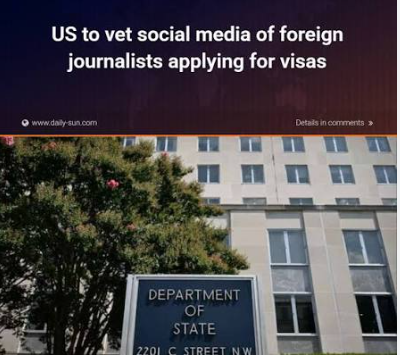
New Delhi: Given that a section of activists, under the garb of journalism, drive their own agendas and misuse social media as a force-multiplier to achieve their ends, the US State Department has decided to vet the social media accounts of foreign journalists applying for visas to work in the United States, the media reported on Thursday.
It was unclear when the reported new policy would take effect.
The report in the conservative news outlet The Daily Signal cited an internal memo that said an initiative by President Donald Trump’s administration that requires applicants for many visa types to make their social media accounts public for screening was being expanded to include foreign media representatives
The expanded vetting reportedly targets foreign journalists and other visa applicants as the US steps up immigration and national security checks.
Applicants for another type of visa for workers from Canada and Mexico also will now be included in the screening, it said.
The White House and the State Department’s official accounts on X shared a link to the article, but the State Department declined to confirm the specifics of the report, citing a policy of not commenting on “purported internal documents,” the reports said
A State Department spokesperson said that what the department calls “online presence vetting” is used to ensure that applicants are eligible for a visa under US law.
“The Department of State is screening and vetting to the maximum extent possible every foreign national seeking admission to the United States to ensure they will respect US law, including the terms of their admission, and do not pose a threat to US security, public safety or national interests,” the spokesperson said.
“Officers use a variety of methods to make informed decisions that protect national security, prevent fraud and ensure a thorough review of applicants,” the spokesperson added.
The Department of Homeland Security (DHS) tightened rules last month around how long foreign journalists working in the United States, as well as other visa holders including foreign students, could remain in the country. It also builds on a series of steps that Trump’s administration has taken since he began his second term in taking office in January 2025 to make online speech a factor in immigration and visa decisions.
These steps have raised concerns among civil liberties advocates about freedom of speech. US Citizenship and Immigration Services has said it will screen the social media posts of immigrants and visa applicants, including for what it deems antisemitic content and “anti-Americanism.”
The administration has cancelled the visas of foreign students in the United States who engaged in pro-Palestinian activism, in some cases attempting to deport those students. The State Department said in October 2025 that it revoked the visas of six foreign nationals over comments about the assassination of conservative activist Charlie Kirk, and said it would continue identifying visa holders it believed had celebrated the killing.
Pakistan, too
Even Pakistan has imposed further restrictions on foreign media outlets operating in the country, for the first time seeking to routinely control the movement of Pakistani nationals working for them.
Until the new government restrictions were first circulated widely on Sunday, only foreign citizens working as journalists were routinely subject to controls on movement outside Islamabad, Lahore and Karachi.
Now, Pakistani journalists, fixers and others working for foreign media will also need government permission to travel and report outside those three major cities and must register with the government.
Pakistani officials have not said what prompted the new restrictions, which come amid the ongoing popular protests in Pakistan-occupied Kashmir (PoK) and widening insurgencies in the country’s various provinces. The guidelines affect all foreign media outlets operating in the country.
A human rights group expressed concern that the curbs threaten independent reporting and encourage self-censorship. The controls mark “an alarming step” in Pakistan’s “narrowing space for press freedom,” said Patricia Gossman of Human Rights Watch, calling for them to be “immediately reversed.”
A government official said the new media restrictions were not intended to prevent criticism of the government or legitimate investigative journalism.
The Financial Times said it supports the ability of journalists to report freely and independently. The BBC said in a statement it was “extremely concerned” about the new restrictions and called for them to be reversed.
Earlier restrictions on foreign journalists also impacted movement inside PoK and the insurgency-stricken provinces of Balochistan and Khyber Pakhtunkhwa.
The new restrictions were posted by the government’s Information Ministry on Sunday night on a WhatsApp channel used to communicate with foreign outlets.
The undated Information Ministry document surfaced a day before a WhatsApp notice by the government on Monday ordered foreign outlets without reporting permission to leave PoK immediately, which has held multi-round regional elections since late July, marred by deadly clashes between protesters boycotting the vote and security forces.