



By Harsh Pargat
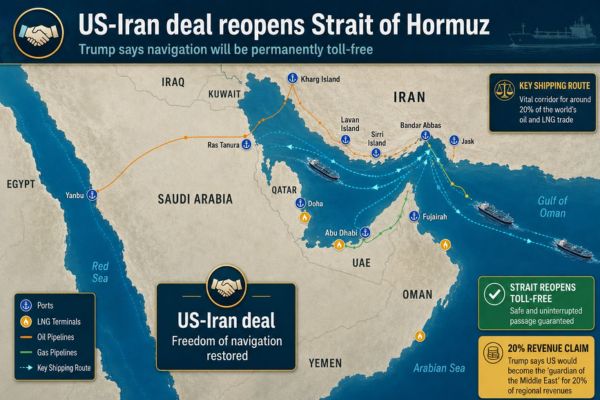
The United States said that the Strait of Hormuz would be toll free under a new Iran deal. This latest development comes in the US-Tehran negotiation. This move is an effort to restore confidence. The agreement can help continue the oil and gas supply in the global market. The current agreement emerges after the intense confrontation between America and Iran. The agreement between Washington and Tehran seeks to end the cycle of escalation and the Strait of Hormuz. When the war started, Iran could institutionalize a system of transit fees for ships passing through Hormuz. Now under the proposed agreement, the US officials maintained that commercial vessels should be able to transit without fees.
The American government is emphasizing that the agreement is expected to guarantee long-term, toll-free access through one of the most important strategic waterways. This is an important assurance to all shipping companies. The global maritime operators were worried not only about security threats but also about the possibility of recurring financial charges. A toll-free regime would reduce uncertainty and help in restoring normal, commercial operations.
The global analysts are monitoring the situation and the immediate effects. Many experts are concerned, and they are in doubt about a return to normalcy; according to them, security assessments, insurance rates, and shipping schedules will take time to stabilize. For the United States, securing free navigation is a major strategic objective. The different nations have long argued that international waterways should be open for all.
The US is claiming that its success in protecting global commerce and security was a significant effort. The reopening of the Strait could also help Iran reintegrate into regional and global trade networks. As per India’s concern, the reopening will be good news for India, as India relies on crude oil imports originating from the Gulf region. There are many challenges for India’s economic growth, but the reopening of the route and the prospect of a toll-free passage could help stabilize energy prices and reduce transportation expenses. Stable maritime conditions would support trade, investment, and connectivity, which are important to India’s foreign policy.
As per the new agreement with Iran, toll-free transition represents a maritime policy. This development can assist in accelerating international trade. Energy security, regional stability, and global economic confidence.
For countries like India, a stable and open Strait of Hormuz is not a geopolitical concern, but it is a strategic necessity. In conclusion, it can be envisaged that the agreement marks the beginning of a long term in Gulf security or simply a temporary phase in a long-running confrontation.
(The writer is a researcher, International Relations & Security Studies with a focus on West Asia)
Please share view [email protected]