




Virendra Pandit
New Delhi: Amid growing concerns over China’s export controls on rare earth elements and strategic metals vital for global technology supply chains, the four Quad partners on Tuesday firmed up a key framework for cooperation in ensuring steady supplies of critical minerals, the media reported.
On the sidelines of the Quadrilateral Security Dialogue (Quad) Foreign Ministers’ meeting in New Delhi, these democracies signed a deal to ensure supplies of mining and processing of critical minerals. In recent years, a peeved China has dubbed Quad the “Asian NATO,” directed against Beijing.
Countering China’s tight grip on global supplies of critical minerals, these Quad partners–India, the US, Australia, and Japan—resolved to mobilise up to USD 20 billion to strengthen supply chains across mining, processing, and recycling of critical minerals and rare earth elements (REEs).
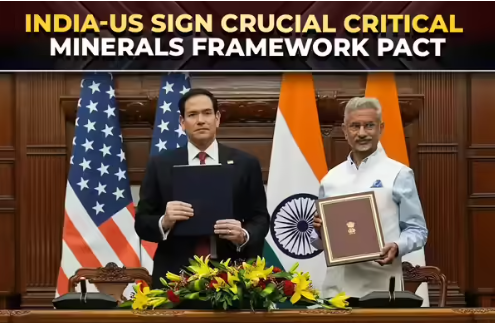
While all four Quad members agreed on a multilateral Quad Critical Minerals Framework to secure Indo-Pacific supply chains, India and the US formally signed a standalone bilateral India–US Critical Minerals Framework.
- Quad Multilateral Agreement: During the Quad Foreign Ministers’ meeting, all four member nations agreed to launch initiatives to secure and diversify the mining, processing, and recycling of critical minerals to counter single-source monopolies in the Indo-Pacific; and
- India-US Bilateral Deal: On the sidelines of that same Quad meeting, S. Jaishankar and US Secretary of State Marco Rubio also signed a specific bilateral framework, designed to foster financing, technological collaboration, and joint investments to ensure steady supplies of rare earths and critical minerals for defense, semiconductors, and electric vehicles.
“It is something very timely and critical,” External Affairs Minister S. Jaishankar remarked in presence of US Secretary of State Marco Rubio.
“This framework aims to deepen our cooperation across the entire critical minerals and rare earth supply chain, including mining, processing, recycling and related investment,” he said.
Dr. Jaishankar said the framework will strengthen resilient and diversified supply chains, help financing of projects as well as ensuring effective management of critical minerals and rare earths.
“It is one more sign of how close our cooperation has been in a world where there are so many challenges but also so many opportunities,” he said.
Rubio highlighted the strategic partnership between the US and India and how important it is for the respective national interests of both countries.
“It is a tangible example of that,” he said, referring to the inking of the pact.
“We are two countries that have strategic interests in ensuring reliable long-term access to critical minerals and supply chains that are important for our innovation economy,” he said.
Pax Silica
Rubio also cited the US-backed Pax Silica initiative.
“The groundwork was laid for this deal on February 4 when you joined us at the Critical Minerals Forum that we hosted in Washington DC,” he said, adding it gained momentum after India signed the Pax Silica initiative.
“Today, because we both have a strategic and shared interest in the fact that vibrant innovation economies such as ours cannot afford to leave the foundational materials of these industries vulnerable to single source monopoly that could deny us these things, not just in a time of conflict, but as a leverage point contrary to our sovereign national interests,” he said.
“I’m glad we were able to sign this because, in addition to being an important document and important agreement, it brings a tangible example of the strategic partnership between the US and India,” he said.
The Pax Silica initiative was launched in December 2025 to build a secure, resilient, and innovation-driven supply chain for critical minerals and artificial intelligence (AI).
Critical minerals
“The Quad partners intend to support the development of secure critical minerals supply chains, which are essential for advanced technologies, economic growth, and the resilience of our industrial bases,” a statement on the “Quad Critical Minerals Initiative Framework” issued by the Ministry of External Affairs (MEA) on Tuesday said.
The four countries intend to work together to use economic policy tools and coordinated investment to accelerate the development of diversified and fair critical mineral markets and support the supply of critical minerals that are crucial to our region’s economic growth and security, it added.
The framework was finalised at the Quad Foreign Ministers’ meeting in New Delhi, hosted by Dr. Jaishankar and attended by Foreign Ministers of Australia (Penny Wong), Japan (Toshimitsu Motegi), and the US (Marco Rubio).
The coalition expressed grave concern over the overreliance on a single nation (China) for the processing and refining of REEs and critical minerals. It specifically condemned the use of non-market policies and practices that distort global markets and disrupt high-tech manufacturing.
Beijing’s sweeping export restrictions—which target everything from raw heavy rare earths to specific processing technologies—have pushed nations to de-risk their technological and defense supply chains.
To counteract these vulnerabilities, the Quad partners outlined a sweeping Quad Critical Minerals Initiative Framework, focused on concrete, actionable strategies, including,
- Diversified Sourcing: Identifying and accelerating projects that have a “Quad nexus” (located in partner countries, headquartered by partner companies, or supplying partner markets);
- Regulatory Alignment: Cooperating to accelerate and streamline licensing, permitting, and regulatory processes for mining and refining operations across member states, and
- Technology & Recycling: Building capacity for geological mapping, resource assessment, and the recovery of critical minerals from e-waste and scrap materials.
The Quad members agreed to improve the overall environment for critical minerals development through actions such as sharing, where appropriate, information on good practices and technical approaches to permitting, licensing, and regulatory processes, including measures to accelerate or streamline permitting timelines and processes.
They also decided to cooperate on technology development and capacity building related to geological mapping and resource assessment.
And, they intended mobilisation of USD 20 billion through both government and private sector support, including new and existing efforts through a number of identified actions.
These include identifying projects with a Quad nexus, such as those located in Quad partner countries, operated by companies headquartered in Quad partner countries, or supplying Quad markets, that address critical mineral supply chain gaps.
The countries also seek to support strategic critical minerals projects, including through export credit agencies, development finance institutions, mobilisation of private capital, or other public supporting tools, such as guarantees, loans, equity participation, insurance, subsidies, and offtake or other commercial arrangements.
Also on the agenda is exploring new mechanisms to help mobilise private capital and strengthen critical minerals supply chains in Quad partner countries and regionally.