PM Modi shares article on Somnath Temple’s enduring legacy and civilisational significance







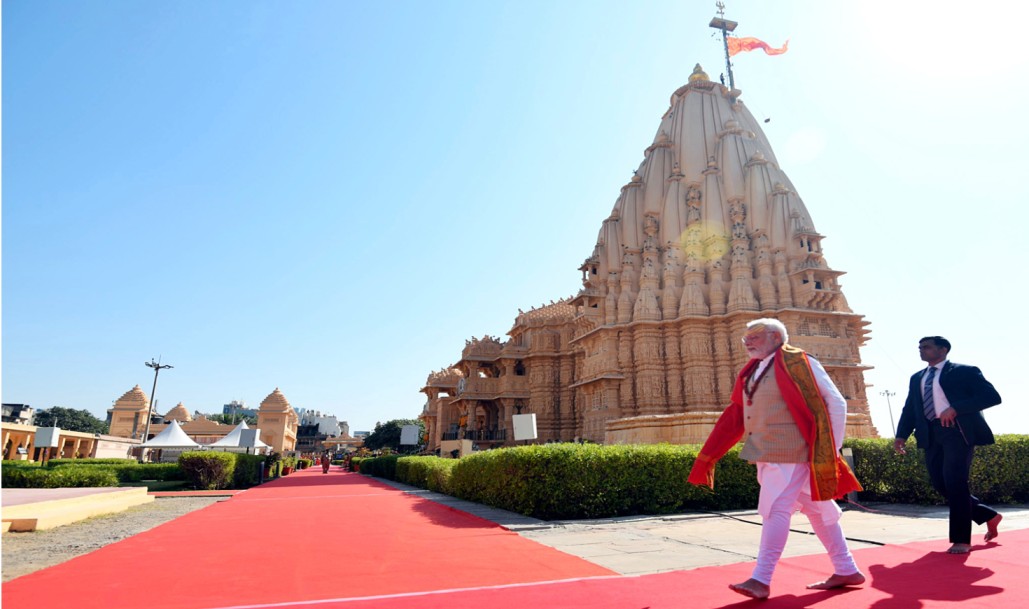
New Delhi: Prime Minister Narendra Modi on Monday shared an article by Union Culture and Tourism Minister Gajendra Singh Shekhawat highlighting the resilience, cultural continuity and timeless civilisational significance of the Somnath Temple in Gujarat.
“More than a temple, Somnath is a testament to India’s enduring spirit. From ruin to renewal, its journey reflects the unconquerable heritage of India and her undaunted legacy,” PM Modi said while sharing Shekhawat’s article on X.
Shekhawat’s article, published as part of the ongoing Somnath Swabhiman Parv commemorations, reflects on the temple’s historical journey through repeated invasions, destruction and reconstruction over nearly a millennium. It presents Somnath as a symbol of India’s cultural resilience, spiritual continuity and collective memory.
Located at Prabhas Patan on Gujarat’s Kathiawar coast, the Somnath Temple is revered as the first among the twelve Jyotirlingas of Lord Shiva. Shekhawat notes that the temple has endured repeated attacks since the 11th century but continued to survive through the faith and efforts of devotees, rulers and communities who rebuilt it over generations.
Referring to the raid by Mahmud of Ghazni in 1026, Shekhawat said that while Persian chronicles celebrated the attack as a military victory, Indian traditions remembered it through narratives of resistance, loss and eventual restoration. He emphasises that Somnath never disappeared from India’s spiritual consciousness despite repeated destruction.
Shekhawat also highlights the role of regional rulers and leaders in restoring the temple over time, including the Chaulukyas, Maratha queen Ahilyabai Holkar and, after Independence, Sardar Vallabhbhai Patel. Patel had visited the Somnath ruins in November 1947 and pledged to rebuild the temple as a symbol of India’s cultural resurgence.
The reconstructed Somnath Temple was consecrated on May 11, 1951, in the presence of India’s first President Rajendra Prasad. Shekhawat describes the event as a reaffirmation of India’s shared cultural memory and civilisational confidence in the post-Independence era.
The Somnath Swabhiman Parv, currently being observed as a year-long national commemoration, marks two major milestones – 1,000 years since the first recorded attack on the temple and 75 years since the reopening of the reconstructed shrine in 1951.
Shekhawat further describes Somnath as a unique confluence of Shaiva and Vaishnava traditions, reflecting the plural and inclusive nature of Indian heritage. He notes that Prabhas Patan has historically remained a sacred geography associated with Lord Shiva, Lord Krishna and several ancient pilgrimage traditions.
Highlighting the present-day transformation of the temple complex, the article says that under the leadership of Prime Minister Narendra Modi, who also serves as Chairman of the Shri Somnath Trust, the temple has entered a renewed phase of cultural revival and heritage conservation. Governance reforms, infrastructure development, sustainability initiatives and women-led service programmes have strengthened Somnath’s role as a living spiritual and cultural centre.
Shekhawat also connects Somnath’s journey to India’s broader vision for the future, stating that as the country moves towards 2047, the temple stands as a reminder that a civilisation remains strong when it stays rooted in its values while adapting to changing times.
The Somnath Swabhiman Parv celebrations will culminate in a major national event on May 11, accompanied by cultural programmes, yatras, educational initiatives and coordinated events across Jyotirlinga temples and Shiva shrines nationwide.
(DD News)