




New Delhi: As Prime Minister Narendra Modi visits the sacred Somnath Temple on May 11 to commemorate 75 years of its reopening, the historic shrine once again stands at the centre of India’s cultural and spiritual consciousness.
The occasion marks not only the diamond jubilee of the temple’s consecration in 1951 but also 1,000 years since the first recorded attack on Somnath in 1026 – two defining milestones that together symbolise destruction and renewal, struggle and resurgence.
Located at Prabhas Patan on Gujarat’s Saurashtra coast, Somnath is revered as the first among the twelve Jyotirlingas of Lord Shiva and occupies a central place in India’s spiritual tradition. Mentioned in the Shiva Purana and celebrated in the Dwadasha Jyotirlinga Stotram, the temple has for centuries drawn pilgrims, saints and rulers from across the subcontinent.
Yet Somnath’s significance extends far beyond religion. Over nearly a millennium, the temple became a symbol of India’s civilisational endurance. Repeatedly attacked, plundered and destroyed by invaders beginning in the 11th century, the shrine was rebuilt time and again through the devotion of ordinary people, rulers and spiritual leaders who refused to let its flame fade.
The first major recorded assault came in January 1026 when invaders attacked and desecrated the temple, beginning a turbulent chapter in its history.
Over the centuries that followed, Somnath witnessed cycles of destruction and reconstruction. Kings such as Kumarapala in the 12th century and rulers of Junagadh later restored the shrine, while Maratha queen Ahilyabai Holkar consecrated a new temple at Somnath in the 18th century after another phase of devastation.
The temple’s modern rebirth began after Independence when Sardar Vallabhbhai Patel visited the ruins in 1947 and resolved to rebuild Somnath as a symbol of India’s restored cultural confidence. Supported by public participation and national resolve, the present temple was constructed in the Kailash Mahameru Prasad architectural style.
On May 11, 1951, India’s first President Rajendra Prasad ceremonially consecrated the restored temple, calling it a symbol of India’s spiritual strength and resurgence.
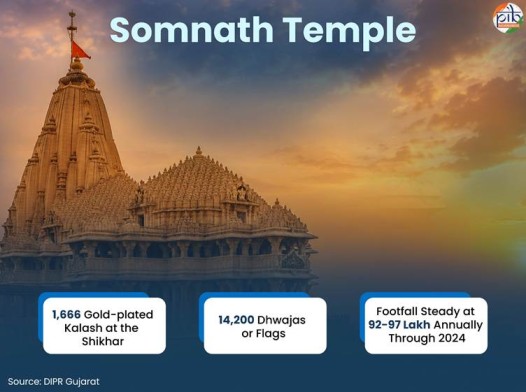
Today, 75 years later, Somnath remains both a sacred pilgrimage site and a living emblem of continuity. The temple complex rises majestically along the Arabian Sea shoreline with a 150-foot shikhar crowned by a 10-tonne kalash and a 27-foot dhwajdand symbolising its enduring spiritual presence. The shrine features 1,666 gold-plated kalash and over 14,200 dhwajas, reflecting centuries of devotion and craftsmanship.
Somnath attracts between 92 lakh and 97 lakh devotees annually, making it one of India’s most visited pilgrimage centres. Rituals such as Bilva Pooja alone draw over 13.77 lakh devotees every year.
Cultural initiatives including the Light and Sound Show, first introduced in 2003 and upgraded in 2017 with 3D laser technology, have further deepened public engagement with the temple’s history. The Vande Somnath Kala Mahotsav has also revived ancient dance traditions believed to date back nearly 1,500 years.
The Somnath Swabhiman Parv, being observed this year, commemorates both the thousand-year journey since the first attack and the 75th anniversary of the temple’s reopening.
Earlier this year, PM Modi participated in the Swabhiman Parv celebrations at Somnath, which included a 72-hour Omkar chanting ceremony and a grand Shaurya Yatra featuring a symbolic procession of 108 horses honouring warriors who defended the temple through the centuries.
Among the most remembered figures in Somnath’s history is Hamirji Gohil, who is revered in local memory for sacrificing his life while defending the temple during Zafar Khan’s invasion in 1299. Though not extensively documented in official chronicles, Hamirji’s story survives through oral tradition and represents the ideal of rajdharma — the duty to protect faith, society and heritage even in the face of overwhelming odds.
PM Modi, who also serves as Chairman of the Somnath Trust, has described the temple as a symbol of “Bharat’s unconquerable spirit” and highlighted its journey “from ruin to renewal.” As part of the commemorations, special pujas will be held at Somnath for the next 1,000 days.
The Somnath Trust has also expanded the temple’s role beyond worship into education, welfare, sustainability and women’s empowerment.
Vocational training programmes in digital literacy, tailoring and beauty services are helping youth and women in nearby villages gain employment opportunities. Scholarship programmes support students after Class 10 and Class 12, while the “School on Wheels” initiative provides mobile digital education in rural areas.
The Trust also runs extensive community welfare activities including daily food donation programmes, medical assistance for economically weaker families, physiotherapy facilities and free eye and dental camps.
During the COVID-19 pandemic, the Trust provided relief support worth over ₹10 crore across two waves, including food distribution, medical infrastructure, oxygen support and assistance for frontline workers and migrant labourers.
Somnath has also emerged as a model for sustainable pilgrimage management. Declared a “Swachh Iconic Place” in 2018, the temple has adopted several eco-friendly initiatives. Temple flowers are converted into vermicompost for nearly 1,700 Bilva trees, while plastic waste is transformed into paver blocks under Mission LiFE, producing nearly 4,700 blocks every month. Rainwater harvesting systems recycle about 30 lakh litres of water monthly.
A Miyawaki forest developed across 72,000 square feet around the temple contains 7,200 trees and absorbs approximately 93,000 kilograms of carbon dioxide annually. Even sacred Abhishek water is purified and distributed as Somganga jal, benefiting over 1.13 lakh families by December 2024.
Women’s empowerment has also become a key pillar of the temple administration. Of the 906 employees working under the Somnath Temple Trust, 262 are women. The Bilva Van is entirely managed by women, while dozens are employed in prasad distribution and temple dining services.
Overall, 363 women receive direct employment through temple-related activities, collectively earning nearly ₹9 crore annually.
As Somnath marks 75 years of its reopening, the temple stands not merely as a monument of stone and faith, but as a living testimony to India’s resilience, cultural continuity and civilisational confidence.
From the shores of Prabhas Patan, its story continues to echo across generations – a reminder that while empires rise and fall, faith and identity endure.
(DD News)