




Manas Dasgupta
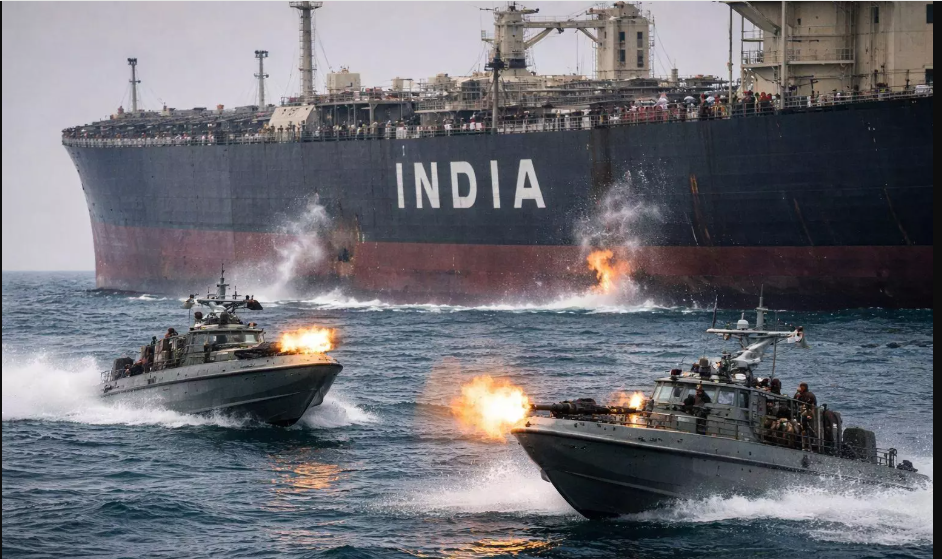
NEW DELHI, Apr 18: Two Indian vessels, including a large crude oil tanker carrying about two million barrels of Iraqi oil, were on Saturday fired upon by the Iran Navy north of Oman, official sources said.
Shortly after reports emerged that the Indian ships were forced to turn back from the Strait of Hormuz, official sources confirmed that two vessels, Jag Arnav and Sanmar Herald, were involved in the incident. The vessels — Jag Arnav and Sanmar Herald— came under direct attack, raising fresh concerns over maritime security in the region. “Both vessels were fired upon,” an official said. Iran has previously said that countries not involved in the conflict with the US and Israel would not be targeted.
The development has led to a strong protest from India’s foreign ministry, with New Delhi summoning the Iranian envoy over the matter. The Iranian envoy, Dr Mohammad Fathali, was summoned by the MEA for a meeting at 6:30 PM. He met the MEA joint secretary for the Pakistan-Afghanistan-Iran desk.
“The Ambassador of the Islamic Republic of Iran in New Delhi was called in by the Ministry of External Affairs for a meeting with Foreign Secretary this evening. During the meeting, Foreign Secretary conveyed India’s deep concern at the shooting incident earlier today involving two Indian-flagged ships in the Strait of Hormuz. He noted the importance that India attached to the safety of merchant shipping and mariners and recalled that Iran had earlier facilitated the safe passage of several ships bound for India. Reiterating his concern at this serious incident of firing on merchant ships, Foreign Secretary urged the Ambassador to convey India’s views to the authorities in Iran and resume at the earliest the process of facilitating India-bound ships across the Strait,” MEA said in a statement.
“The Ambassador of Iran undertook to convey these views to the Iranian authorities,” the ministry added.
The Indian Navy is trying to ascertain details of the incident as there was no Indian Navy ship in the Straits of Hormuz, they added. India has two destroyers, one frigate and one tanker in the Gulf of Oman. There were no injuries reported after the incident. A strong protest has been lodged by India, with the joint secretary asking the Iranian envoy to explain why the firing took place.
According to Marine Traffic, Jag Arnav, bulk carrier sailing under the flag of India, was travelling from Al Jubail in Saudi Arabia and was en route India. The second ship Sanmar Herald, was enroute to India, carrying crude oil from Iraq. The officials said that India was taking the firing by Islamic Revolutionary Guard Corps seriously and the country stands for open and free navigation in the Strait of Hormuz.
The Strait of Hormuz, located between Iran and Oman, is one of the world’s most vital oil transit corridors, through which 20% share of global crude shipments passes. India is among the countries with the highest number of vessels passing through the strait, reflecting its dependence on energy imports from the Gulf region.
Iran has, amid the war with the US, listed India among friendly nations whose ships it is allowing to cross through the vital strait while keeping others halted with threats of drone-missile attack. The attacks come even as Iran announced temporary reopening of the Strait of Hormuz on Friday after a US-brokered 10-day ceasefire agreement on Thursday between Israel and Lebanon.
Maritime trackers even showed a convoy of eight tankers transiting the strait in the first major movement of ships since the US-Israeli war on Iran began seven weeks ago. US President Donald Trump on Friday said Iran had agreed to open the strait, while Iranian officials said they wanted the US to fully lift its blockade of Iranian tankers.
The British military also confirmed that two gunboats from Iran’s Revolutionary Guard opened fire on a tanker transiting the Strait of Hormuz, after Iran said it has re-imposed restrictions on the vital waterway. The United Kingdom Maritime Trade Operations Centre said the tanker and crew were reported safe, without identifying the vessel or its destination.
Some merchant vessels received radio messages from Iran’s navy stating that the strait was shut again and that no ships were allowed to pass.
Ship-tracking data showed five vessels loaded with liquefied natural gas from Ras Laffan in Qatar approaching the strait on Saturday morning. Hundreds of ships have been stuck in the Persian Gulf since the conflict between the US-Israel and Iran started on February 28, and Tehran closed the strait, forcing Gulf oil and gas producers to sharply cut production.
Iran had announced reopening of the Strait following a separate US-brokered 10-day ceasefire agreement on Thursday between Israel and Lebanon. Maritime trackers even showed a convoy of eight tankers transiting the strait in the first major movement of ships since the US-Israeli war on Iran began seven weeks ago. But following the US President’s assertion that blockade of Iranian ports would continue till the peace deal with Iran was completed, enraged Iran to re-impose restrictions on the Strait of Hormuz.
Some vessels reported that Iran’s navy had been broadcasting a VHF message saying the Strait of Hormuz was closed again. “Attention all ships, regarding the failure of the US government to fulfil its commitment in the negotiation, Iran declares the Strait of Hormuz completely closed again. No vessel of any type or nationality is allowed to pass through the Strait of Hormuz,” the radio message said.
The military spokesperson said Iran had earlier agreed, “in good faith,” to the managed passage of a limited number of oil tankers and commercial vessels following negotiations, but said continued US actions had forced Tehran to restore tighter controls on shipping through the strategic chokepoint.