




Manas Dasgupta
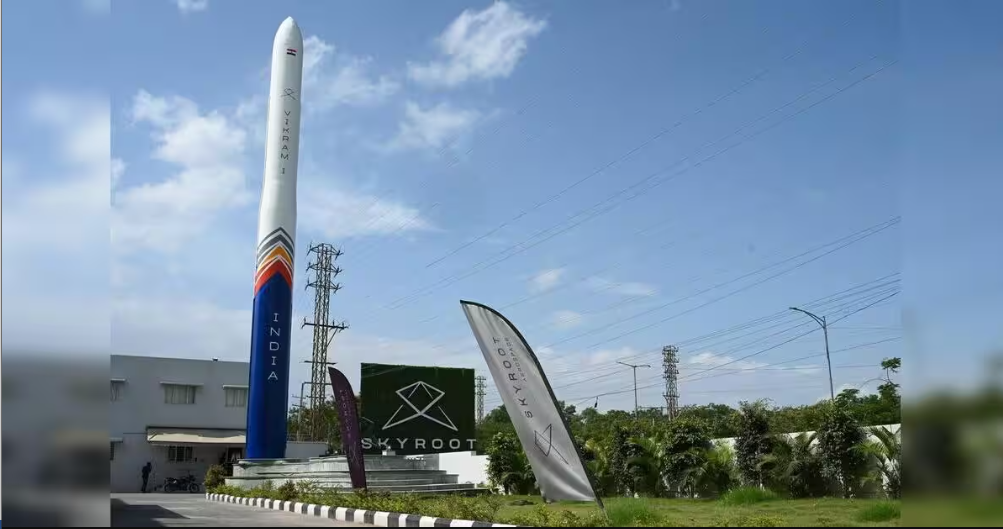
NEW DELHI, July 18: As Skyroot’s Vikram-1 rocket soared into space, it became the first privately developed Indian rocket to attempt an orbital mission, marking a defining moment not just for the company but also for India’s rapidly emerging private space sector. With this, India became only the third country in the world after the United States and China, whose private industry can reach orbit on its own launch vehicle.
Anxiety and nervousness gave way to excitement and euphoria as the clock struck 12:05:30 on a clear Saturday afternoon at the Sriharikota launch pad since the liftoff encountered a little hiccup as the rocket blastoff was put on a “planned hold” just minutes before the scheduled timing of 11:30 am by the mission control team.
At 12:21 pm, history was made when the mission was declared successful as the commentators at the launch site announced, “Hello, space. We have arrived,” with the injection of the payload in its orbit. The lift-off has secured its place in the history of India’s space missions.
The seven-storey Vikram-1 rocket built by Hyderabad-based firm Skyroot shot through the sky after lifted off ISRO’s First Launch Pad at Sriharikota and, a little over fifteen minutes later, placed its payloads in an orbit roughly 450 km above the earth. The rocket was Aerospace, and the mission was named “Aagaman,” Sanskrit for “arrival” marks the arrival of India’s private sector in the global launch business. Hyderabad-based Skyroot Aerospace has joined a small and elite group of global companies that have successfully developed and launched orbital rockets.
Vikram-1 is carrying technology demonstration payloads from Grahaa Space, Cosmoserve, DCubed and Skyroot’s own SCOPE, along with Cosmos Diamonds’ artwork “Cosmic Bloom” and a micro-art piece featuring micro-sculptures of Sir CV Raman, Dr Vikram Sarabhai and Dr APJ Abdul Kalam. Vikram-1 is a seven-storey-tall, multi-stage orbital launch vehicle built with an all-carbon composite structure and powered by in-house developed propulsion systems, including 3D-printed engines and high-thrust solid-fuel boosters.
Designed to carry small satellites weighing up to 350 kg to Low Earth Orbit (LEO), its first test flight is targeting a 450 km orbit at a 60-degree inclination.
Congratulating the Skyroot team on the historic feat, the Prime Minister told the young team, “you have made India proud.” “You have planted India’s aspirations in space and have also given roots to the dreams of the youth,” PM Modi told Chandana as his team listened to the PM’s praise on speakerphone.
Commending the young team, the Prime Minister said they had shown what India’s youth were capable of. Chandana pointed out that the average age of his team is 28 years. “Your team has proved my faith in the youth of India right. Many doubted our space dreams, but this team has shown that if trusted, Indian youth can do wonders,” the PM told the beaming team.
The rocket is also carrying a special message from the Prime Minister. The message, printed on a commemorative card, will travel beyond Earth’s atmosphere alongside hundreds of cards carrying wishes and aspirations from people around the world. In his message to Skyroot on a postcard, PM Modi simply wrote “Vande Mataram.”
“Vande Mataram is now in space,” the Skyroot CEO told the Prime Minister. Ahead of Mission ‘Aagaman’, Skyroot Aerospace said its Vikram-1 rocket also carries the signatures of the engineers, technicians and team members who helped build it, honouring everyone behind India’s landmark private space mission.
Named after the father of India’s space programme, Vikram Sarabhai, the Vikram-1 vehicle represents the next step for Skyroot after the company’s successful Vikram-S suborbital mission in November 2022.
It is not just Vikram-1; ISRO has its own Small Satellite Launch Vehicle (SSLV) in play, and ‘Agnikul’ is reportedly working on its own line of rockets. All these projects promise to deliver a solid boost when it comes to sending the satellites into a lower orbit of India, especially when it is getting quite busy due to constellations like Starlink and OneWeb, which have already been pushing up the fleets of small satellites for things like satellite internet service.
The private space in India has grown immensely, and since then, the doors have opened wide for non-government players. Startups like Skyroot are following ISRO’s path, and now they are building their own space rockets. Mission Aagaman signals that things are changing. This is not just about science and technology anymore. Rather, it is about forging a space community that brings together scientists, entrepreneurs, investors, policymakers, and everyday citizens.
Since the 2020 reforms and IN-SPACe’s creation in 2022, India’s space startups have multiplied from a handful to more than 400, but until Saturday they all needed ISRO’s rockets to fly. A private launcher turns ISRO from gatekeeper into landlord — and turns access to orbit from a national programme into a market. The small-satellite launch business is supply-starved worldwide; Skyroot pitches itself as a cab service to space. Saturday was only the first ride.