



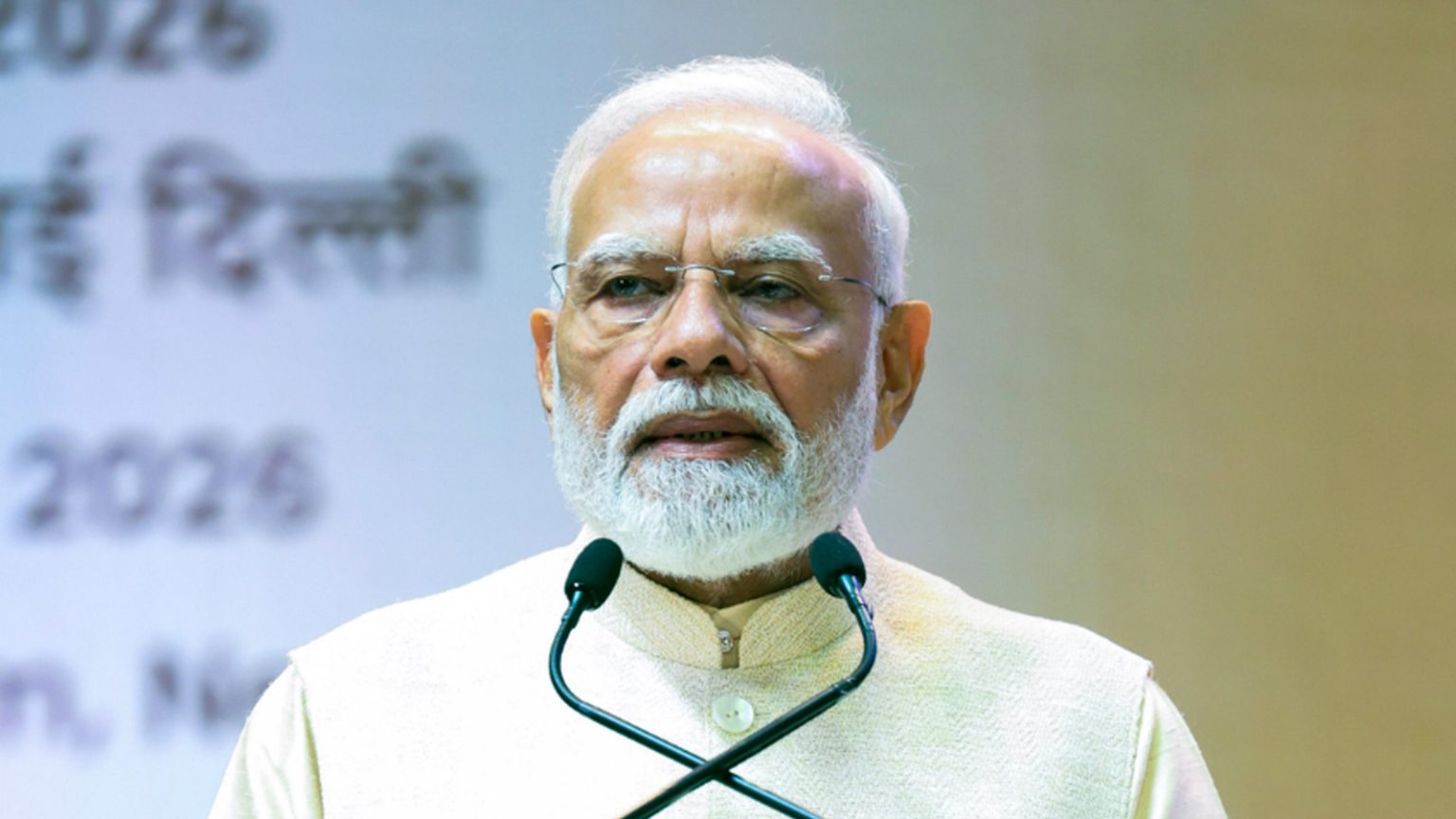

New Delhi: Prime Minister Narendra Modi on Thursday participated in the centenary celebrations of the Union Public Service Commission (UPSC) at Bharat Mandapam in New Delhi, describing the completion of 100 years as a landmark milestone and calling for timely reforms that prepare the civil services for the needs of a rapidly changing India in the years ahead.
Addressing the gathering, PM Modi said the centenary was not merely a celebration of the institution’s 100-year journey but also a celebration of the aspirations of millions of young people who appear for competitive examinations and the trust Indians place in the UPSC.
He said the commission had maintained its credibility across changing generations, governments, technologies and examination syllabi.
The celebrations also saw the release of a commemorative postage stamp, a special coin and a compilation of 100 significant case laws associated with the UPSC.
‘Nation First, Citizen First’
Highlighting the role of recruitment institutions in building a developed India, PM Modi said two principles should remain the key touchstones for selection processes – “Nation First” and “Citizen First.”
He said the young people recruited into public services would not only shape the country’s future but would also be among its principal beneficiaries.
“When candidates filled with this spirit are selected, achieving national goals will become that much more natural and easier,” the Prime Minister said.
Recalling the challenges faced by India after Independence, PM Modi paid tribute to former Deputy Prime Minister Sardar Vallabhbhai Patel for strengthening the administrative structure needed to govern the newly independent country.
“The steel frame that was needed for the reconstruction of the nation was provided by Sardar Patel,” PM Modi said.
He noted that while the UPSC had its origins in 1926 during British rule, the institution successfully adapted after Independence to serve the aspirations of a free India.
Recruitment must test motivation for public service
The Prime Minister said the changing aspirations of citizens require changes in the way civil servants are selected.
He stressed that recruitment examinations should go beyond testing a candidate’s knowledge and also examine why a young person wants to join the civil services.
“We must bring youth into Public Services who are driven by Public Service, not Public Office,” PM Modi said.
He suggested that newly inducted civil servants could be encouraged to record their original motivation for joining public service, allowing them to revisit those reasons when confronted with challenges later in their careers.
PM Modi said the UPSC and state public service commissions could consider institutionalising similar mechanisms for candidates.
‘Nagrik Devo Bhava’ as governance principle
Calling for a transformation in the traditional approach to administration, PM Modi said governance should move away from the old “Mai-Baap” mindset and instead be guided by the principle of “Nagrik Devo Bhava” – treating citizens as being nothing short of divine.
“For us, the service of the citizen is paramount,” he said.
PM Modi said India’s 21st-century work culture is based on three principles: Pro-People, Pro-Active and Good Governance.
He said civil servants should be empathetic, proactive and capable of finding innovative solutions to complex problems. They should also assess how laws and government decisions affect citizens and work to make their lives easier.
Civil services must prepare for new challenges
The Prime Minister said the India of 2047 would have a significantly different socio-economic landscape, with greater urbanisation and a narrowing rural-urban divide.
As citizens increasingly become accustomed to instant services and real-time solutions, including those enabled by artificial intelligence, administrative systems will also have to become faster and more responsive.
PM Modi said future civil servants would face challenges such as information warfare, deepfakes, algorithmic bias and climate justice.
Recruitment agencies, he said, would therefore need to give greater importance to candidates’ foresight and complex problem-solving abilities.
“We will also have to adapt our Selection Parameters and Recruitment Process according to future needs,” he said.
Shorter examination cycles needed
PM Modi also called for the principle of “Time Certainty” to be incorporated into examination processes, arguing that recruitment cycles should be shortened without compromising standards.
He pointed out that prolonged examination processes can impose substantial financial burdens on candidates and their families through coaching fees, accommodation, transportation and other expenses.
Reducing examination timelines, he said, would therefore not only be an administrative reform but also an “equity reform.”
The Prime Minister also called for greater cross-learning among the UPSC and state public service commissions. He suggested that existing conferences of selection commissions should focus more on international standards, technological improvements and the sharing of best practices.
Greater use of technology and capacity building
PM Modi urged the UPSC and state commissions to continuously strengthen their institutional capacity and make greater use of digital infrastructure created under Mission Karmayogi.
He suggested that the i-GOT platform could be used for capacity building and professional development.
The Prime Minister also highlighted the expansion of opportunities in public services, particularly for candidates from rural areas and women.
He noted that the proportion of women candidates in civil services had risen from around 3 per cent in 1952 to more than 30 per cent today. He also pointed to the appointment of three women among the four UPSC Chairpersons appointed after 2014.
“These changes are not just statistics; they show how much the scope of opportunities in the country has expanded,” PM Modi said.
45-fold rise in candidates since UPSC’s 50th anniversary
PM Modi also highlighted the dramatic expansion in participation in competitive examinations since the UPSC’s Golden Jubilee in 1976, saying the number of candidates had increased around 45-fold.
He said this growing pool of aspirants represented the country’s expanding talent base but also placed a greater responsibility on recruitment bodies.
The Prime Minister reminded selection commissions that they were not merely choosing candidates for government jobs but selecting people who would eventually become the face and representatives of the government at the grassroots level.
“Therefore, all of you have a very huge responsibility of selecting the right person,” he said.
Protect UPSC’s core values
As the UPSC begins its second century, PM Modi called for the institution to upgrade its systems and prepare for emerging challenges while preserving the values that underpin its credibility.
He said the commission’s independence, impartiality, merit, confidentiality and fairness must remain uncompromised.
“These values must always remain,” the Prime Minister said.
Concluding his address, PM Modi expressed confidence that the UPSC would continue to evolve with changing times while preserving its institutional legacy and playing a central role in India’s public administration in the decades ahead.
[DD News]