



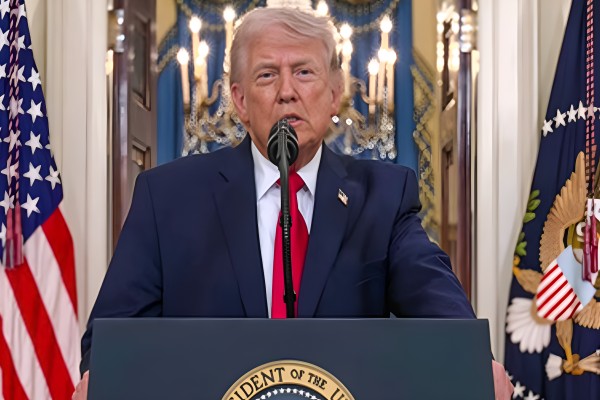

New Delhi: U.S. President Donald Trump said he would indefinitely extend the ceasefire with Iran to allow more time for peace negotiations, though it was not clear on Wednesday if Iran or Israel, the U.S. ally in the two-month war, would agree.
In a statement on social media, Trump said the decision followed a request from Pakistani mediators “to hold our Attack on the Country of Iran until such time as their leaders and representatives can come up with a unified proposal … and discussions are concluded, one way or the other.”
Pakistan has been hosting negotiations in Islamabad aimed at ending the conflict, which has lasted two months, claimed thousands of lives, and disrupted the global economy.
Despite the ceasefire extension, Trump indicated the U.S. Navy would continue its maritime blockade of Iran, a move Tehran considers an act of war.
Iranian officials had not formally responded by Wednesday morning, though early reactions suggested skepticism.
Tasnim News Agency, linked to the Islamic Revolutionary Guards Corps (IRGC), said Iran had not requested any ceasefire extension and reiterated threats to challenge the blockade. An adviser to Iran’s lead negotiator, parliamentary speaker Mohammad Baqer Qalibaf dismissed Trump’s announcement as insignificant and possibly strategic posturing.
Trump’s wartime rhetoric has fluctuated sharply. In an expletive-filled threat against Iran only two weeks ago he promised that a “whole civilization will die tonight”, while at other times he has appeared keen to end the violence and market uncertainty.
The latest announcement comes after Trump stepped back from earlier threats to target Iranian infrastructure, actions that drew criticism from United Nations Secretary-General António Guterres and others for potentially violating international humanitarian law.
Uncertain path for peace talks
The conflict began on February 28 when the U.S. and Israel launched airstrikes on Iran. It quickly expanded across the region, involving Gulf states hosting U.S. forces and Lebanon after Hezbollah joined the fighting.
Israeli Prime Minister Benjamin Netanyahu has long advocated for regime change in Iran, but Trump has given shifting and sometimes contradictory rationales for joining Israel to launch the war and how he foresees it ending, stirring confusion in global markets.
U.S. stock futures rose, the dollar wavered and oil prices turned lower on Wednesday after Trump’s announcement.
The war has killed more than 5,000 civilians and displaced hundreds of thousands, mainly in Iran and Lebanon. It has also severely disrupted shipping through the Strait of Hormuz, a critical route for global energy supplies, fuelling fears of a wider economic recession.
Iran has repeatedly used its strategic position in the strait to exert pressure by threatening shipping routes in response to U.S. and Israeli actions.
Trump said in his statement he was willing to extend the ceasefire because “the Government of Iran is seriously fractured, not unexpectedly so,” referencing the killing of key figures early in the war, including Supreme Leader Ayatollah Ali Khamenei, who has since been succeeded by his son.
Just hours before announcing the extension, Trump had told the CNBC news channel that he was not inclined to continue the temporary truce and that the U.S. military was “raring to go.”
Meanwhile, planned peace talks in Islamabad appeared uncertain. U.S. Vice President JD Vance, expected to participate had planned to return to Pakistan on Tuesday, but a White House official said he had not yet departed Washington due to ongoing policy discussions.
Iranian officials told Reuters that they are open to further talks if the U.S. abandons what they describe as coercive tactics, while firmly rejecting any negotiations that resemble surrender.
(DD News)