Roving Periscope: Trump ‘takes over’ the UK—before he will meet King Charles in Sept


Virendra Pandit
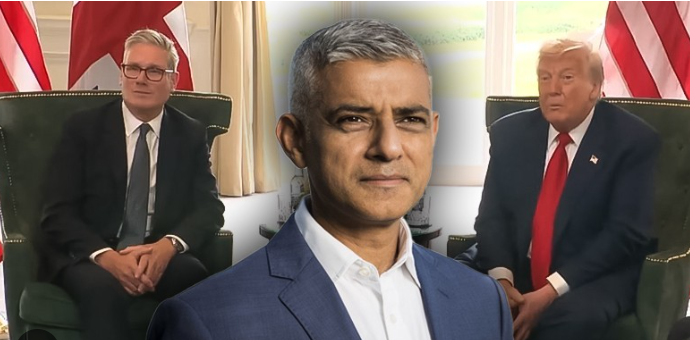
New Delhi: He behaved like the King of Scotland, made Sir Keir Starmer a mere ‘extra’ in his own land, and called the London Mayor “nasty person” in the presence of the UK Prime Minister, the media reported on Tuesday about US President Donald Trump’s ongoing tour to the homeland of his mother’s ancestors.
Writing for CNN, Stephen Collinson said, “Donald Trump looked like the last King of Scotland. To the skirl of bagpipes, the President welcomed Keir Starmer to one of his Scottish golfing palaces in his mother’s ancestral homeland. The PM flew in Monday as a guest and a supplicant in a corner of his own United Kingdom.”
PM Starmer, he said, was a mere extra as Trump held court in a mind-bending news conference that rollicked through topics like his hatred of wind power, the window frames in his ballroom, and Windsor Castle.
Yes, after his ongoing five-day trip to Scotland, Trump is set to visit the UK again from September 17 to 19, when King Charles III and Queen Camila will host him at Windsor Castle.
On Monday, Trump called London Mayor Sadiq Khan a “nasty person” in the presence of PM Starmer. “I’m not a fan of your mayor. I think he’s done a terrible job.” An embarrassed Starmer insisted that Khan was his “friend.”
But doubling down on his view of Khan, Trump went on: “I think he’s done a terrible job. But I would certainly visit London.”
In January 2025, on the eve of Trump’s return to the White House, Khan, 54, son of a British-Pakistani couple, penned an article warning of western “reactionary populists” posing a “century-defining challenge” for progressives.
During his first term in power, Trump accused Khan, the first Muslim mayor of a western capital, of doing a “very bad job on terrorism,” calling him a “stone cold loser” and “very dumb.”
In a podcast recorded before Trump’s re-election on November 5, 2024, Khan accused the incoming US President of targeting him because of the colour of his skin.
“He’s come for me because of, let’s be frank, my ethnicity and my religion,” he said.
Trump capped his protocol-reversing day by flying the UK PM across Scotland on Air Force One to another of his exclusive clubs, in yet another ostentatious show of US power optics.
Events in America’s new temporary capital in southwest Scotland were an object lesson in how Trump flexes his indomitable personality and relentless sense of others’ weaknesses to impose personal power and rack up big wins for himself, the media reported.
Six months into his second presidency, Trump is getting exactly what he wants on many fronts. He’s destroying the global free trading system by lining up framework trade deals that enshrine one of his longtime obsessions — tariffs. He sent US stealth bombers to bombard Iran’s nuclear program. And he’s wrung promises of a vast increase in military spending from NATO members.
Even at home. Trump has bullied US Congress into submission. He’s imposing his ideology on great universities and forced private law firms to do pro bono work for him. He’s weaponizing the justice system against his foes. And he’s effectively shut down the southern border and halted undocumented migration.
This is the kind of “winning” that eluded him in his first term and that he promised his MAGA supporters would reach such a volume they’d grow tired of winning.
Yet Trump is such a polarizing President — one whose “wins” are sometimes more theatre than substance — that his current streak bears close examination.
Internationally, it is fair to ask: Is Trump racking up victories for the American people or for himself? Is his coercive power over allies and smaller states a sign of strength or the behavior of a schoolyard tough guy? And what will be the consequence of his wins in the long term — years after his zest for a headline proclaiming a great “deal” has passed? The alliances that made the US a superpower seem especially vulnerable in this regard, Collinson wrote.
If Trump is really a dominant global force, the proof will come in his handling of three critical issues highlighted on his trip to Scotland: a wrenching famine in Gaza, the war in Ukraine, and trade.