




Virendra Pandit
New Delhi: An angry Cuba on Saturday criticised fresh sanctions announced by US President Donald Trump, calling them “collective punishment” against its people, the media reported.
The statement came as thousands of Cubans gathered in their capital, Havana, for a massive May Day march on Friday near the US embassy.
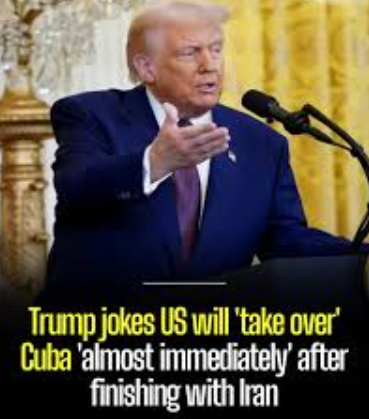
Tensions mounted after Trump said in a speech in Florida on Friday that the United States could be “taking over” Cuba, “almost immediately,” adding concerns in Havana.
In the Cold War years, Cuba was a close ally of the then Soviet Union, directly threatening America from its backyard. After the 1991 dissolution of the USSR, however, the USA’s Republicans and Russia have, at best, remained ‘frenemies,’ refraining to rub each other the wrong way, recognizing areas of each other’s influence, even helping one another indirectly—as in Ukraine.
It was in this backdrop that, in late March 2026, Trump allowed a sanctioned Russian tanker, Anatoly Kolodkin, to deliver approximately 730,000 barrels of oil to Cuba, temporarily easing a de facto blockade. President Trump stated he had “no problem” with the shipment, which provided short-term relief for Cuba’s severe energy crisis and blackouts.
Their protests against each other’s geopolitical moves have also been muted, even rhetorical. When the US virtually annexed Venezuela, Russia heaved a sigh of relief in Ukraine!
Trump has even said he could send Secretary of State Marco Rubio to lead Cuba! Rubio is a Cuban-American. Born in Miami, Florida, in 1971, he is the son of Cuban immigrants who moved to the United States in 1956, before Fidel Castro took power. He is the first Latino to serve as the U.S. Secretary of State.
No wonder, Trump, if and when he annexes Cuba, Rubio could be sent to run it. While the US is waiting for Iran to cool down, Cuba is a low-hanging fruit!
Cuba: A distant neighbour
Cuba is located approximately 90 miles (145 kilometers) south of Key West, Florida, at its closest point. This short stretch of water, the Straits of Florida, separates the two countries. While this is the minimum distance, general air travel distance between major locations can be over 1,500 miles, according to media reports.
Its close proximity to the US was the reason for the Soviet Union to support Cuba having a decades-long Communist regime, led by Fidel Castro. In October 1962, the USSR secretly installed nuclear-armed ballistic missiles in Cuba, triggering a 13-day standoff known as the Cuban Missile Crisis. Led by Soviet leader Nikita Khrushchev, the move aimed to deter a US invasion of Cuba.
In the end, Moscow retreated, and so did Washington.
But the US is now securing the Western Hemisphere with a refurbished Monrow Doctrine (1823) to keep away China. And Russia has no problem with that.
So, Cuba may be a right fit for the US geopolitical strategy in its backyard.
Resistance
But, unlike the Venezuelans, the Cubans may resist against the Trump takeover.
The May Day rally was marked by slogans of unity and resistance, with crowds vowing to “defend the homeland.” The march was led by Cuban President Miguel Diaz-Canel and former revolutionary leader Raul Castro, younger brother of Fidel Castro.
Cuban Foreign Minister Bruno Rodriguez condemned the newly imposed sanctions, saying that they unfairly target the Cuban population. In a post on social media platform X, he said that the sanctions show an intention to once again impose “collective punishment.”
In a separate Spanish-language statement, Rodriguez described the measures as “illegal” and “abusive.” Cuban officials argue that such restrictions worsen living conditions for ordinary citizens rather than affecting political leaders.
The latest sanctions were introduced through an executive order signed by Trump. They target individuals linked to key sectors of the Cuban economy, including energy, defence, mining, financial services, and security.
The order also focuses on Cuban officials accused by Washington of corruption or serious human rights abuses. The US government said that these steps are aimed at holding those in power accountable.
Economic crisis
Cuba is already facing a difficult economic situation. A long-standing US trade embargo has strained the country’s economy.
Conditions have worsened in recent months due to a fuel blockade imposed earlier this year. Shortages of essential goods and frequent power cuts have become common. Tourism, once a major source of income, has also dropped sharply.
Despite economic challenges, large crowds turned out for the May Day rallies. More than six million people had signed petitions in support of the government and national sovereignty in recent weeks.
The protests come at a time when both countries had shown signs of renewed dialogue, with US officials visiting Cuba for talks in April. The latest sanctions, however, suggest relations may worsen again.