Roving Periscope: Huge cost of raging Mideast war starts biting one and all





Virendra Pandit
New Delhi: As the raging war between Iran, on one side, and the US-Israel duo plus their Arab allies, on the other, continued for the sixth day on Thursday, its aftereffects are beginning to bite not only the combatants but also other countries having little to do with regional or global politics.
Its war against Iran is costing Israel USD 3 billion a week. From February 28, its attack on Iran cost the Trump administration USD 700 million per day, according to media reports.
India is also starting at a shortage of LPG, and increased costs and likely inflation. Also, while around 70,000 metric tons of Basmati rice from India is stuck in the Middle East, some 20,000 war zone-bound containers are currently stuck at two Indian ports (Deendayal/Kandla Port in Gujarat, and Jawaharlal Nehru Port in Maharashtra—with exporters unable to load cargo as several sailings have been postponed and shipping lines reassess vessel movement through the region.
The ongoing war with Iran could cost Israel an estimated New Israeli Shekel (NIS) 9.4 billion (USD 3 billion) per week under current restrictions on economic activities, the Israeli Finance Ministry has warned.
“In a letter sent to the Home Front Command chief, Maj. Gen. Shai Klapper, Finance Ministry Director-General Ilan Rom asked to ease restrictions to allow for a gradual, partial reopening of businesses and workplaces as early as Thursday,” the Times of Israel reported.
“There is no dispute about the need to preserve a defence policy adapted to the security situation, but at the same time, shutting down the economy on a broad scale carries heavy economic costs,” Rom warned.
“We need a solution that addresses both the security needs of the Home Front and the needs of the economy, after two and a half years in which the economy has been paying a heavy economic price in light of the increase in security needs and the repercussions of the war,” the top Finance Ministry executive reportedly said.
Soon after Israel and the US launched their joint offensive against Iran on Saturday (February 28, 2026) morning, the Israel Defence Forces’ (IDF) Home Front Command issued nationwide guidelines prohibiting all gatherings, educational activities and workplaces, except for essential businesses.
The guidelines limit travel to work, encourages work from home, and has instructed educational institutions to be shut down.
On Monday, after a fresh assessment amid the continuing conflict with Iran, the Home Front Command extended nationwide restrictions until Saturday night.
Rom asked Gen. Klapper to shift Home Front Command restrictions from allowing only essential activity to allowing limited activity, the orange alert level, instead of the current red alert level.
Under the current restrictions, the weekly loss to the Israeli economy is estimated at NIS 9.4 billion, taking into account the closure of educational institutions, workplace prohibitions, and mobilization of reserve soldiers, the Finance Ministry was quoted as saying.
Under limited activity restrictions (orange level alert), workplace and economic activities are permitted, subject to close proximity to protected spaces, while educational institutions remain closed.
Rom is said to have emphasised that the weekly damage to the economy under limited activity restrictions is estimated to be about NIS 4.5 billion (USD 1.5 billion), less than half the cost of activity under the red level.
“This policy will enable the expansion of economic activity while maintaining Home Front security, in a manner that meets both economic and security needs,” the Finance Ministry said.
Clearly, the war is beginning to pinch the combatants as well as others. Soon, its impact could become visible because of the immense financial, human, and resource burdens of conflict, beyond military budgets, shifting to directly and negatively impacting the civilian economy, public services, and standard of living.
It will be characterized by rising inflation, the diversion of funds from social sectors, and the physical destruction of infrastructure, often leading to a long-term reduction in economic output, particularly in the war-torn Middle East where a dozen countries are affected.
War disrupts supply chains and increases government debt, often leading to high inflation. A war can generally raise inflation by about 15 percentage points over five years in affected countries. Governments often divert funds from crucial social sectors like education, healthcare, and infrastructure to finance military actions, causing a decline in the quality of life for citizens.
The physical destruction of factories, power stations, and transportation networks ruins economic assets and halts production, which can shrink GDP by an average of 30 percent in conflict zones, the reports said.
In 2024, global military spending hit a record USD 2.72 trillion, driven by ongoing conflicts and geopolitical tensions.
Deaths, injuries, and forced migration (refugees) shrink the labour force and, combined with school closures, can diminish productivity for an entire generation.
The economic impact is not limited to participants alone; neighbouring countries often experience a 10 percent decline in output due to broken trade links and displaced populations.
For example, the cost of recovery and reconstruction after three years of war in Ukraine in 2025 was estimated at over USD 500 billion, nearly three times its 2024 GDP.
Likewise, two decades of post-9/11 wars cost America an estimated USD 8 trillion, including long-term veterans’ care.
In 2024, violence had an estimated USD 19.1 trillion impact on the world economy, representing around 13.5 percent of global GDP.
Impact on the US economy
The first 24 hours of the US offensive against Iran (“Operation Epic Fury”) cost an estimated USD 779 million, with total costs quickly exceeding USD 1.4 billion for initial operations. Operations involving carrier strike groups, such as those in the Persian Gulf, are adding roughly USD 13 million per day in operational costs.
The conflict has triggered an immediate rise in gasoline prices, with analysts forecasting further jumps of 20-30 cents per gallon in the USA. This is exacerbating a pre-existing cost-of-living crisis, with only 25 percent of Americans supporting the US strikes in early polling.
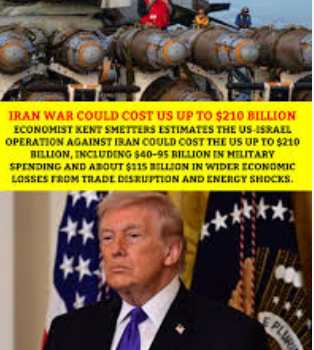
Projections suggest that if the conflict persists, total economic losses to the United States could range from USD 50 billion to over USD 200 billion.
The US government debt reached 122.8 percent of GDP at the end of 2025, with war-related borrowing significantly contributing to this, as post-9/11 conflicts were largely funded through debt rather than increased taxes.
By 2030, interest payments on debt incurred from post-9/11 wars are expected to exceed USD 2 trillion, doubling the amount spent on the operations themselves.
Future medical and disability care for veterans from the Afghanistan and Iraq wars is estimated to add another USD 2 trillion in costs by 2050.
Since 2021, the US has focused on ‘great power competition’ with China and Russia, with nearly USD 3.4 trillion spent on countering China since 2012.
Analysts note that the USD 5 billion-plus spent in just a few days of the 2026 Iran conflict could have covered SNAP (food assistance) benefits for over 2 million Americans.
Despite these costs, US Congress is considering increasing the 2026 defense budget to over USD 1 trillion, representing a 13 percent increase from 2025.