Roving Periscope: After 3 years, India and UK sign landmark six billion pound FTA




Virendra Pandit
New Delhi: India and the United Kingdom on Thursday announced a bilateral free trade agreement (FTA), which is expected to boost exports by a multi-billion-pound amount and potentially double them by 2030.
Negotiations on the trade deal took three years, having been started by former PM Boris Johnson in 2022.
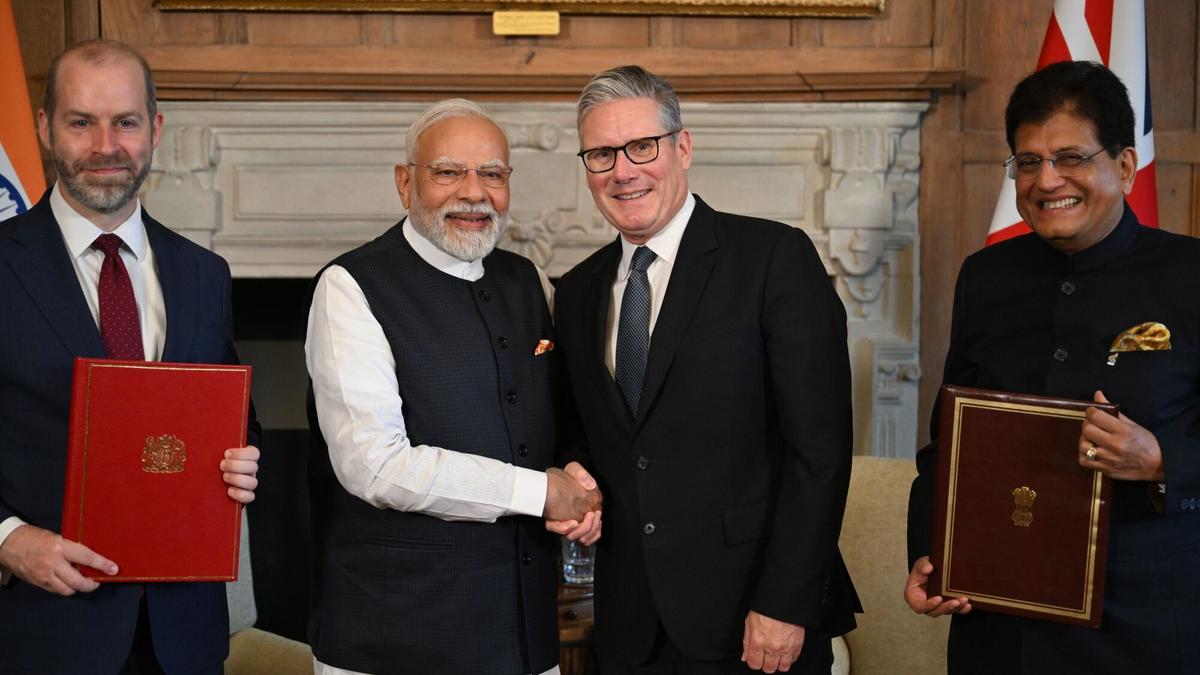
Union Commerce Minister Piyush Goyal and British Trade Minister Jonathan Reynolds inked the nearly USD 7.5 billion pact in the presence of Prime Minister Narendra Modi and UK PM Keir Starmer, the media reported.
The Indian farmer is expected to benefit the most from this pact, known as the Comprehensive Economic and Trade Agreement (CETA). India’s agricultural and processed food products will now enjoy duty-free access to British markets.
The British markets will now open up to Indian farm produce and farmers will enjoy better benefits than exporters from European countries. Indian farm products such as turmeric, pepper and cardamom, and processed products like mango pulp, pickles, and pulses, will get duty-free access, which would boost farmers’ market reach and provide them with bigger profit margins.
Under the pact, imports from the UK will also enjoy duty-free access to the vast Indian market. The government says it has taken steps to safeguard the sensitive agricultural sector from British imports. There will be no tariff concessions on dairy products, apples, oats, and edible oils to ensure domestic farmers are not affected.
The FTA will also benefit India’s fisheries sector, particularly in coastal states such as Andhra Pradesh, Odisha, Kerala, and Tamil Nadu. Exports like shrimp, tuna, fishmeal, and feeds, which currently attract duties ranging from 4.2 percent to 8.5 percent in the UK, will now be able to access the British market duty-free.
Exporting labour-intensive products such as leather, footwear and clothing will now be easier, and the cost of whiskey and cars imported from the UK will reduce. Other imported goods, such as medical devices, will also be cheaper in India now.
After the signing ceremony, PM Modi said the deal will reduce the “cost of doing business” and enhance “confidence of doing business.” This pact will also strengthen global stability and prosperity.
He referred to the UK’s support in the aftermath of the Pahalgam terror attack on April 22 and thanked Prime Minister Starmer for his support in the fight against terrorism. He also condoled the deaths of UK nationals in the Ahmedabad plane crash in June.
Describing the trade pact as “historic,” the UK PM said, “Both the countries will see a boost in wages and living standards,”, adding that it will boost whiskey distillers in Scotland. “It will bring down prices of Indian clothes, shoes, foods for British citizens.”
With this FTA, the UK cars and whisky will be cheaper to export to India and Indian textiles and jewellery cheaper to export to the UK. The deal took three years to reach and also commits to a new India-UK plan to tackle illegal migration.
Sir Keir said the deal would create more than 2,200 British jobs across as Indian firms expand their operations in the UK and British companies secure new business opportunities in India.
“Our landmark trade deal with India is a major win for Britain,” he said, with new jobs expected to benefit engineers, technicians and supply chain workers in the aerospace, technology and advanced manufacturing sectors.
“We’re putting more money in the pockets of hardworking Brits and helping families with the cost of living, and we’re determined to go further and faster to grow the economy and raise living standards across the UK.”
The UK government said the deal, announced in May 2025 after three years of negotiations, will boost the British economy by £4.8 billion a year.
The FTA was okayed by the Modi government earlier this week. After ratification by Parliament, it is expected to take effect next year, the reports said.
The agreement includes lower tariffs on clothing and footwear, cars, foodstuffs including frozen prawns, jewellery and gems
UK exports that will see levies fall include gin and whisky, aerospace, electricals and medical devices, cosmetics, lamb, salmon, chocolates and biscuits.
The UK already imports £ 11 billion in goods from India but the lower tariffs agreed will make Indian exports cheaper, including for components used in advanced manufacturing.
Indian manufacturers are also expected to gain access to the UK market for electric and hybrid vehicles.
Average tariffs for UK exports to India will drop from 15 percent to 3 percent, making it easier for British companies to sell goods in India.
Whisky tariffs for exports to India have been slashed in half, from 150 percent to 75 percent, giving the UK an immediate advantage over international competitors in reaching the Indian market, and the tariff will drop to 40 percent by 2035.
The two PMs also agreed on closer collaboration around defence, education, climate, technology and innovation.
Enhanced intelligence sharing and operational collaboration will assist in tackling corruption, serious fraud, organised crime, and irregular migration.
This includes finalising a new sharing agreement for criminal records, which will assist court proceedings, help maintain accurate watchlists, and enable the enforcement of travel bans.
The deal has not given the UK as much access as it would have liked to India’s financial and legal services industries, and talks continue on a bilateral investment treaty aimed at protecting British investments in India and vice-versa.
The two nations are also discussing UK plans for a tax on high-carbon industries, which India believes could hit its imports unfairly.
New Delhi welcomed an extended exemption on national insurance contributions, calling this “an unprecedented achievement” when the deal was agreed to in May.
The agreement means staff from Indian companies who are temporarily transferred to the UK, and staff from UK firms who are temporarily working in India, will only pay social security contributions in their home country, rather than in both places.
The UK already has similar reciprocal “double contribution convention” agreements with 17 other countries including the EU, the US and South Korea.
Today’s visit is PM Modi’s fourth to the UK since he became India’s PM in 2014.
The latest deal comes a year after the UK-India Technology Security Initiative was signed by the two countries, allowing joint work on telecoms security and emerging technologies.