




Manas Dasgupta
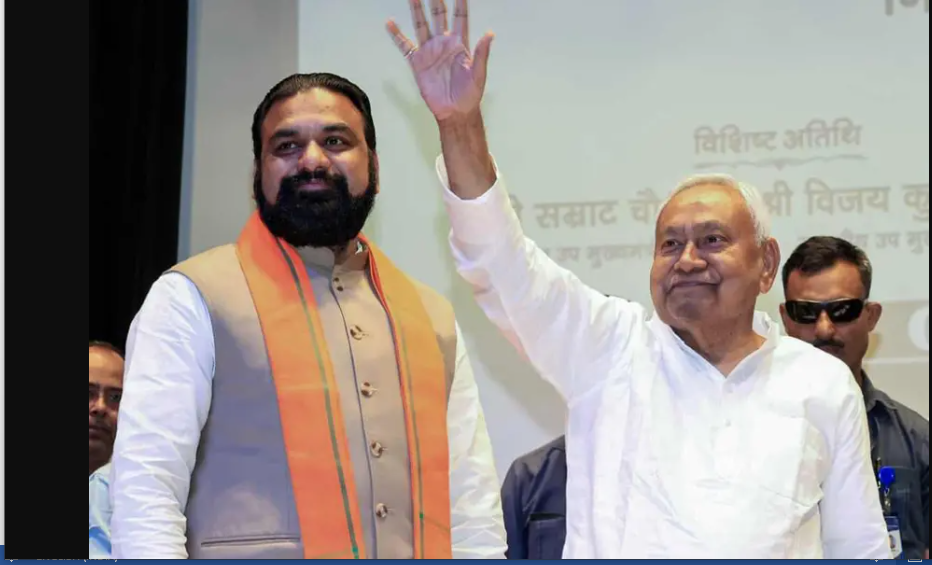
NEW DELHI, Apr 14: Marking the end of an era, Mr Nitish Kumar on Tuesday resigned as the Chief Minister of Bihar paving the way for the BJP’s Samrat Choudhary, a deputy chief minister in his outgoing cabinet, to take over the mantle of the state.
Mr Choudhary, who was elected the leader of the NDA legislature party, is set to take oath as the state’s new Chief Minister at 11 am on Wednesday. Prime Minister Narendra Modi is likely to attend the oath-taking ceremony of the new government at the Lok Bhawan to witness his BJP for the first time holding the chief minister’s post.
In a day of rapid political developments, Mr Nitish Kumar after garlanding the statue of the framer of the constitution Dr BR Ambedkar, held his last cabinet meeting announcing his decision to resign and dissolving the cabinet and later also addressed the JD(U) legislators. This was followed by the BJP legislature party meeting where Mr Choudhary was elected the leader and the choice was later approved by the NDA legislature party to ensure shifting of the mantle of the state from the JD(U to the BJP, both alliance partners of the NDA.
Chaudhary’s elevation carries historic significance, as he will become the first Chief Minister from the BJP in Bihar. The party, which has been a key player in the state’s coalition politics for years, is now set to lead the government independently.
Samrat Choudhary’s name as the BJP legislative party leader in Bihar was proposed by Deputy Chief Minister Vijay Kumar Sinha and seconded by MLAs Renu Devi, Mangal Pandey and Dilip Jaiswal. The formal announcement was made by the union agriculture minister Shivraj Singh Chouhan who attended the NDA meeting as a central observer.
Earlier, Nitish Kumar submitted his resignation from the post of the CM to Governor Syed Ata Hasnain. Kumar, the longest-serving CM of Bihar, made this announcement on X after he met the governor at Lok Bhawan in Patna.
Accompanied by Deputy Chief Minister Samrat Choudhary, JD(U)’s national working president Sanjay Jha and state minister Vijay Choudhary, Kumar reached Lok Bhawan and submitted his resignation. “I have done a lot of work for the people of Bihar. Recently, I decided to leave the post of chief minister…and therefore, after today’s cabinet meeting, I met the governor and submitted my resignation to him,” Kumar added.
Born on November 16, 1968, in Bihar’s Munger district, Samrat Chaudhary comes from a prominent political family. His father, Shakuni Chaudhary, served as a six-time MLA from the Tarapur constituency, while his mother, Parvati Devi, held the same seat in 1998 representing the Samta Party. In the 2025 elections, Samrat reclaimed the family stronghold, continuing a remarkable streak in which the father, mother and son have together won the seat in nine out of the last twelve elections. He began his political journey in 1990.
Samrat Choudhary’s early political innings were shaped under Lalu Prasad Yadav’s Rashtriya Janata Dal. He later had associations with Nitish Kumar’s JDU and was involved in a 2014 attempt to engineer a split by bringing over a dozen MLAs with him before eventually aligning with the BJP. His formative years in governance include serving as Agriculture Minister in the Rabri Devi cabinet in 1999.
Choudhary has showcased adaptability throughout his career, having served in key positions in the governments led by Jitan Ram Manjhi and Nitish Kumar. His shift to the BJP in 2018 marked a significant turn which allowed him to take on more assertive roles within the party. After joining the BJP, Samrat Choudhary quickly climbed the organisational ladder. He moved from the role of state unit Vice President to Leader of the Opposition in the Legislative Council, and eventually became state president in 2023.
Mr Kumar, who has just began his new innings as a member of the Rajya Sabha, had served as Chief Minister for over two decades, taking oath for a record tenth term on November 20, 2025, and concluding it on April 14, 2026, the day marking the end of the inauspicious Kharmas month.
In a long post after tendering his resignation, Nitish Kumar listed the works done under his regime and also expressed gratitude to Prime Minister Narendra Modi. The post read, “You know that on 24 November 2005, the NDA government was formed in the state for the first time. Since then, the rule of law has prevailed in the state, and we have been continuously engaged in development work. The government has worked for the development of all sections of society from the very beginning—whether Hindus, Muslims, upper castes, backward classes, extremely backward classes, Dalits, or Mahadalits—work has been done for everyone. Work has been done in every sector, whether education, health, roads, electricity, or agriculture. A lot of work has also been done for women and youth.
“In recent times, this work has been taken even further. For the next five years, that is, from 2025 to 2030, the formation of 7 Nishchay-3 has been done. This will lead to even more work, as a result of which Bihar will advance significantly. The Centre is also providing full cooperation in Bihar’s development. For this, we bow to the honorable Prime Minister Shri Narendra Modi Ji. Bihar will develop even faster and join the top states of the country, thereby making an important contribution to the progress of the nation.
We have done a lot of work for the people of Bihar. For so many days, we have continuously served the people. We had decided that we would now leave the post of Chief Minister, and therefore, after today’s cabinet meeting, we met the honorable Governor and submitted our resignation to him. Now the new government will look after the work here. The new government will have my full cooperation and guidance. Even ahead, a lot of very good work will be done, and Bihar will advance a great deal.
I extend my heartfelt thanks to everyone and offer my best wishes.”
The 57-year-old Choudhary, who was Nitish Kumar’s deputy, belongs to the Koeri, or Kushwaha caste, a prominent other backward class (OBC) community that accounts for roughly 6-7 per cent of Bihar’s population. Among the backward castes, the Kushwaha community is the largest after the Yadavs. According to sources, the Nitish Kumar’s JD(U) had asked the BJP to appoint a Chief Minister from this very caste group.
After joining the BJP, Choudhary emerged as one of the sharpest critics of Nitish Kumar. In 2022, he publicly vowed not to remove his trademark saffron turban until he unseated Kumar. However, things changed after JDU reunited with the BJP in 2024. During the 2025 state polls, the JDU returned to power and Samrat Choudhary was named the Deputy Chief Minister.
The BJP has been the junior partner in state since 2005, barring a few years in between, but had to wait until today to have its own leader in the top post. Nitish Kumar’s party has 85 MLAs in the 243-members Assembly, just four less than the BJP’s tally.
A larger-than-life figure, Nitish Kumar has dominated Bihar politics for 50+ years. He started as a novice with the Janata Party in 1974. By the time he quit as Chief Minister – in April 2026 – the 75-year-old had written himself into the history books – a ‘sushasan babu‘ (‘good governance’ man) with unrivalled powers of persuasion. The next Bihar election is in 2030. That gives Choudhary and the BJP time to establish itself as the party to beat – as Nitish Kumar’s JDU was for decades – in the state.