




Manas Dasgupta
NEW DELHI, Apr 14: The hopes of the United States and Iran resuming negotiations for the end of the West Asia war has brightened after the failed first round of talks in Islamabad and the delegates of the two countries are expected to converge back in the Pakistani capital this week or early next week for another attempt to break the ice before the two-week ceasefire ends on April 21.
Pakistani and Iranian officials on Tuesday told the media that the talks were expected to resume soon. While Iranian officials expressed openness to talks, Pakistani officials said they reached out to Iran, which showed a ‘positive response.’
According to US media reports, President Donald Trump has shown a willingness to resume in-person negotiations soon if he believes Tehran is ready to submit to his demands. Washington and Tehran are weighing new in-person negotiations in a bid to reach a deal aimed at ending their six-week war before the ceasefire expires.
Sources told the media that discussions were still underway about a new round of talks, while a diplomat from one of the mediating countries went further to say Tehran and Washington have agreed to it. According to the report, an official from the Iranian embassy in Islamabad said that the coming rounds of talks can happen “sometime later this week or earlier next week. But nothing is finalised as of now.” Earlier, a senior Iranian source told media: “No firm date has been set, with the delegations keeping Friday through Sunday open.”
On Monday, Iranian ambassador Mohammad Fathali said Iran was ready for another round of negotiations with the US, given that there are no “unlawful demands.” “If you want progress in any diplomatic process, [both] sides [should be] ready for negotiations. And unlawfully avoid unlawful demands,” Fathali said. The Iranian envoy also stressed that the future of the ceasefire depends on the way the US approaches the negotiations. “If they accept our conditions, we should expect that we will have another round of negotiations,” he said.
It’s unclear if the same level of delegation would be expected to attend, the diplomat and US officials said. According to the report, Islamabad and Geneva are two of the possible locations being discussed for the new round of talks. A US official said that venue and timing had not been decided, but the talks could happen Thursday.
This came after Trump told reporters earlier on Monday that “we’ve been called by the other side” and “they want to work a deal.” US Vice President JD Vance also said Iran has moved in the direction of the US during the peace talks in Islamabad to end the war, and it was for Tehran to make the next move on taking the discussions forward. “I wouldn’t just say that things went wrong. I also think things went right. We made a lot of progress,” Vance said.
“They moved in our direction, which is why I think we would say that we had some good signs, but they didn’t move far enough,” said the US vice president, who led the delegation comprising Special Envoy Steve Witkoff and Jared Kushner, for the talks with the Iranian delegation.
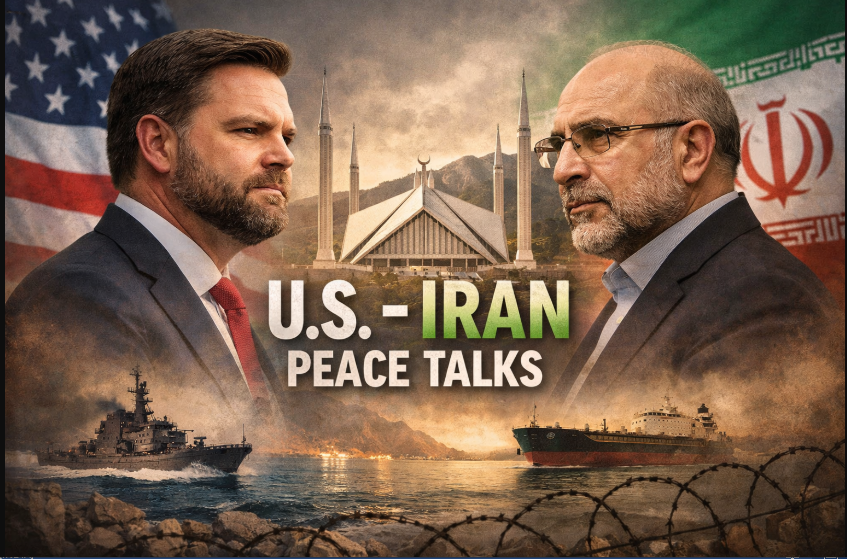
The United States and Iran ended 21 hours of face-to-face talks in Islamabad on Sunday without reaching a deal, leaving the fate of the fragile, two-week ceasefire still unclear. The US delegation, led by Vance, and the Iranian delegation, led by parliament Speaker Mohammad Bagher Ghalibaf, had discussed how to advance a ceasefire already threatened by deep disagreements and Israel’s continued attacks against the Iran-backed Hezbollah in Lebanon.
Among the slew of issues at stake was the Strait of Hormuz, a major transit point for global energy supplies that Iran has effectively blocked but the US has vowed to reopen, as well as Iran’s nuclear programme and international sanctions on Tehran. “There was a strong hope in the middle of the talks that there would be a breakthrough and the two sides would reach an agreement. However, things changed within no time,” a Pakistani government source said.
Face-to-face talks between Iran and the US were held over the weekend after 47 years, but failed to yield positive results. Shortly after, US President Donald Trump imposed a move to block ships entering or leaving Iranian ports.
Sources said a proposal had been sent to the US President for the delegations to return to Islamabad to resume discussions. While no date had yet been decided, both countries could return as early as the end of this week, the source said.
A Pakistani official revealed that they reached out to Iran, who responded with “a positive response that they will be open to a second round.”
The Pakistani official, along with another, said Islamabad was communicating with both sides regarding the timing of the next round of talks.
Speaking about the official confirmation of the next round of talks, Donald Trump said on Monday that “the right people” reached out to seek a deal. “We’ve been called this morning, base right people, the appropriate people, and they want to work a deal,” Trump said at the White House.
America’s Gulf ally Saudi Arabia is also reportedly pressing the Donald Trump administration to drop the Strait of Hormuz blockade and return to the negotiating table as the war against Iran and the closure of the Strait of Hormuz have shattered a status quo that prevailed among West Asian oil and gas producers for decades. Saudi Arabia is worried that President Donald Trump’s move to block the Iranian port may worsen the situation.
Arab officials told the American media about Saudi Arabia’s fears that Trump’s move to close Iranian ports could lead Tehran to escalate and disrupt other important shipping routes.
The US decision to blockade all Iranian shipments out of or into the Strait of Hormuz is aimed at raising the pressure on Iran’s already crippled economy. But Saudi Arabia has reportedly warned the US that Iran might retaliate by closing the Bab al-Mandeb –a Red Sea chokepoint crucial for the kingdom’s remaining oil exports.
Over the six weeks of war, Tehran has now demonstrated both its ability and willingness to seal off the critical waterway and strike vital infrastructure across the region, fundamentally altering the risk calculus for its neighbours and jeopardising Gulf countries’ long-term oil and gas strategies.
Saudi Arabia, after weeks of disruption, managed to get its oil exports back up to their pre-war level of around seven million barrels a day by piping its crude across the desert to the Red Sea while Iran’s Hormuz blockade persisted. Riyadh is worried those supplies would be at risk if the Red Sea’s exit route were also closed.
The long stretch of coastline near the Bab al-Mandeb is controlled by Iran’s Houthi allies in Yemen. Houthis, who are part of Iran’s axis of resistance, severely disrupted the waterway for much of the war in the Gaza Strip, and now Iran is putting pressure on the group to close the chokepoint again, Arab officials said.
“If Iran does want to shut down Bab al-Mandeb, the Houthis are the obvious partner to do it, and their response to the Gaza conflict demonstrates that they have the capacity to do it,” experts said. Iran’s semi-official Tasnim news agency, which is close to the Islamic Revolutionary Guard Corps, has reported that the US blockade of Iranian ports could lead the country to close the Red Sea gateway.
Ali Akbar Velayati, a foreign-policy adviser to Iran’s supreme leader, said in a social media post on April 5 that Tehran looks at Bab al-Mandeb “just as it looks at Hormuz. And if the White House thinks of repeating its stupid mistakes, it will quickly realise that the flow of global energy and trade can be disrupted with a single signal.” On Monday, Iran also issued a threat against the maritime security of its neighbours if the US blocks its shipping routes.
“If the security of Iran’s ports in the Persian Gulf and the Sea of Oman is threatened, no port in the Persian Gulf and the Sea of Oman will be safe,” Iran’s armed forces said in a statement published by state-run IRIB News. The war has sharply exposed how vulnerable the West Asian energy infrastructure is. Now, the pushback by Saudi Arabia also exposes the limitations of US efforts to pry open the critical waterway, through which 20 per cent of global oil and liquefied petroleum gas (LNG) passes in peacetime. Iran’s chokehold on the Strait has cut off around 13 million barrels a day in oil exports, sending futures prices above $100 a barrel.
The US blockade of Iranian ports went into effect on Monday, with the White House assuring America’s Gulf allies are on board with the move. “President Trump has been clear that he wants the Strait of Hormuz to be fully open to facilitate the free flow of energy… The administration is in frequent contact with our Gulf allies, whom the President is helping by ensuring that Iran cannot extort the United States or any other country,” White House spokeswoman Anna Kelly said.